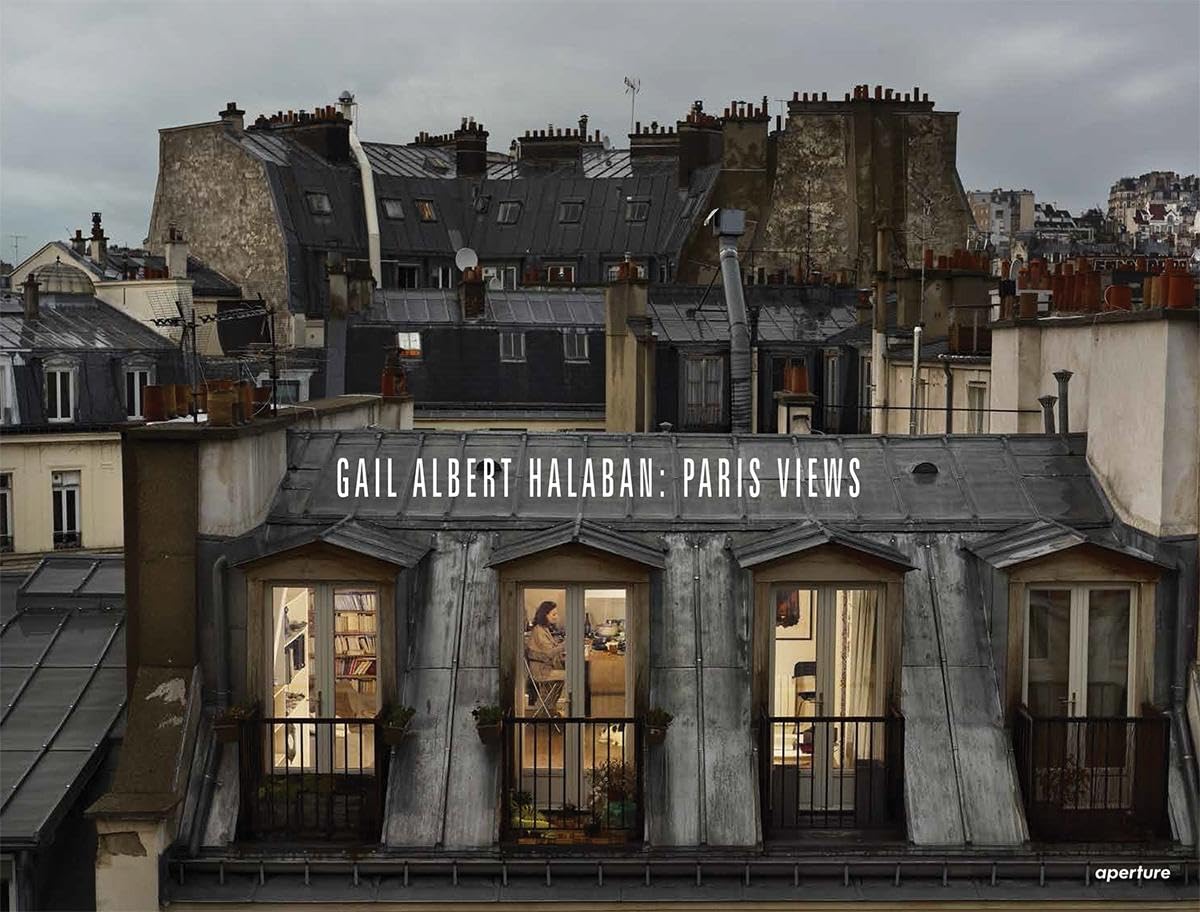
Gail Albert Halaban: Paris Views
-
Photographer
-
Publisher
-
ISBN
-
Publication Year2014
Description
Gail Albert Halaban’s Paris Views looks across the courtyards and façades of Paris, entering domestic life through one of the city’s most charged architectural devices: the window. Photographed between 2012 and 2013, the series transfers the premise of Halaban’s earlier Out My Window project from New York to Paris. Yet this is not a conventional portrait of the French capital. Monumental streets and familiar landmarks give way to illuminated rooms, neighboring apartments, and the partial narratives visible from one building to another.
The scenes are carefully directed rather than covertly seized. Residents appear within their own interiors, framed by windows and separated from the camera by urban space. This method gives the photographs a cinematic clarity while preserving uncertainty: an observed gesture may seem intimate, theatrical, or both. Halaban uses the façade as a compositional grid and the window as a boundary between public visibility and private experience. The resulting pictures examine loneliness and proximity, domestic routine and fantasy, without resolving those tensions into a single account.
Published by Aperture in 2014, the 120-page book gathers these images into a sustained study of looking. Across the sequence, repetition becomes meaningful: windows recur as stages, pictures within pictures, and points of contact between strangers. Paris emerges less as scenery than as a structure of relations—between residents, buildings, photographer, and viewer. The reader is repeatedly placed in the ambiguous position of being welcomed into a scene while remaining outside it.
For a photobook collection, Paris Views merits attention as the book-form articulation of a clearly defined photographic method. Its significance lies not in an inventory of Parisian motifs, but in the way architecture, portraiture, and constructed narrative are made inseparable. It also marks a geographic extension of Halaban’s window-based work, showing how one premise changes when applied to another urban fabric. The book rewards close sequencing: individual rooms invite speculation, while their accumulation produces a broader meditation on how city dwellers see—and imagine—one another.