← Back to Home

Paris Changing: Revisiting Eugène Atget’s Paris

Collector Grade · C- Rarity · Common Deal · Great Confidence · Low
Hardcover English 192 pages 28.96 × 22.61 × 2.29 cm 1025 g

Experimental Legacy Market Signal

Rarity 5.6/100 · Collector 0/100 · Deal 78.26/100 · Listings: 9 · Avg price: $39.11 · Min price: $13.21

These scores use the legacy monthly asking-price aggregate. They do not use the new exact-edition, condition, completeness, and destination-shipping rules.

Description

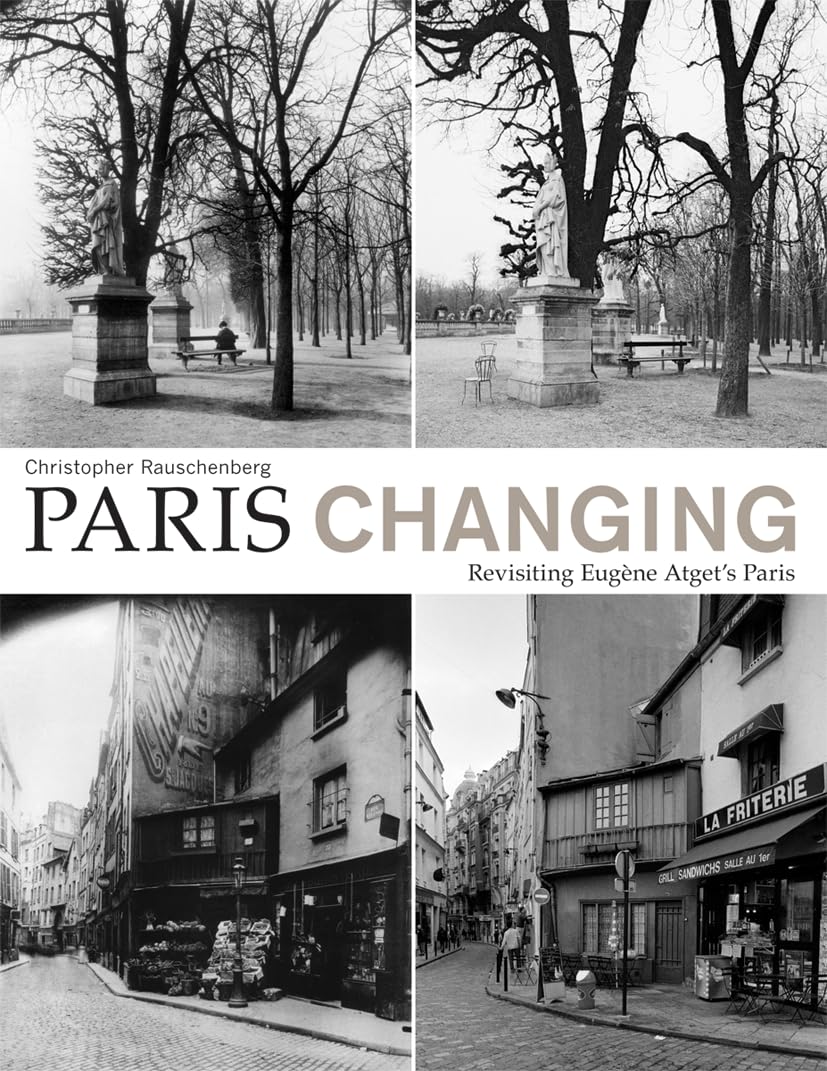
Christopher Rauschenberg’s *Paris Changing: Revisiting Eugène Atget’s Paris* begins with a precise act of return. During a year in the late 1990s, Rauschenberg sought out and rephotographed many locations recorded by Eugène Atget, whose work from 1888 to 1927 encompassed Parisian streets, parks, buildings, inhabitants, and the architecture disappearing as the city became a modern capital. The project asks what remains when a photographer follows not only another artist’s coordinates, but also his attentiveness to place.

The book is organized around seventy-four historical and contemporary pairings. Repetition becomes an analytical method: altered façades, vegetation, street use, and patterns of preservation can be considered alongside less tangible continuities of atmosphere and urban form. Rauschenberg’s photographs maintain an aesthetic and emotional correspondence with Atget’s precedents without treating the earlier images as instructions to be copied mechanically. The result is at once an homage and an independent study of Paris under the pressure of time.

Maps identify each site, extending the paired photographs into a record that can be read spatially as well as chronologically. Essays by Clark Worswick and Alison Nordstrom address Atget’s life and place Rauschenberg’s work within the broader practice of rephotography; an epilogue by Rosamond Bernier and a concluding portfolio of Rauschenberg’s other contemporary Paris photographs widen the book beyond strict then-and-now comparison. Duotone reproduction gives the two bodies of work a measured tonal relationship while preserving their historical distinction.

Published by Princeton Architectural Press in 2007, this 192-page hardcover deserves attention for the rigor of its comparative structure. For collectors concerned with photographic responses to archives, cities, and historical memory, its significance lies in the sustained collaboration it constructs across generations: Atget’s Paris is neither merely illustrated nor nostalgically recovered, but used as the foundation for a second, carefully mapped act of looking.

Preview Pages