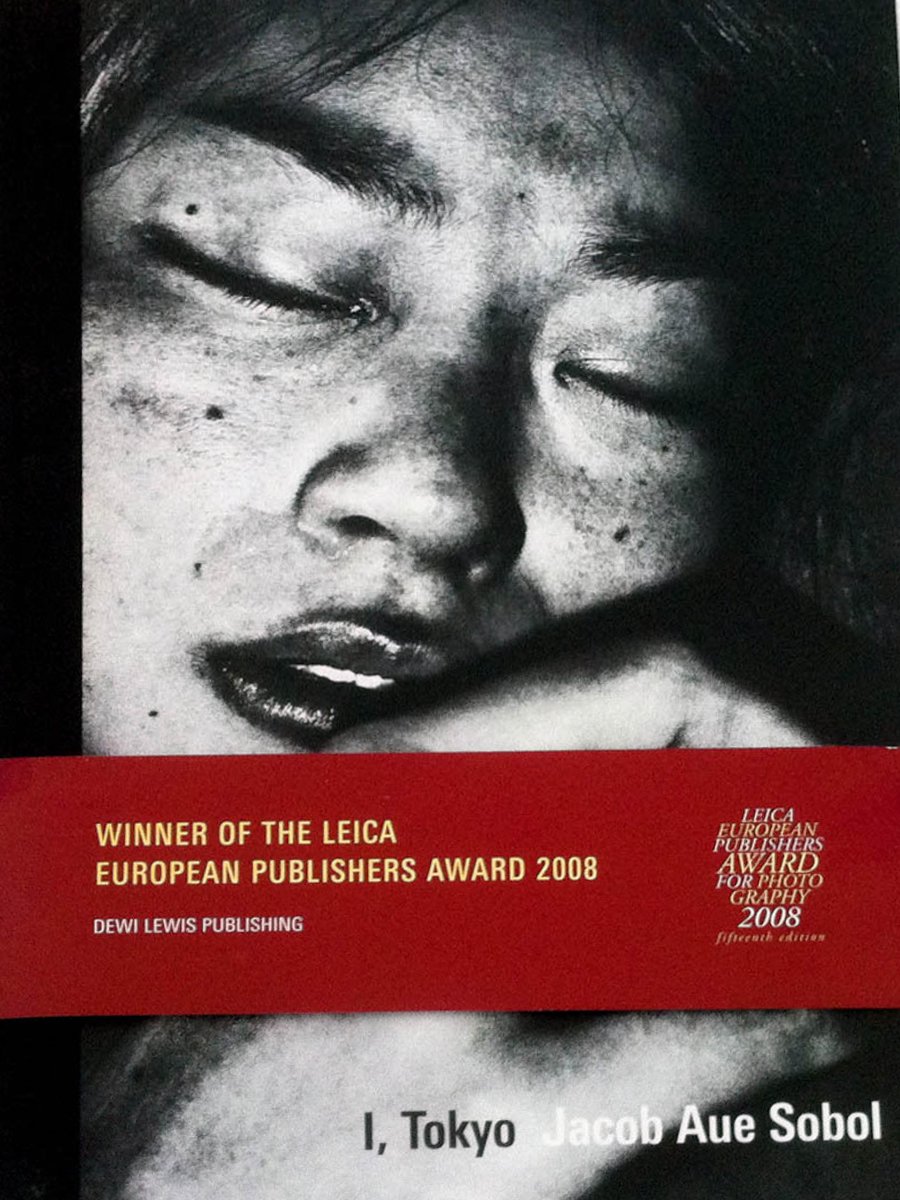
Jacob Aue Sobol arrived in Tokyo in spring 2006 and spent the following eighteen months photographing what he encountered. His point of departure was a feeling of invisibility: crowded morning trains carried salarymen and uniformed schoolgirls, yet conversation and eye contact seemed largely absent. In I, Tokyo, that estrangement becomes both subject and method, prompting a search for individual presence within the city’s compressed public life.
Rather than organizing Tokyo around monuments or familiar urban spectacle, Sobol worked in streets, parks and other shared spaces. He photographed homeless people sleeping outdoors, spent time with rent boys in Kabukicho, and paid particular attention to a younger generation described as detached from traditional Japanese culture and values. The city emerges through encounters with people whose lives complicate any singular account of its social order.
The book’s defining tension lies between distance and access. Sobol began as an outsider moving anonymously through the metropolis, but gradually met people who invited him into their homes and allowed him to photograph intimate moments. This movement from public observation to private proximity gives the project its force. Tokyo is neither celebrated nor condemned; it remains, in Sobol’s own terms, simultaneously attractive and repellent, a setting in which isolation and connection continually press against one another.
Published by Dewi Lewis Publishing in 2008, the 108-page hardcover is a concentrated photographic account of Tokyo in the mid-2000s. Its significance for a photobook collection rests not on comprehensiveness, but on the clarity of its position: a personal record shaped by sustained contact, declared from the outset by the first-person title. I, Tokyo merits attention as a study of how documentary photography can negotiate outsiderhood, urban anonymity and earned intimacy without resolving their contradictions.