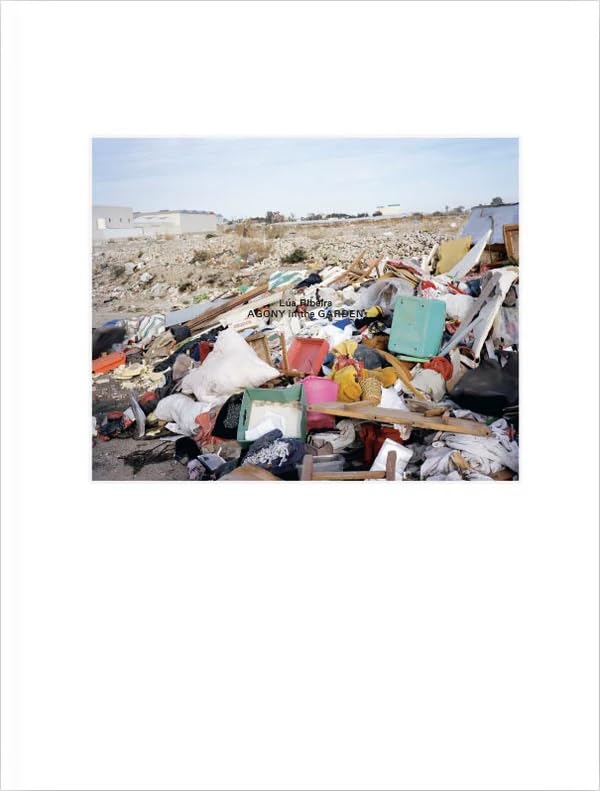
Created on the peripheries of Madrid, Málaga, Granada and Almería, Lúa Ribeira’s *Agony in the Garden* brings a geographically dispersed series into the concentrated form of a photobook. Published in 2025, the work takes youth culture as its subject while locating it away from metropolitan centres. These peripheral settings are not incidental backdrops: together they establish a social and spatial frame through which youth, place and visibility can be considered.
Movement, drama and performance are central to Ribeira’s approach. Rather than presenting youth culture as a stable category to be surveyed, the series emphasizes action and the construction of presence before the camera. Its title introduces a further register of tension, invoking an image of ordeal and suspended decision without fixing the photographs to a single religious reading. Performance here can therefore be understood both as spectacle and as a means by which identity is enacted, tested and made public.
The book is a concise 64-page sequence, yet its oversized 28 × 37 cm hardcover format gives the photographs an unusually expansive field. That contrast—between a limited page count and a broad physical scale—encourages close attention to individual images while preserving the cumulative force of the series. The photobook format also draws together locations separated across Spain, allowing their shared concerns to emerge through adjacency and sequence rather than through geography alone.
For a serious collection, the book’s significance rests on this focused conjunction of contemporary Spanish peripheries, youth culture and a performative photographic language. As a first edition issued in 2025, it provides a defined book-form presentation of the project: compact in extent, substantial in scale and clear in its thematic concentration. It deserves attention as an example of how documentary subject matter can be shaped through movement, theatricality and the deliberate ordering of photographs.