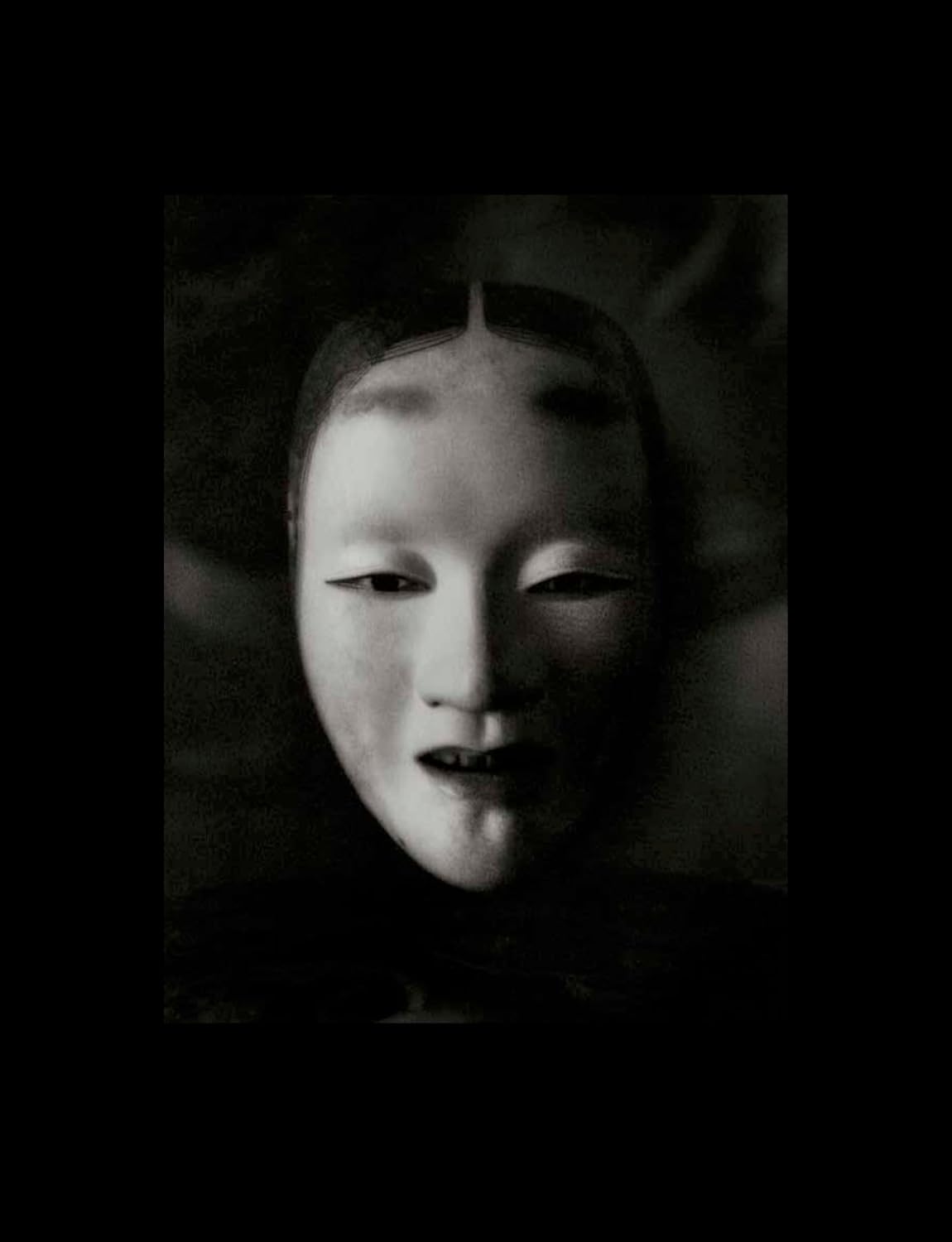
Kenro Izu’s Mono No Aware: The Beauty of Impermanence brings together three closely related bodies of photographs: fourteenth-century Noh masks held by the Nohgaku Museum in Kanazawa; stones and monumental sacred trees surrounding the remains of ancient shrines constructed as Noh stages; and wildflowers and grasses that bloom briefly near the photographer’s home. Moving between cultural artifact, consecrated landscape, and seasonal growth, Izu considers how time becomes visible in objects and places.
The title invokes the Japanese recognition that beauty is inseparable from change and loss. Izu develops this idea through three aesthetic terms: yūgen, associated with mystery and profundity; sabi, with the beauty of age; and wabi, with austerity. These are not presented as abstract definitions but as complementary ways of attending to weathered surfaces, restrained forms, and short-lived natural events. The approximately one hundred images establish a measured correspondence between the masks’ enduring expressions, the accumulated age of stone and trees, and the fragile duration of plants.
The book also extends a sustained concern within Izu’s practice. Born in Osaka and based in New York from the age of twenty-one, he established his studio there in 1974. Across five decades, his photography has addressed sacred sites around the world and what he describes as an inner sacredness within his subjects. Here, that concern is brought into an intimate field: theatrical objects, remnants of ritual architecture, and vegetation close to home share the same contemplative regard.
Published by Nazraeli Press in 2025, the 168-page work is arranged as two linen-bound hardcovers in a custom slipcase. The first edition is limited to 1,000 copies. For a collection concerned with Japanese photographic practice, representations of Noh, or the photobook as a structure for sustained contemplation, its significance lies in the precise convergence of subject and form: three distinct categories of image are held together by a disciplined inquiry into duration, aging, and disappearance.