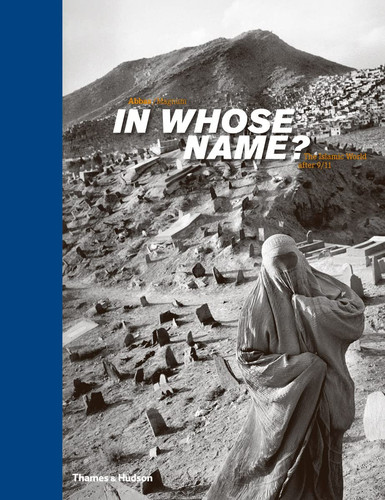
In Whose Name?: The Islamic World after 9/11 begins with a precise historical shock. On September 11, 2001, the Iranian-born photographer Abbas watched the World Trade Center towers fall on television in Siberia. The event prompted a seven-year photographic undertaking across the Islamic world. Published in 2009, this book assembles the project’s final results, asking how a vast and internally varied region might be pictured amid the disturbance, uncertainty, and threat that followed the attacks.
Abbas worked in sixteen countries, among them Iran, Iraq, Lebanon, Afghanistan, Saudi Arabia, Israel, Palestine, Turkey, Indonesia, Thailand, Kenya, and Zanzibar. That geographic breadth counters any notion of a single, uniform Islamic world. Excerpts from his diary accompany the photographs, introducing the observations of a traveler who sought out people and places beyond the immediate focus of breaking news. The result is grounded in political history without being confined to its most visible flashpoints.
His approach depends on close attention to gesture, action, and social relation. Abbas described his characteristic image as a “suspended moment”: an instant extracted from conflict or ordinary life that carries implications beyond the event depicted. Here, scenes marked by anxiety coexist with a wedding or an improvised ball game. Such shifts are not incidental relief; they establish the book’s humane scale, showing daily existence continuing within a period commonly represented through crisis alone.
Issued by Thames & Hudson as a 272-page hardcover containing 173 photographs, the volume is notable for the sustained structure of its inquiry. For a serious photobook collection, its significance rests in the conjunction of long-form fieldwork, wide comparative scope, and an image-text form that preserves both public events and private observation. It is a considered record of how one photographer addressed religion, politics, and ordinary life at a consequential historical moment.