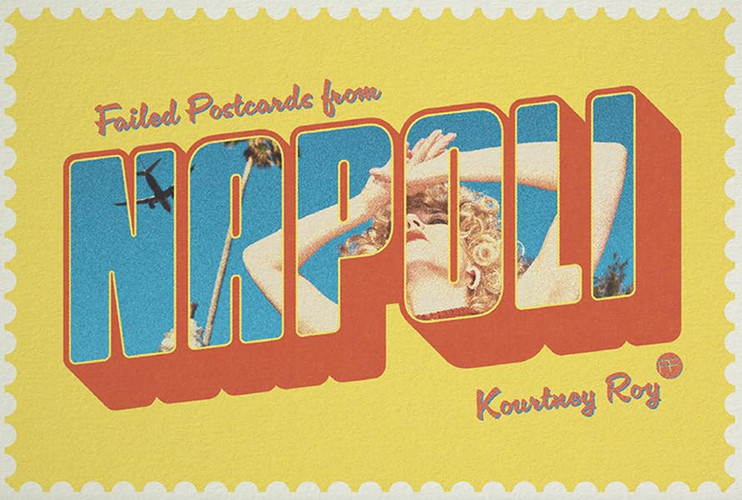
Kourtney Roy’s Failed Postcards from Napoli begins at the edges of Naples rather than with its familiar emblems. The project is concerned with urban interstices and margins: places that sit outside the city’s expected public image. Its title establishes the central tension. A postcard is meant to reduce a place to a legible, desirable view; Roy’s “failed” versions resist that economy of recognition.
Roy approaches these peripheral spaces through cinematic framing and mise-en-scène. The result is not a neutral survey of the city, but an authored encounter in which observation and construction remain in productive tension. Naples appears less as a fixed identity than as a setting whose surfaces, intervals and overlooked zones can support uncertain narratives. The work asks what happens when a city is pictured without being made immediately picturesque.
Published by André Frère Éditions in 2026, the book gathers the project across 104 pages of colour imagery. Its compact paperback format—20 × 13.5 centimetres—has an affinity with the portable scale suggested by the postcard, while providing room for a sustained photographic proposition. That relationship between subject and book form is especially pertinent here: images associated with circulation, tourism and quick recognition are redirected into a slower, more ambiguous encounter.
For collectors, the book’s importance lies in the clarity of this proposition and in Roy’s combination of urban observation with staged, cinematic image-making. Failed Postcards from Napoli is a focused study of how photographic conventions shape the idea of a place—and how those conventions can be unsettled. It warrants attention as a considered book-length treatment of Naples’s margins, rather than another inventory of the city’s established icons.