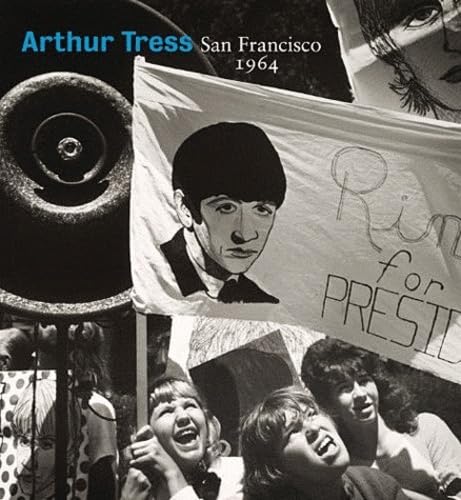
Arthur Tress arrived in San Francisco in 1964 as a young photographer and turned his camera toward the city’s streets. The sixty-four photographs gathered in San Francisco 1964 resist the conventions of a postcard survey. Formally posed street portraits sit beside candid observations of shop windows, signs, and local peculiarities, locating the city’s character in encounters between people and the built environment. Throughout, the ordinary is edged with the absurd—a concern that would remain central to Tress’s work.
The historical moment is unusually charged. During that summer, San Francisco hosted the 28th Republican National Convention and the opening of the Beatles’ first North American tour. Tress did not simply illustrate these headline events. His attention to public behavior, commercial display, and incidental detail records their surrounding atmosphere: a Bay Area poised at the beginning of a turbulent cultural period.
Published by Prestel in 2012, the 111-page hardcover brought this early body of work together decades after the negatives were made. An introductory essay situates the photographs historically, while an interview with Tress addresses both their making and their rediscovery. The volume includes seventy-five duotone illustrations, giving the street pictures and portraits a coherent monochrome setting without detaching them from their documentary origins.
For collectors, the book’s significance lies less in bibliographic claims than in the position of the photographs within Tress’s career. He is widely associated with dreamlike, staged imagery; here, those later preoccupations can be traced within direct observation, in the unstable boundary between the commonplace and the strange. San Francisco 1964 is therefore both a specific record of an American city at a consequential moment and a focused account of an artist’s early visual intelligence. Its combination of recovered work, historical framing, and the photographer’s own testimony makes it a substantial reference for collections concerned with postwar American street photography and the formation of an individual practice.