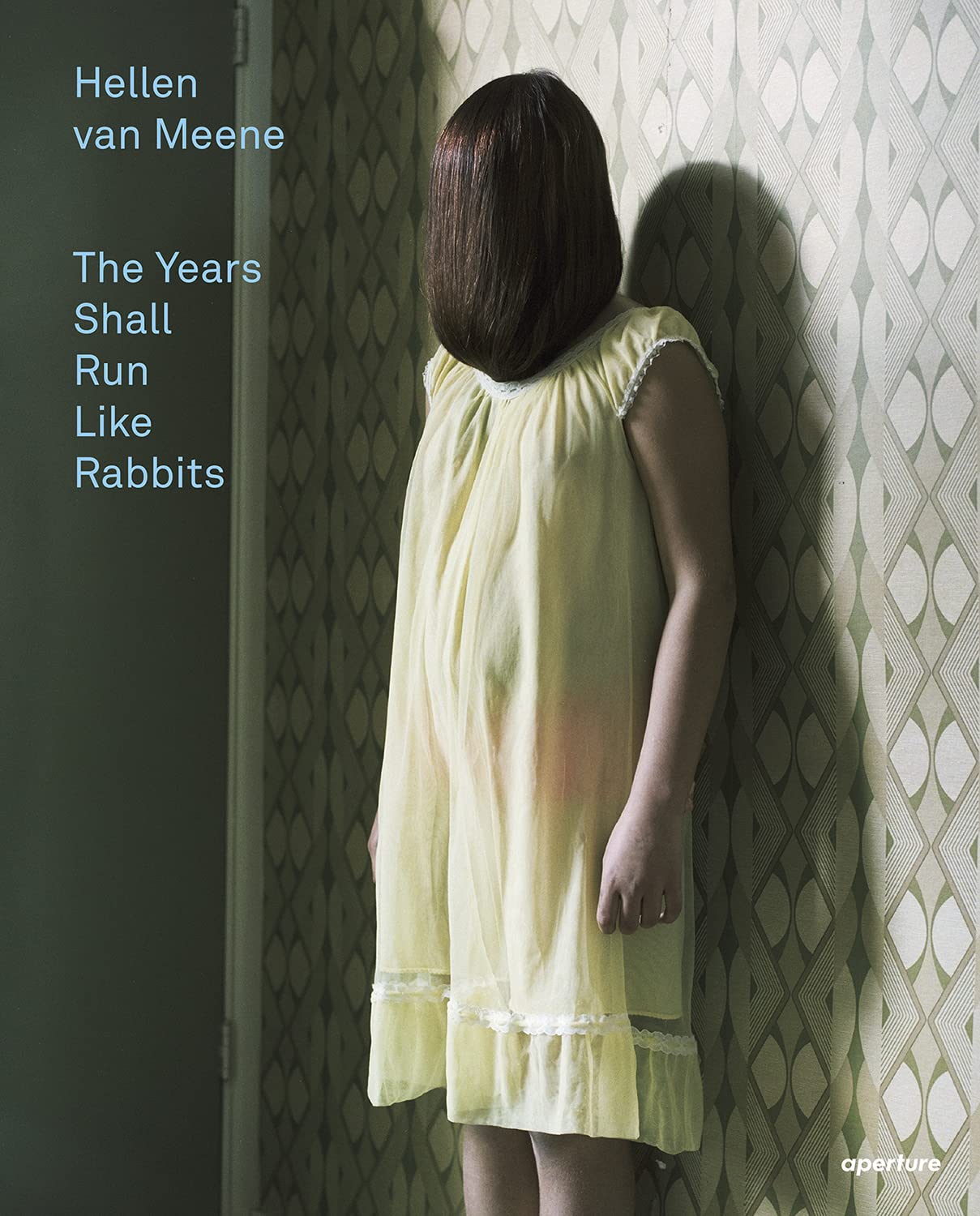
Published by Aperture in 2015, Hellen van Meene’s The Years Shall Run Like Rabbits gathers more than 250 photographs made across two decades. The substantial survey centers on the artist’s portraits of girls and boys approaching adulthood—a transitional state rendered not as a sociological category, but through individual encounters marked by reserve, self-consciousness, and fragile composure.
Van Meene carefully positions her subjects within domestic rooms, gardens, and other immediate surroundings. Her control of light and pose gives the pictures a pronounced formal elegance, with an acknowledged lineage to seventeenth-century Dutch painting. Yet their order is never entirely settled. Awkward gestures, imperfect appearances, and inward expressions introduce psychological tension, complicating the distinction between a constructed portrait and an unguarded moment. The images depend on the intimacy of the photographer’s collaboration with each sitter: vulnerability is neither incidental nor treated as spectacle, but held within the structure of the photograph.
Seen at this scale, recurring concerns become legible across van Meene’s practice. Adolescence appears as both a particular phase of life and a broader condition of uncertainty, while the sequence allows subtle variations in posture, setting, illumination, and emotional distance to accumulate. The title’s sense of time rushing forward acquires force through this sustained attention to subjects poised between childhood and adulthood. An essay by Martin Barnes provides an accompanying critical framework.
For collectors concerned with contemporary portraiture, the book’s importance lies in the breadth and coherence of its presentation rather than in claims of scarcity. This 256-page hardcover offers an extended account of how van Meene has renewed a historically resonant pictorial language through close, psychologically charged collaboration. It is especially valuable as a concentrated study of the relation between staging and disclosure—and of how a portrait can remain formally composed while preserving the sitter’s uncertainty.