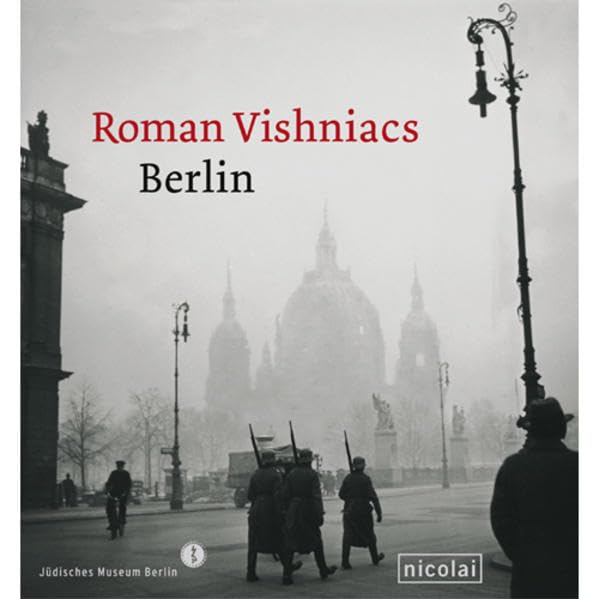
Published in 2005 to accompany an exhibition at the Jüdisches Museum Berlin, Roman Vishniacs Berlin places a closely defined body of images within both a personal and a civic history. The exhibition ran from 4 November 2005 to 5 February 2006; the book, jointly issued by the museum and Nicolai, gives that institutional presentation a lasting form.
Its subject is not simply Berlin as an urban spectacle. The catalog records identify a more particular field: the city’s Jewish population, Berlin between 1918 and 1945, and Vishniac’s family, friends, and associates. These intersecting themes suggest a curatorial approach in which public history is encountered through private relationships. The city emerges not as an anonymous backdrop but as a network of communities and attachments shaped by a consequential historical period.
That combination distinguishes the volume from a general survey of Berlin photography. Biography, social history, and the pictorial record are held together within a single framework, allowing the personal dimensions of Vishniac’s Berlin to remain visible alongside the broader history of the city. The possessive construction of the title is therefore significant: this is a Berlin defined by proximity and experience rather than a claim to comprehensiveness.
The German-language paperback comprises 131 pages. For a serious photobook collection, its importance lies less in any unverified market distinction than in the precision of its subject and context. It documents an exhibition organized by a major Berlin institution and preserves a focused presentation of material concerning Jewish life, personal association, and the city’s interwar and wartime history. Collectors interested in documentary photography, exhibition publications, or photographic accounts of twentieth-century Berlin will find here a clearly bounded work in which individual memory and historical place are brought into direct relation.