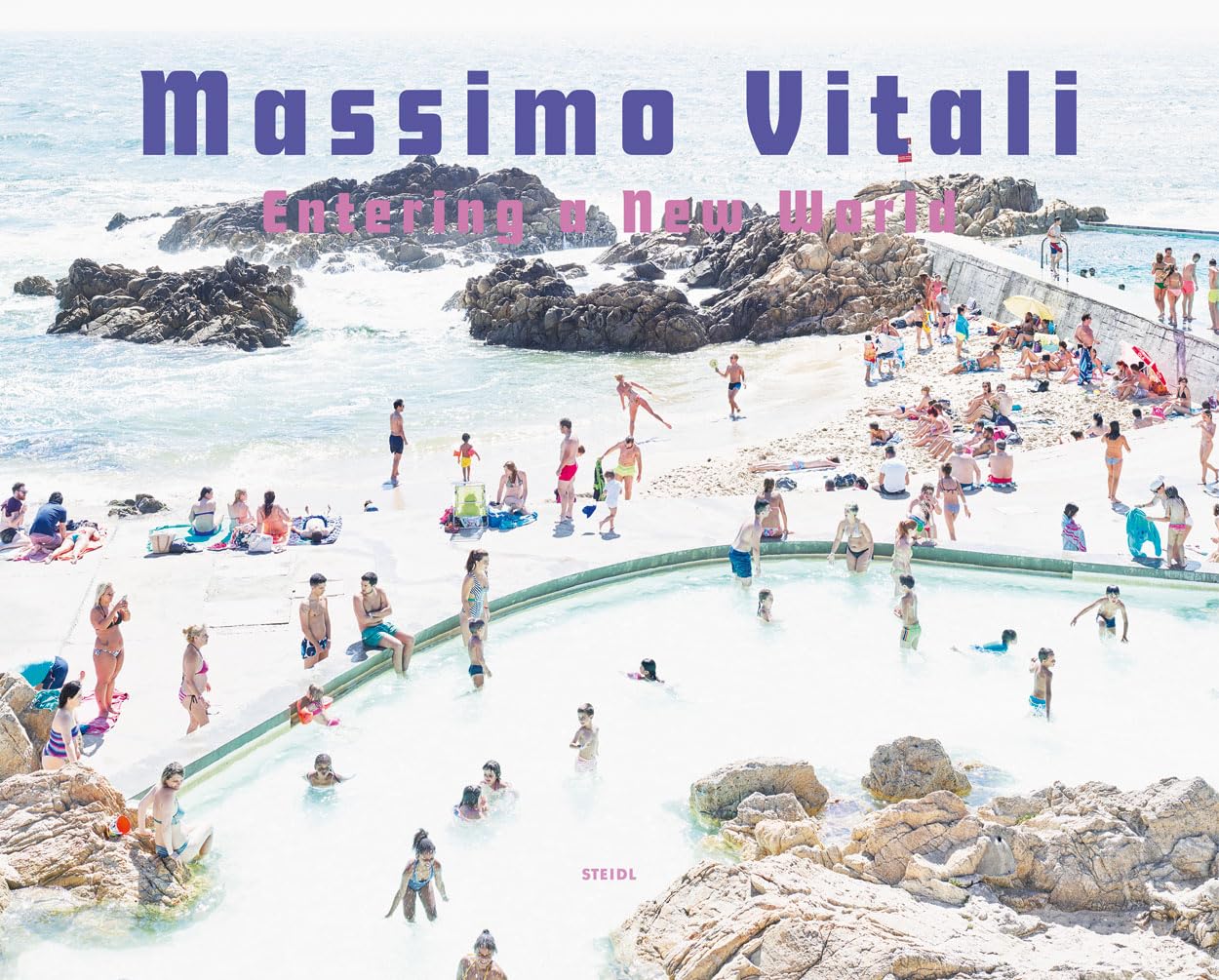
Massimo Vitali’s *Entering a New World* brings together photographs made from 2009 to 2018, a decade in which his studies of collective life continued across beaches, historic sites and commercial spaces. Published by Steidl in 2019, the 208-page volume concentrates on people gathered in public: resting by the sea, moving among the ruins of the Roman Forum or negotiating a crowded shopping promenade. These are social scenes, but also close observations of the environments that organize leisure and movement.
Vitali treats the crowd as both subject and measure. Individual gestures remain embedded within a larger field of bodies, architecture and landscape, allowing apparently ordinary recreation to register as a changing social pattern. The photographs can be read simultaneously as expansive topographical descriptions and as restrained critiques of contemporary habits. Their significance lies in this doubleness: pleasure and consumption, freedom and regulation, personal choice and mass behavior coexist within the same frame.
The period covered also records a consequential change in Vitali’s working method, from large-format film to medium-format digital photography. Rather than presenting technology as a subject in itself, the book places that transition within the continuity of his long attention to human groups and their surroundings. It follows earlier Steidl publications devoted to his work, including *Landscape with Figures* and *Landscape with Figures / Natural Habitats, 1994–2009*, while establishing a distinct chronological chapter after 2009.
For a serious collection, the book deserves attention less as an isolated survey than as a clearly defined segment of Vitali’s evolving practice. Its decade-long span connects his established vocabulary of crowded leisure spaces with a shift in photographic process, while its range of locations broadens the beach imagery closely associated with his work. The result is a sustained account of how public environments reveal social behavior—often most clearly when nothing exceptional appears to be happening.