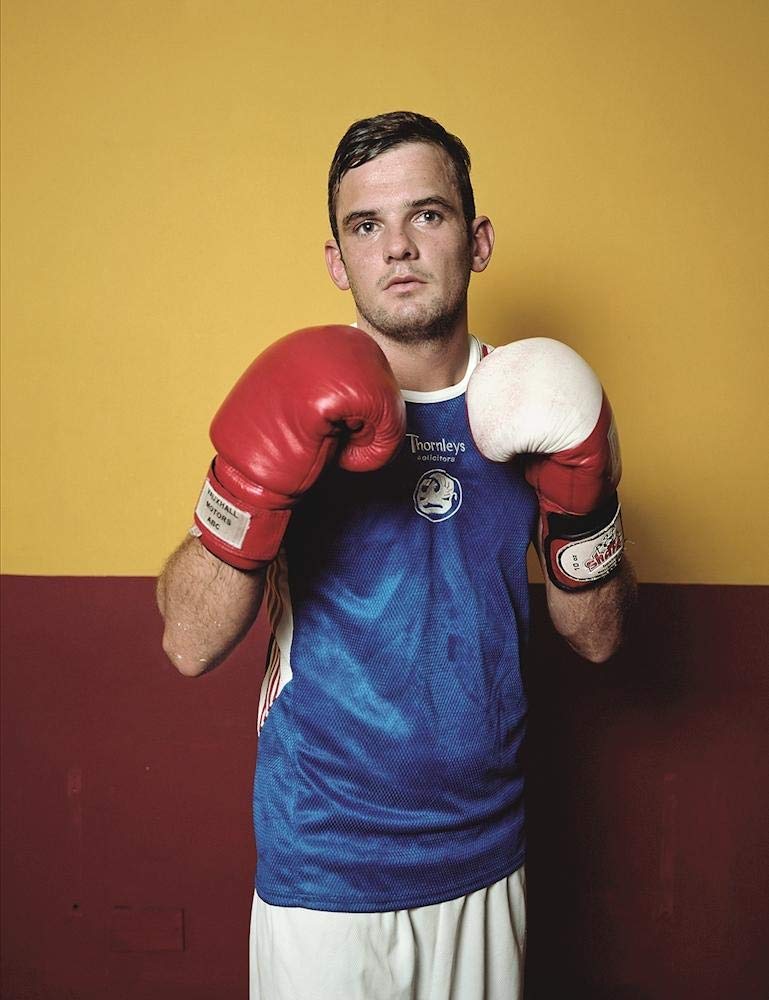
Jona Frank began photographing at an amateur boxing club in Ellesmere Port, outside Liverpool, in the autumn of 2010. The resulting portraits form the subject of *The Modern Kids*: boys and young men encountered in a setting where discipline, performance and physical contact shape how they present themselves. Published by Kehrer Verlag in 2015, the book concentrates on amateur boxing while using the gym as a closely bounded arena for considering adolescence and masculinity.
Frank’s subjects often meet the camera with studied toughness. They are shirtless and sweating, their hands enlarged by brightly coloured, padded gloves; yet the effort of maintaining that pose remains visible. Rather than treating vulnerability as the opposite of masculine strength, the photographs hold both conditions together. The boxing club becomes a place in which identities are rehearsed: confidence can appear provisional, bravado can coexist with uncertainty, and protective equipment can make the body seem at once formidable and exposed.
This tension gives the project its particular clarity. Frank does not need to leave the gym or turn the young boxers into symbols detached from their circumstances. Clothing, posture, gaze and the material vocabulary of the sport carry the argument. The portraits attend to a formative age when social expectations are already being absorbed but have not yet settled into adult composure. Their significance lies less in recording competition than in observing how boys learn to embody an idea of toughness before another person—and before a camera.
Presented as an 80-page hardcover, *The Modern Kids* is a concise study rather than a broad survey of boxing culture. For collectors of portraiture, youth photography or work concerned with gender and social performance, its interest rests in the precision of that focus. Frank’s sustained attention to one amateur club produces a coherent photographic inquiry into the unstable boundary between display and self-protection, making the book a considered document of contemporary boyhood as much as of sport.