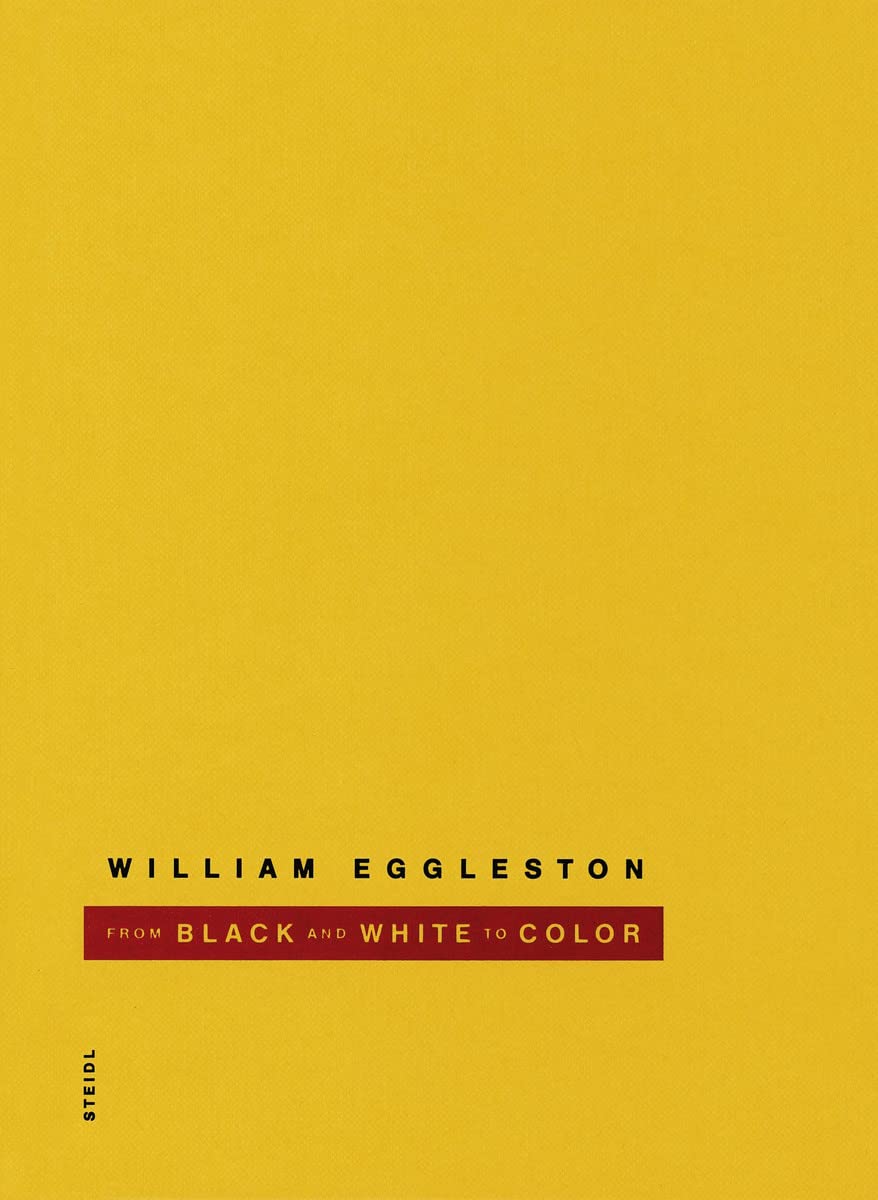
William Eggleston began photographing around his Memphis home at the end of the 1950s, working in black-and-white with a 35mm camera. From Black and White to Colour takes that early practice as its starting point and follows the decisive change that occurred when he adopted colour near the end of the following decade. Published by Steidl in 2014, the book places these two phases in sustained relation rather than treating the monochrome pictures merely as a prelude.
Eggleston’s early fascination with Henri Cartier-Bresson provides one point of departure, but the photographs show him forming a distinctly personal account of the American everyday. Supermarkets, diners, petrol stations and automobiles recur alongside isolated, almost spectral figures. Such ordinary subjects become a field for testing framing, spatial tension and the unstable boundary between incident and atmosphere. The move into colour therefore appears not simply as a technical change, but as a reorientation of how familiar surroundings could be organised and perceived.
The volume is concerned as much with discontinuity as development. By bringing the black-and-white work into contact with the colour photographs that followed, it makes visible both persistent motifs and pronounced formal breaks. Photographs unpublished at the time of the book’s appearance add further depth to this account, allowing the reader to examine less familiar material within the formation of Eggleston’s mature vision. Agnès Sire is credited as curator, underscoring the book’s character as a considered editorial presentation rather than a general retrospective survey.
For a serious photobook collection, its importance lies in this concentrated view of artistic transition. It offers a basis for comparing two closely connected bodies of work and for seeing how Eggleston’s attention to commonplace American spaces changed across photographic media. The value of the book is thus documentary and editorial: it gathers evidence of an evolving visual language while preserving the ruptures that made the turn to colour consequential.