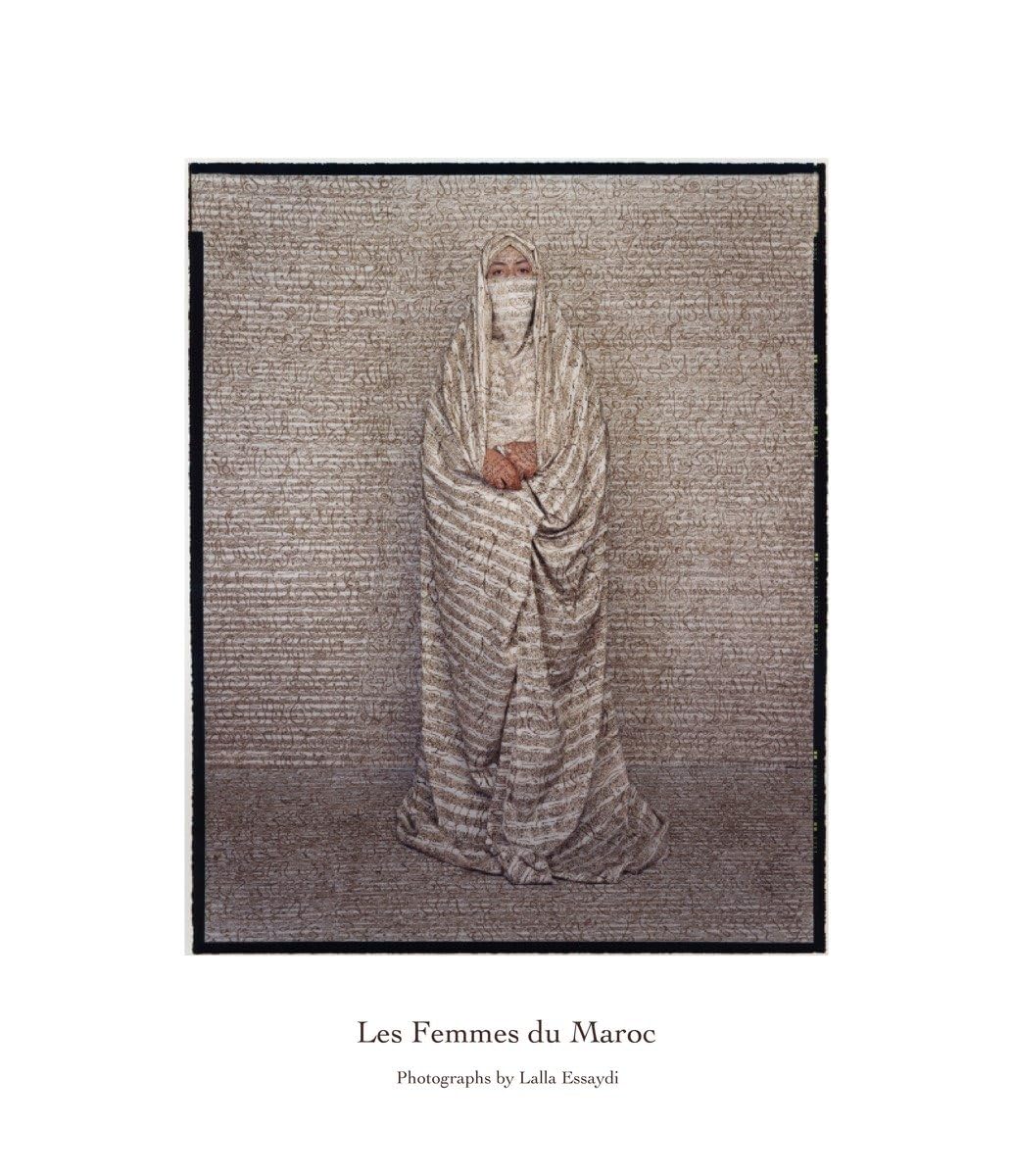
Lalla Essaydi’s Les Femmes du Maroc places women and portraiture at the center of its inquiry. Published by powerHouse Books in 2009, the volume gathers photographs concerned not simply with individual likenesses, but with how Moroccan women have been represented and understood. Its title is direct; the questions raised by the work are less easily settled.
Essaydi revisits a historically charged field of images from the position of a Moroccan-born artist. The portraits address contemporary social structures while acknowledging the histories that continue to shape perceptions of women. Beauty, in this context, is not merely decorative: it becomes something to be reclaimed from inherited conventions of looking. The women pictured therefore occupy a space between personhood and representation, resisting reduction to the veil, the symbol, or the generalized category of “woman.”
The book’s distinction lies in this sustained tension between visibility and elusiveness. Portrait photography ordinarily promises recognition, yet Essaydi’s subject remains in progress rather than fixed by the camera. Her approach allows identity to appear layered and contingent, connecting the immediate presence of the sitter with broader questions of gender, culture, and historical memory. The result belongs equally within discussions of photographic portraiture, women’s studies, and representations of Muslim women.
For a serious photobook collection, Les Femmes du Maroc merits attention as a concentrated presentation of a significant artistic inquiry. It brings Essaydi’s treatment of Moroccan women into book form, where individual portraits can be considered as parts of a larger argument about who controls images and how established visual histories may be reconsidered. Its importance rests not on bibliographic claims, but on the precision of its subject and on the productive friction between portrait, cultural history, and contemporary identity.