Photographer
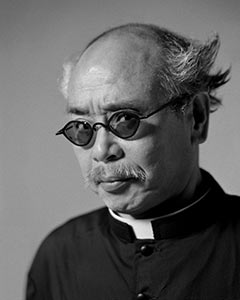
Jan Saudek
Jan Saudek was born in Prague in 1935. As a child, he experienced the Nazi occupation of Czechoslovakia; he and his twin brother, the painter Kaja Saudek, were among the few members of their family to survive internment in a concentration camp. That early encounter with mortality and the fragility of the body would echo throughout his later work. Saudek trained as a printer before turning to photography in the 1960s, developing a practice that lay far outside the official socialist-realist currents of the time.
His visual language is immediately distinctive. Rather than documenting the world, he constructs it. Using his basement studio as a stage, he arranges couples, families, and solitary figures against peeling walls and painted backdrops. Photographing in black and white, he then applies transparent oil colors by hand, transforming the print into something halfway between photograph and painting. The result evokes baroque allegory, surrealist dreams, and the psychological dramas of seventeenth-century Dutch or German art. His subjects—young women and aging men, twins, mothers and children—recur to explore love, desire, identity, and death, often with a frank sensuality that has provoked both admiration and outrage.
The main bodies of work that define Saudek are less single photobooks than repeated thematic cycles: the chamber of lovers and couples in darkened rooms, and the allegories of womanhood—nakedness, pregnancy, aging, and the corpse-like slumber of models surrounded by symbols of time. These cycles were disseminated through numerous exhibitions and printed volumes, and they became iconic for their rendering of a highly personal universe that contrasts with the photojournalistic tradition of his Central European peers. His approach of manually manipulating photographs also anticipated, by decades, the digital image editing that would become routine in contemporary photography.
Saudek’s career has developed through both success and marginalization. Because his imagery was sexually explicit by the standards of his society, his work was often censored or attacked by critics, yet it also gained international recognition from the 1970s onward. He received a Lifetime Achievement Award in recent years, honoring his impact on staged and painterly photography. His photographs have been shown in galleries from Europe to North America, and artist-run spaces continue to revisit them as part of a postwar European photography that defies easy categorization. Museums and collectors now regard him as an important bridge between art photography and the traditions of painting.
For collectors of photobooks, Saudek’s prints and the exhibition catalogs in which they appear offer an entry point into a vision that is at once painterly and harshly real. The hand-colored images reproduce poorly in magazine pages; it is in well-made monographs with fine offset and good paper that the subtle tints and textural depth truly emerge. Galleries such as Robert Koch have represented his work, and their editions and catalogs provide context for understanding how his underground scenes move from the camera to the wall. A recommended approach is to begin with retrospectives and gallery publications rather than small anthologies, so that the sequencing of thematic cycles can be appreciated.
〔PBL-BIO/2〕




COMMUNITY DISCUSSION
Discuss this entry
Share interpretations, reading notes, and source-aware questions. For catalog corrections, use the feedback form below.
No discussion yet. Start the first focused conversation.
Sign in to join the discussion.
Optionally receive a digest when related photobooks are added to the catalog.
See something incorrect? Sign in to suggest a correction or report an issue.