Photographer
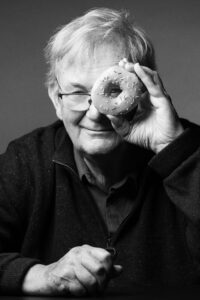
Roger A. Deakins
Sir Roger Alexander Deakins, born 24 May 1949, is an English cinematographer whose images have shaped late twentieth- and early twenty-first-century cinema. Although his primary craft is cinematography rather than still photography, his command of light, composition, and visual narrative has made his work a reference point for photographers and filmmakers alike. He is a member of the British Society of Cinematographers and the American Society of Cinematographers, and he has worked repeatedly with directors such as the Coen brothers, Sam Mendes, and Denis Villeneuve.
Deakins’s visual language is marked by restraint and precision. He favors naturalistic light, carefully controlled color, and compositions that use landscape, architecture, and negative space as emotional forces. Rather than drawing attention to camera movement or technical display, his images often let a scene breathe, allowing performance and environment to carry meaning. This approach distinguishes him from more overtly stylized cinematographers; his work can be stark or lyrical, but it rarely feels arbitrary. In films such as Fargo, No Country for Old Men, and Sicario, the camera observes space with a cool, almost documentary patience, while in The Shawshank Redemption and Skyfall it finds moments of quiet grandeur.
His major bodies of work include The Shawshank Redemption (1994), Fargo (1996), O Brother, Where Art Thou? (2000), A Beautiful Mind (2001), No Country for Old Men (2007), True Grit (2010), Skyfall (2012), Sicario (2015), Blade Runner 2049 (2017), and 1917 (2019). These films matter not simply as popular titles but as case studies in how lighting, lens choice, and framing can define a story’s emotional register. O Brother, Where Art Thou? is often cited for its digital color grading, which helped push digital intermediate workflows into mainstream practice. Blade Runner 2049 and 1917 earned him Academy Awards for Best Cinematography, and they demonstrate his ability to work at vastly different scales, from intimate character studies to large-format spectacle.
Deakins’s career development reflects a steady ascent through British and international cinema. An alumnus of the National Film and Television School, he later became an honorary fellow in recognition of his contributions to British film. He received a Lifetime Achievement Award from the American Society of Cinematographers in 2011, was appointed CBE in 2013, and was knighted in the 2021 New Year Honours. His influence is visible in the work of younger cinematographers who admire his discipline and his resistance to empty spectacle. He is not associated with a single movement, but his name has become shorthand for a certain kind of intelligent, image-driven filmmaking.
For photobook collectors, Deakins is an unusual figure: his primary legacy is in moving images, not in printed photographic monographs. Yet his relevance to lens-based collecting lies in how he treats composition and light as narrative tools. Publications that document cinematography, film production, or the visual design of his major works can offer insight into his sequencing of images and his collaborative process. As an entry point, collectors might look to cinema-related books and exhibition catalogues that discuss his films rather than expecting a traditional photobook career. His work rewards attention to atmosphere, scale, and the disciplined use of visual restraint.
Wikipedia’s biographical entry identifies Roger A. Deakins as an English cinematographer. It records his birth on 24 May 1949 in Torquay, Devon, and notes his long collaborations with directors including Joel and Ethan Coen, Sam Mendes, and Denis Villeneuve. It also documents his Academy Award wins for Blade Runner 2049 and 1917, alongside many nominations, and surveys his career from early British film work to major international productions.
The Chinese Wikipedia article on 罗杰·狄金斯 identifies him as a British cinematographer and provides a parallel biographical overview. It records his birth date and place, his major directorial collaborations, and his Academy Award recognition for Blade Runner 2049 and 1917. As a multilingual reference point, it helps document his international reception and the standardized Chinese form of his name.
The British Film Institute’s profile page for Roger Deakins identifies him as a cinematographer and provides selected film credits. As a page from the BFI, a national film institution, it serves as an institutional reference for his career and his connection to British film culture. It helps document how his work is catalogued within established film heritage and reference resources.
Encyclopaedia Britannica provides a concise biography of Roger Deakins, presenting him as a British cinematographer born on 24 May 1949 in Torquay, Devon, England. The entry highlights his distinctive visual style and his sustained collaboration with the Coen brothers, and it notes his Academy Awards for Blade Runner 2049 and 1917. It situates him among the most recognized cinematographers in contemporary cinema.
The official Roger Deakins website is the cinematographer’s primary online presence. It provides direct information about his professional identity and work, distinguishing it from fan or third-party pages. While it does not replace a full critical biography, it confirms his public professional profile and serves as an authoritative starting point for his filmography and ongoing activities.

Selected Works & Key Projects
A source-backed introduction to individual photographs and significant bodies of work.
Key projects

Project · 1971
North Devon photographs
This group originates in a year-long Beaford Arts Centre commission made after Deakins graduated from college. He photographed rural life in North Devon; the photographs were subsequently gathered in Byways for the first time. Damiani characterizes them as records of a vanished postwar Britain and identifies an ironic English sensibility in the pictures. The project merits selection because it is the explicitly commissioned, place-based foundation of Deakins’ still-photographic practice, rather than a later accumulation of pictures made during leisure or film travel, and because the monograph gives the group a defined public context.
View source ↗-
1975
Education
Graduated in Cinematography from the National Film and Television School
NFTS identifies Roger Deakins as a 1975 cinematography graduate. This training milestone establishes his documented connection to the school’s cinematography program before his subsequent professional work in documentary and feature filmmaking.
Source: National Film and Television School, “NFTS Launches Graduate Impact Report 2020” Verified Sep 16, 2026
-
1984
Career milestone
Photographed Nineteen Eighty-Four
For Michael Radford’s Nineteen Eighty-Four, Deakins helped create a desaturated vision of Orwell’s totalitarian world. BFI’s Sight and Sound notes his revival of bleach-bypass processing, producing silvery blacks and muted blue tones. The publication treats the film as the point at which his distinctive dramatic-screen style decisively emerged, making it a consequential early feature in his career.
Source: BFI Sight and Sound, “Remain in light: Roger Deakins in ten shots” Verified Sep 16, 2026
-
1994
Award
Academy Award nomination for The Shawshank Redemption
The Academy Awards Database records Roger Deakins as a 1994 nominee in Cinematography for The Shawshank Redemption. The nomination placed his work on the prison drama within the Academy’s official awards record and remains a major early recognition in his feature-film career.
Source: Academy Awards Database, Roger Deakins search results Verified Sep 16, 2026
-
2010
Award
ASC Lifetime Achievement Award
The American Society of Cinematographers lists Roger Deakins as the recipient of its Lifetime Achievement Award in 2010. The honor recognizes a sustained body of cinematography rather than a single title, marking institutional acknowledgement by the professional society whose initials he uses after his name.
Source: American Society of Cinematographers, “Past Nominees & Winners” Verified Sep 16, 2026
-
March 4, 2018
Award
Won the Academy Award for Blade Runner 2049
At the 90th Academy Awards, Roger A. Deakins won the Oscar for Cinematography for Blade Runner 2049. The Academy’s ceremony record documents both the film and his credited name, making this a definitive institutional recognition of his cinematography on Denis Villeneuve’s science-fiction feature.
Source: Academy of Motion Picture Arts and Sciences, The 90th Academy Awards Verified Sep 16, 2026
-
February 9, 2020
Award
Won the Academy Award for 1917
At the 92nd Academy Awards, Roger Deakins won the Oscar for Cinematography for 1917. The Academy identifies him as the category’s winner for the 2019-release film, documenting a second Academy Award in his career and recognition for his work on Sam Mendes’s war drama.
Source: Academy of Motion Picture Arts and Sciences, The 92nd Academy Awards Verified Sep 16, 2026
-
2021 New Year Honours
Award
Appointed Knight Bachelor
The UK Government’s 2021 New Year Honours notes identify Roger Deakins CBE as a Knight Bachelor. The citation recognizes his exceptional and sustained contribution to British cinematography and his international contribution to film and culture, specifically referring to 1917 alongside earlier films including The Shawshank Redemption and Skyfall.
Source: GOV.UK, “Notes on higher awards in the New Year Honours Overseas and International List 2021” Verified Sep 16, 2026
-
2021
Photobook
Published Byways
Byways, published by Damiani in 2021, is credited to Roger A. Deakins and presented by the Martin Parr Foundation as a book spanning rural North Devon and locations around the world. It is a significant milestone in the still-photography side of his practice, bringing photographs made beyond his cinematography assignments into a dedicated monographic publication.
Source: Martin Parr Foundation, “Byways” Verified Sep 16, 2026
Other institution
American Society of Cinematographers (ASC)
The American Society of Cinematographers is the honorary professional body for directors of photography, founded in 1919. Roger A. Deakins is documented as a member, a peer-reviewed affiliation that situates his camera work within the institution's record of American cinematography and its craft standards.
Verified 2026-09-16Wikipedia
Other institution
British Society of Cinematographers (BSC)
The British Society of Cinematographers is the United Kingdom's honorary guild for directors of photography. Deakins, who trained in Britain before moving into feature films, appears among its members, linking his career to the British craft tradition and its institutional documentation.
Verified 2026-09-16Wikipedia
Publishing relationship
Damiani
The Italian art-book publisher Damiani issued Byways, a collection of Roger A. Deakins's black-and-white still photographs made alongside and before his film career. The publication documents his standing as a photographer in his own right, separate from his cinematography.
Verified 2026-09-16Damiani
Blade Runner 2049 — Wikipedia (opens a new site)
Encyclopedic entry on the Denis Villeneuve film photographed by Roger Deakins, documenting the production, release and critical reception of the work for which he received his first Academy Award for Best Cinematography. Useful as a checkable source on the film's credited personnel, awards record and the critical discussion of its visual design.
Roger Deakins — Official Website (opens a new site)
The official website of Roger Deakins, maintained as his primary online presence and a first-hand source for information about his film work and his photography. Its value for research lies in being author-controlled: where secondary coverage disagrees on credits or chronology, the material published here represents the photographer's own record of his projects and activities.
Roger Deakins — Wikipedia (opens a new site)
Encyclopedic reference entry on the English cinematographer Roger Deakins, tracing his career from early British film work through long-running collaborations with the Coen brothers, Sam Mendes and Denis Villeneuve. It records his Academy Awards for Blade Runner 2049 and 1917 alongside the nominations that preceded them, and functions as a baseline source for verified biographical and filmographic facts rather than commentary.


COMMUNITY DISCUSSION
Discuss this entry
Share interpretations, reading notes, and source-aware questions. For catalog corrections, use the feedback form below.
No discussion yet. Start the first focused conversation.
Sign in to join the discussion.
Optionally receive a digest when related photobooks are added to the catalog.
See something incorrect? Sign in to suggest a correction or report an issue.