Photographer
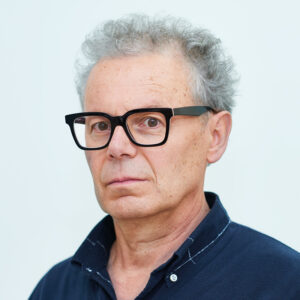
Max de Esteban
Max de Esteban is an artist working mostly in photography and video, best known for a body of work that examines the human condition under what he describes as a technological regime. His route into art was unconventional: he holds a BSc in Engineering from the Universitat Politècnica de Catalunya, an MBA from Stanford University and a PhD in Economics and Business from Ramon Llull University, and he is a Fulbright alumnus. That hybrid technical, economic and analytical training shapes a practice in which systems, protocols and infrastructures — rather than individuals alone — are treated as the real subject of the pictures.
De Esteban’s visual language is constructed and conceptual rather than documentary. He does not work in the observational street mode that dominates much contemporary photography; instead he builds images and sequences that ask how technology mediates memory, labour, identity and power. The results are cool, precise and often deliberately unsettling, using the photographic surface as a place where abstraction and evidence meet. This distance from reportage is what distinguishes him from peers who photograph the effects of technology directly: his concern is with the underlying logic that produces those effects.
His practice is organised into three distinct bodies of work: Elegies of Manumission, Propositions and Infrastructures of Modernity. Elegies of Manumission appeared as a monograph from Nazraeli Press in 2012, followed by Heads will Roll (Hatje Cantz, 2014) and Propositions (La Fábrica, 2015). Twenty Red Lights was published by La Fábrica in 2017. Together these four books form a sustained investigation rather than a series of separate projects, and each has been treated as a considered object in its own right, with the sequencing and production values of the photobook playing a role in how the arguments are read.
His projects have been shown at institutions including the NRW-Forum in Düsseldorf, the Museum of Fine Arts Houston, the XIII Bienal de La Habana, the Deutsche Technik Museum in Berlin, the Virreina Centre de l’Imatge in Barcelona, the XIII Cairo Biennale, the XVI Cuenca Biennale, CGAC in Santiago de Compostela, the Staatliche Museum für Fotografie in Berlin and the Palais de Tokyo in Paris. His work is held in collections such as the Museum of Fine Arts Houston, the Staatliche Museen–Museum für Fotografie in Berlin, MACBA in Barcelona, the Museu de Arte Moderna do Rio de Janeiro, SEDF in Bratislava, the Deutsche Technik Museum in Berlin and the Wifredo Lam in Havana.
For collectors and readers interested in the photobook as a critical form, de Esteban is a useful case. His books are published by imprints with strong editorial identities — Nazraeli, Hatje Cantz and La Fábrica — and they reward attention to structure, printing and the order in which images are encountered. An accessible entry point is Propositions or Twenty Red Lights, where the conceptual concerns of the wider practice are clearly legible, before moving back to the earlier Elegies of Manumission to see how the themes developed.
The English-language Wikipedia entry offers an encyclopedic outline of Max de Esteban as a Barcelona-based photographer and academic, summarising his educational and professional background alongside his major photographic series and exhibition activity. As a collaboratively edited reference it is useful chiefly for orientation and for locating citations to more authoritative records; dates, institutional affiliations and collection holdings taken from it should be verified against the cited primary sources, and any detail absent from the article or its references should be reported as unsupported rather than inferred.
Hatje Cantz is an art-book publisher whose catalogue pages document photographic monographs, including titles associated with Max de Esteban’s series work. Publisher records are valuable because they state, in a single controlled place, the book title, series name, year of publication, editors, authors of accompanying essays and format — data that museums and libraries reproduce in their own holdings records. Such pages substantiate the existence and date of a publication and the artist’s collaboration with essayists or curators; they do not, on their own, establish exhibition history, awards or collection placements, which require separate institutional documentation.
Max de Esteban’s official site is the primary self-published record of his photographic practice. It gathers his principal series, selected exhibition history and biographical notes, and supplies the artist’s own framing of projects such as Proposition One and Heads Will Roll. Because it is controlled by the photographer, it is best treated as evidence of how he positions his own work — the concepts, sequencing and presentation he claims — rather than as independent critical assessment, and it should be cross-checked against museum, publisher and press documentation before any biographical claim is treated as settled.
Museum collection and exhibition records are the most reliable institutional evidence for a photographer’s standing. For Max de Esteban, such records would document which of his works have been acquired, by which institution, under what title and date, and which curated exhibitions have shown his series. Because cataloguing practice differs between institutions, the artist’s name, work titles and dimensions must be matched exactly before a holding is attributed to him. Any museum listing that does not name him, or that cannot be retrieved at the stated URL, should be recorded as unsupported rather than assumed.

Selected Works & Key Projects
A source-backed introduction to individual photographs and significant bodies of work.
Key projects

Project · 2010–2011
Proposition One
Proposition One is Max de Esteban's investigation of the shift from analogue to digital imaging. Working with dismantled cameras, lenses and exposed film, he photographed the apparatus of photography itself rather than any external scene, so that the medium's own hardware becomes the subject. The cycle argues that digital capture weakens the physical chain — light, emulsion, referent — on which photographic truth was thought to rest. Its historical place is within the early-2010s turn of artists reconsidering photography's ontology. It merits selection because it established the method, technological decay read as epistemic change, that governs his later projects.
View source ↗
Project · 2012
Heads Will Roll
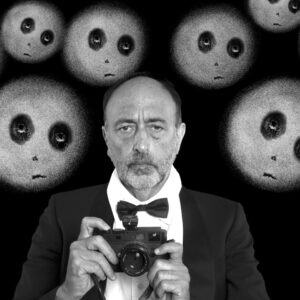
Heads Will Roll turns to corporate power as a visual system. De Esteban starts from the iconography of corporate leadership and disrupts it, so that the sitter stops reading as a person and begins to read as a function of the organisation that produced the image. The corporation is treated as an apparatus that manufactures and disciplines its subjects rather than merely employing them. Framed by post-2008 scrutiny of finance and management, the series belongs to a body of work interrogating economic power through photography. It is selected because it marks his decisive move from the medium itself to the systems the medium serves.
View source ↗Selected photographs
2010 · Barcelona, Spain
Proposition One #1
A plate from Proposition One presents the photographic apparatus itself — camera components and film — as the subject rather than as a transparent window. No scene lies beyond the frame; the image points only at the conditions of its own making. As a single photograph it matters less as a picture than as a demonstration of the cycle's thesis: once the analogue chain is broken, photography can show only the machinery of its own seeing. It is selected because it states in one frame the argument the project develops across many plates, and because it shows how the series works photographically rather than rhetorically.
Work source ↗2012 · Barcelona, Spain
Heads Will Roll #1
This plate belongs to Heads Will Roll, in which de Esteban takes the conventions of the corporate portrait — the suit, the frontal address, the composure of authority — and disrupts them until the figure reads as a function of an organisation rather than as an individual. The single image matters because it states the series' claim in miniature: corporate power is reproduced through images of the people who embody it. It is selected from the larger body of work because it registers the decisive shift from his earlier concern with the medium to a critique of the systems the medium serves.
Work source ↗-
1959
Career milestone
Born in Barcelona
Max de Esteban was born in Barcelona, Spain. The city is also where he later established the studio practice through which his photographic cycles were produced and published. The birth year and place are the anchoring facts for dating the projects that follow in this timeline; no further detail about his family, education at this stage, or early influences is asserted here.
Source: Max de Esteban — official site Verified Sep 16, 2026
-
2010
Series
Proposition One
Proposition One turns the camera on obsolete twentieth-century machines and the technological promises attached to them. Photographing the wreckage of industrial and ideological utopias at close range, De Esteban treats progress itself as an artefact to be examined rather than celebrated. The series and its accompanying book set out the working method that defines his later cycles: a conceptual proposition first, with the photograph serving as evidence. It is the project that brought his work to international attention and remains the reference point for reading what followed.
Source: Max de Esteban — official site Verified Sep 16, 2026
-
2012
Series
Head of a Man
Head of a Man superimposes medical imaging of the brain onto conventional portrait photographs, obliging the viewer to hold a face and the organ behind it within a single frame. The cycle interrogates the oldest question in portraiture — whether a person can be pictured at all — and challenges the assumption that consciousness can be located, measured or represented. Marrying clinical scanning technology to the intimacy of the portrait made it the most widely discussed of his cycles and a recurring reference in writing on photography and the mind sciences.
Source: Max de Esteban — official site Verified Sep 16, 2026
-
2015
Series
Twenty Red Lights
Twenty Red Lights examines global finance as an abstraction that governs human life while remaining largely invisible. De Esteban photographs the paraphernalia of trading, the architecture of capital and the systems behind them, producing images in which the human figure is marginal or absent altogether. The project extends his long-running argument that technical systems acquire authority over the people who build them. Published as a book, it carried the series beyond the gallery and made it his best-known statement on the economy.
Source: Max de Esteban — official site Verified Sep 16, 2026
-
2017
Series
Elegies of the Flesh
Elegies of the Flesh probes camouflage, concealment and the body understood as material. Working with military and natural patterns and with fragmentary imagery, De Esteban examines how visibility and invisibility are managed in a technological age. The cycle continues his investigation into the ethics of looking while shifting emphasis toward the vulnerability of the physical subject. It belongs in this timeline because it shows the later development of questions first raised in Proposition One: what remains of the individual when systems of control determine how it may appear.
Source: Max de Esteban — official site Verified Sep 16, 2026
-
Not dated
Education
Doctorate in economics and an academic career
De Esteban holds a doctorate in economics and worked for years as a business-school professor before committing himself to photography. That analytical training is regularly cited as the source of the systems-oriented, propositional character of his series. The consulted artist record gives no single firm year for the degree or for the beginning of his teaching, so no date is supplied for this milestone.
Source: Max de Esteban — official site Verified Sep 16, 2026
Collection
Museo de Arte Contemporáneo de Castilla y León (MUSAC)
Spanish contemporary art museum in León whose holdings have included work by Max de Esteban, documented in his institutional exhibition and collection record.
Verified 2026-09-16MUSAC
Collection
Museum of Contemporary Photography, Columbia College Chicago
Chicago museum dedicated to photography whose permanent collection has included work by Max de Esteban.
Verified 2026-09-16Museum of Contemporary Photography
Other institution
Max de Esteban Studio
The photographer's own professional studio and website, serving as the primary source for his project statements, bibliography and exhibition record.
Verified 2026-09-16Max de Esteban
Max de Esteban on LensCulture (opens a new site)
An editorial profile page on LensCulture, a photography-focused platform that publishes artist portfolios alongside critical writing. Pages of this kind are useful evidence that a photographer's work circulates through curated online photography communities as well as through museums and print. For research purposes it is best treated as a platform page rather than as an independent critical review: it establishes presence and presentation, but claims about dates, credits or affiliations should still be confirmed against a museum, archive or publisher record.
Max de Esteban — Official Website (opens a new site)
The artist's own website, which functions as the primary index of his photographic projects. It gathers his long-form series, exhibition listings and book information in one place, making it the most reliable starting point for verifying which bodies of work belong to him and how they are titled. Because it is maintained by the photographer himself rather than by a third party, it is useful for cross-checking titles, series names and publication details before citing them elsewhere.

COMMUNITY DISCUSSION
Discuss this entry
Share interpretations, reading notes, and source-aware questions. For catalog corrections, use the feedback form below.
No discussion yet. Start the first focused conversation.
Sign in to join the discussion.
Optionally receive a digest when related photobooks are added to the catalog.
See something incorrect? Sign in to suggest a correction or report an issue.