Photographer
Guy Bourdin
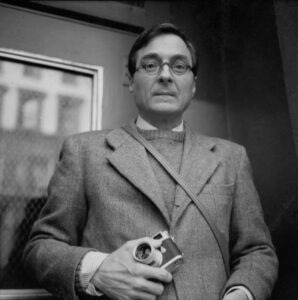
Guy Bourdin (1928–1991) was a French artist and fashion photographer, born in Paris as Guy Louis Banarès. Although he painted throughout his life and was essentially self-taught as a photographer, he became one of the twentieth century’s most radical voices in fashion imagery. From 1955 onward, he worked predominantly for Vogue, developing a body of work that challenged conventional ideas of advertising and editorial photography with its unsettling, highly stylized compositions.
Bourdin’s visual language was unmistakable: saturated color, jarring crops, and a penchant for surreal or violent narratives. He often placed models in strange, sometimes menacing scenarios, using props and architectural settings to create a sense of disquiet rather than glamour. Unlike the more straightforward celebratory approach of contemporaries such as Helmut Newton or Richard Avedon, Bourdin treated fashion as a medium for psychological drama that could tip into horror or absurdity. His paintings, which he continued making in parallel, informed his meticulous attention to color and composition in photographs.
Among his most recognizable achievements are the campaigns for the French shoe label Charles Jourdan in the 1970s and 1980s, which elevated product photography into an art form. His work for Vogue, especially the color editorials produced between the 1960s and his death, remains a touchstone for experimental fashion photography. Since he rarely published photobooks during his lifetime, his legacy was long carried by the extensive archive managed by the Guy Bourdin Estate, which has regularly released retrospectives and exhibitions. Major institutional attention has come posthumously, with galleries like the Michael Hoppen Gallery representing the estate and curating solo shows.
Bourdin’s significance lies partly in his ability to conflate commerce and fine art. He dismantled the usual distance between the viewer and the commodity, often foregrounding legs, shoes, or accessories in ways that made the product uncanny. This continues to inspire contemporary photographers, and his images appear in virtually every survey of fashion photography. However, his work also invites critical discussion: many have noted its darkly eroticized violence toward female subjects, a dimension that complicates his reputation and makes close reading essential.
For collectors and photobook enthusiasts, Bourdin’s posthumous publications are well worth exploring. Titles issued in collaboration with the estate and independent publishers typically feature carefully reproduced color plates, respecting the artist’s original contrasts and saturation. Rather than seeking single vintage prints—which are rare and often contested—collectors often turn to the notable monographs and catalogues that document his editorial work. These books serve as both entry points and definitive records of a photographer whose influence on fashion imagery remains deep and contested.
〔PBL-BIO/2〕


COMMUNITY DISCUSSION
Discuss this entry
Share interpretations, reading notes, and source-aware questions. For catalog corrections, use the feedback form below.
No discussion yet. Start the first focused conversation.
Sign in to join the discussion.
Optionally receive a digest when related photobooks are added to the catalog.
See something incorrect? Sign in to suggest a correction or report an issue.