Photographer
Arbus Friedlander Winogrand
Garry Winogrand (1928–1984) was an American street photographer whose energetic, tilted compositions redefined documentary practice in the decades after World War II. Born in the Bronx to immigrant parents from Budapest and Warsaw, he came of age amid the postwar transformation of American cities and their mass media. He studied painting and photography, then worked as a photojournalist and commercial photographer before establishing himself as a key figure in the New York photography scene, where he shared the spotlight with Diane Arbus and Lee Friedlander in the landmark 1967 exhibition ‘New Documents’ at the Museum of Modern Art.
Winogrand’s visual language was deliberately rough and dynamic. He favored a 35mm Leica, shooting from the hip or with swift, intuitive framing that often resulted in slanted horizons and seemingly haphazard cropping. His photographs celebrated the visual ‘cacophony’ of modern life, capturing people in public—on streets, at zoos, airports, and political events—engaging with their surroundings in ambiguous, often humorous ways. Unlike Arbus’s staged encounters with marginalized subjects or Friedlander’s complex formal self-reflections, Winogrand chased spontaneous interaction and the unpredictable energy of crowds, helping to herald what critics later called the ‘snapshot aesthetic.’
His major bodies of work include ‘The Animals’ (1969), which photographed visitors and animals at zoos to probe human-animal boundaries; ‘Public Relations’ (1977), a critical look at media events and press conferences that exposed the manufactured nature of public images; and the posthumously edited ‘Winogrand 1964’ and ‘Women are Beautiful’ (1975), the latter a controversial yet influential meditation on women in public spaces during the feminist era. He also documented the assassination site of President Kennedy in Dallas, producing a series that grappled with trauma and the mediated spectacle, and left thousands of undeveloped frames at his death, later edited posthumously into books like ‘The Man in the Crowd’.
Winogrand’s influence on street photography is immense. He helped shift the genre away from social-documentary moralism toward a more existential, expressive mode, and his work was championed by curators such as John Szarkowski, who organized ‘New Documents’. His photographs were exhibited widely at MoMA and other institutions, and his legacy has been shaped by estate-edited publications and major retrospectives, including the 2013 retrospective at the San Francisco Museum of Modern Art and the film ‘Garry Winogrand: All Things Are Photographable’ (2019). Scholars and curators continue to debate the balance between his obsessive shooting and the curation of his unfinished work, adding complexity to his canon.
For photobook collectors, Winogrand’s books are essential touchstones in the history of the photobook. ‘The Animals’ and ‘Public Relations’ were printed in editions that now appear in rare-book markets, though their significance lies in their sequencing and design: they pioneered a narrative style that combined sharp observation with playful ambiguity. The posthumous collections, especially those edited by Susan Kismaric and others, reveal the challenge of curating an archive that was never fully organized by the artist. Collectors may seek first editions of his monumental ‘New Documents’ catalogue or the MoMA-associated publications, but the more accessible entry point is the widely reprinted ‘Women are Beautiful’ or the monograph ‘Garry Winogrand’ published by Fraenkel Gallery, which offers a comprehensive overview of his restless vision.
〔PBL-BIO/2〕

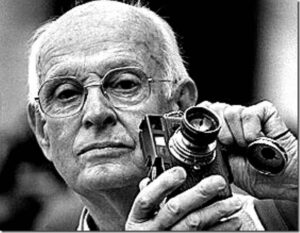
Henri Cartier-Bresson
Shared publisher: The Museum of Modern Art
11 photobook(s) in the library

Dorothea Lange
Shared publisher: The Museum of Modern Art
8 photobook(s) in the library

An-My Lê
Shared publisher: The Museum of Modern Art
2 photobook(s) in the library
Bill Brandt
Shared publisher: The Museum of Modern Art
2 photobook(s) in the library
COMMUNITY DISCUSSION
Discuss this entry
Share interpretations, reading notes, and source-aware questions. For catalog corrections, use the feedback form below.
No discussion yet. Start the first focused conversation.
Sign in to join the discussion.
Optionally receive a digest when related photobooks are added to the catalog.
See something incorrect? Sign in to suggest a correction or report an issue.