Photographer
Robert Adams
Robert Adams (born 1937) is an American photographer whose work has profoundly reshaped the understanding of landscape photography in the late twentieth century. His quiet yet morally urgent images explore the changing terrain of the American West, examining how suburban expansion, deforestation, and industrial development have altered once‑open land. Adams approaches the landscape not as untouched wilderness but as a space shaped by human decisions, balancing clarity of description with a deep ethical concern for what has been lost.
His breakthrough book “The New West” (1974) and participation in the influential 1975 exhibition “New Topographics: Photographs of a Man-Altered Landscape” helped redefine the genre by bringing attention to everyday built environments—tract housing, parking lots, commercial strips, and disturbed land—rendered with calm, luminous black‑and‑white precision. Rather than idealizing nature, Adams photographs the intersection between beauty and damage, revealing the tension between America’s mythic landscapes and the realities of modern development.
Throughout his career, Adams has produced extensive series in Colorado, California, and Oregon, focusing on themes such as clear-cut forests, quiet suburban neighborhoods, and the fragile persistence of light and space in damaged environments. His work has been widely exhibited and published, and he has received major honors including multiple Guggenheim Fellowships, a MacArthur Fellowship, the Deutsche Börse Photography Prize, and the Hasselblad Award. He continues to live and work in the Pacific Northwest, creating contemplative bodies of work that reflect on land, stewardship, and the moral responsibilities of witnessing change.
Robert Adams, an American photographer born in 1937 and originally from Orange, New Jersey, began photographing in 1963 while completing a Ph.D. in English at the University of Southern California. In 1967, while teaching English at Colorado College, he was asked to photograph residential development around Colorado Springs for a conference on the western landscape. His work subsequently focused on urban and suburban expansion and its effects on the natural environment.
Adams published this work in The New West: Landscapes Along the Front Range (1974) and Denver: A Photographic Survey of the Metropolitan Area (1977). He later returned to rural subjects in books including Our Lives & Our Children: Photographs Taken Near the Rocky Flats Nuclear Weapons Plant (1984) and Cottonwoods (1994). His photographs examine environmental change associated with suburban growth and nuclear weapons technology across the American West.
Adams participated in the 1975 George Eastman House exhibition New Topographics: Photographs of a Man-Altered Landscape. His distinctions include National Endowment for the Arts Fellowships in 1973 and 1978, a Guggenheim Fellowship in 1973, and a MacArthur Foundation Fellowship. His black-and-white landscape practice draws on earlier western photography while addressing the tension between regard for the region and concern over human damage to it.
Robert Hickman Adams, born May 8, 1937, in Orange, New Jersey, is an American photographer whose work examines the changing landscapes of the American West. After his family settled in Wheat Ridge, Colorado, in 1952, he studied English at the University of Redlands, earning a BA in 1959, and completed a PhD in English literature at the University of Southern California in 1965.
Adams began photographing in the 1960s while teaching English at Colorado College and became a full-time photographer in 1970. His book The New West (1974) and his inclusion in the 1975 exhibition New Topographics: Photographs of a Man-Altered Landscape at George Eastman House established his association with the New Topographics movement. His photographs frequently address development, environmental change, and what persists within altered Western landscapes.
His honors include Guggenheim Fellowships in 1973 and 1980, a MacArthur Fellowship in 1994, the Deutsche Börse Photography Prize in 2006, and the Hasselblad Award in 2009. He was elected to the American Academy of Arts and Letters in 2014 and inducted into the International Photography Hall of Fame in 2020. Major retrospectives have been presented by institutions including the Philadelphia Museum of Art, Yale University Art Gallery, the Denver Art Museum, the Los Angeles County Museum of Art, and the Museo Nacional Centro de Arte Reina Sofía.

Eden

Sea Stone

American Silence: The Photographs of Robert Adams

Hope is a risk that must be run

Tenancy

The New West

A Road Through Shore Pine

The Place We Live

Light Balances / On Any Given Day in Spring

Skogen

What Can We Believe Where?: Photographs of the American West

The New West: Landscapes Along the Colorado Front Range

Los Angeles Spring

Prairie: Photographs
-
1965
Education
Earned a Ph.D. in English
Adams received his Ph.D. in English from the University of Southern California.
Source: Beinecke Rare Book and Manuscript Library, Yale University Verified Aug 29, 2026
-
1970
Career milestone
Became a Full-Time Photographer
After beginning to photograph while teaching at Colorado College, Adams became a full-time photographer in 1970.
Source: Beinecke Rare Book and Manuscript Library, Yale University Verified Aug 29, 2026
-
1974
Photobook
The New West
First published in 1974, The New West examined development along Colorado’s Front Range through photographs of freeways, tract housing, commercial buildings, signs, and the surrounding land.
Source: Steidl Verified Aug 29, 2026
-
1975–1976
Exhibition
New Topographics: Photographs of a Man-Altered Landscape
Adams participated in the original George Eastman House exhibition, held from October 14, 1975, to February 2, 1976, which presented a new approach to photographing human-altered landscapes.
Source: George Eastman Museum Verified Aug 29, 2026
-
1979
Exhibition
Prairie: Photographs by Robert Adams
The Museum of Modern Art presented this solo exhibition from February 9 through May 1, 1979.
Source: The Museum of Modern Art Verified Aug 29, 2026
-
1980
Representation
Began an Affiliation with Fraenkel Gallery
Adams recalled becoming affiliated with Fraenkel Gallery one year after the San Francisco gallery opened in 1979, placing the start of the relationship in 1980.
Source: Archives of American Art, Smithsonian Institution Verified Aug 29, 2026
-
1989
Exhibition
Robert Adams: To Make It Home: Photographs of the American West, 1965–1986
The Philadelphia Museum of Art presented this approximately 250-photograph survey from February 19 through April 16, 1989, before it traveled to four other US museums.
Source: Philadelphia Museum of Art Verified Aug 29, 2026
-
1994
Award
Named a MacArthur Fellow
Adams was selected as a 1994 MacArthur Fellow in the field of photography.
Source: MacArthur Foundation Verified Aug 29, 2026
-
2004
Archive
Yale Agreed to Archive a Master Set of His Photographs
The Yale University Art Gallery reached an agreement with Adams to archive a master set of his photographs and began collaborating with him to catalogue the work.
Source: Yale University Verified Aug 29, 2026
-
2005–2006
Series
Turning Back: A Photographic Journal of Re-exploration
SFMOMA presented Turning Back from September 29, 2005, to January 3, 2006. The project followed the Columbia River and recorded tourist areas, timber cultivation, clear-cut land, and farms.
Source: San Francisco Museum of Modern Art Verified Aug 29, 2026
-
2009
Award
Received the 2009 Hasselblad Award
Adams received the Hasselblad Foundation International Award in Photography on April 14, 2009.
Source: Hasselblad Foundation Verified Aug 29, 2026
-
2022
Exhibition
American Silence: The Photographs of Robert Adams
The National Gallery of Art presented this exhibition from May 29 through October 2, 2022. Organized in three sections, it included about 175 works drawn from major projects across five decades.
Source: National Gallery of Art Verified Aug 29, 2026
Archive
Beinecke Rare Book and Manuscript Library, Yale University
Holds the Robert Adams Papers, a 14.14-linear-foot archive gifted by Adams in 2018 and documenting his life and career through photographs, correspondence, writings, exhibition materials, artwork, and digital and audiovisual records.
Verified 2026-08-30Robert Adams papers (WA MSS S-4150)
Collection
Yale University Art Gallery
Holds more than 2,000 Robert Adams prints, including master sets of each of his major photographic series.
Verified 2026-08-30Yale University Art Gallery | Environmental Humanities
Collection
National Gallery of Art
Holds an extensive collection of Robert Adams photographs; its artist record lists 359 works, including prints gifted by Robert and Kerstin Adams.
Verified 2026-08-30Robert Adams | National Gallery of Art
Collection
Museum of Modern Art
Its Robert Adams artist record presents 73 works online, documenting the museum’s collection of his photography.
Verified 2026-08-30Robert Adams | MoMA
Collection
J. Paul Getty Museum
The museum’s official collection database identifies Robert Adams and his work within the J. Paul Getty Museum Collection.
Verified 2026-08-30Robert Adams (The J. Paul Getty Museum Collection)
Collection
Metropolitan Museum of Art
Holds Adams’s gelatin silver print Untitled, dated circa 1982 and printed in 1985, acquired through the Stewart S. MacDermott Fund in 1986.
Verified 2026-08-30Robert Adams — Untitled
Collection
San Francisco Museum of Modern Art
Holds Robert Adams photographs spanning multiple subjects, locations, and periods, presented in the museum’s “Works in the Collection” listing.
Verified 2026-08-30Robert Adams · SFMOMA
Collection
Whitney Museum of American Art
First acquired Robert Adams’s work in 1995 and currently lists 36 works by him in its collection.
Verified 2026-08-30Robert Adams | Whitney Museum of American Art
Collection
Amon Carter Museum of American Art
Announced the acquisition of 95 Robert Adams photographs in 2001; works from its holdings subsequently formed a 50-print survey exhibition.
Verified 2026-08-30Amon Carter Museum Announces Major Photography Acquisitions
Representation
Fraenkel Gallery
Represents the work of Robert Adams.
Verified 2026-08-30Fraenkel Gallery | Gallery
Publishing relationship
Steidl
Has published numerous Robert Adams books, including Gone?, The Place We Live, From the Missouri West, Los Angeles Spring, Eden, and Words That Helped.
Verified 2026-08-30Robert Adams — Steidl Verlag
Publishing relationship
Aperture Foundation
Has published nearly a dozen books of Adams’s photographs and essays, beginning with From the Missouri West and followed by titles including Beauty in Photography and Why People Photograph.
Verified 2026-08-30Aperture Timeline
Oral History Interview with Robert Adams, July 20, 2010 (opens a new site)
Toby Jurovics interviewed Robert Adams at the photographer’s home in Astoria, Oregon, about his upbringing, transition from teaching literature to photography, and the development and publication of his work. Adams also discusses landscape photography, environmental change in the American West, and the moral and spiritual concerns informing his practice.
Robert Adams: Photographing a “landscape of mistakes” (opens a new site)
Robert Adams reflects on the mystery and contradictions of photographing the American West. Discussing landscapes in Colorado and California, he considers how photographs can hold evidence of human alteration alongside enduring beauty.
Robert Adams: Countless Miles of Photographs (opens a new site)
Publisher Gerhard Steidl visits Robert Adams at his home to deliver four reissued books. Adams, his wife Kerstin, and editor Joshua Chuang discuss revisiting the publications, while Adams reflects on how he began making photographs and what photography has meant to him.
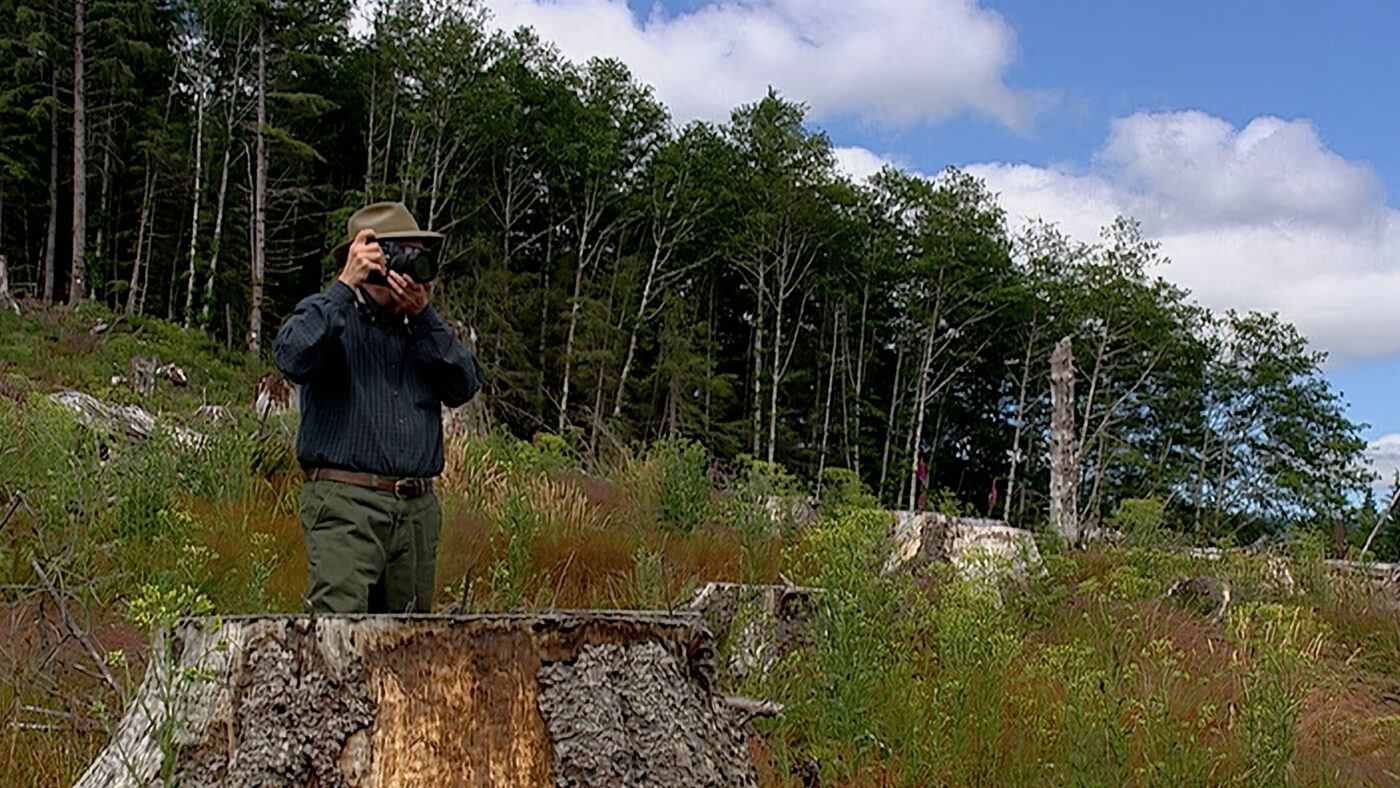
Robert Adams in “Ecology” (opens a new site)
Robert Adams discusses photographing suburban development around Colorado Springs and finding unexpected beauty in landscapes altered by human activity. The segment also considers his series Turning Back (1999–2003), made with his wife, which addresses deforestation in the American West.
Transcript (opens a new site)COMMUNITY DISCUSSION
Discuss this entry
Share interpretations, reading notes, and source-aware questions. For catalog corrections, use the feedback form below.
No discussion yet. Start the first focused conversation.
Sign in to join the discussion.
Optionally receive a digest when related photobooks are added to the catalog.
See something incorrect? Sign in to suggest a correction or report an issue.