Photographer
Berenice Abbott
Berenice Abbott (1898–1991) was a pioneering American photographer celebrated for her documentary images of New York City, her influential portraits of Parisian cultural figures, and her groundbreaking scientific photography. Born in Springfield, Ohio, Abbott studied sculpture in New York, Berlin, and Paris before turning to photography in 1923 while working as an assistant to Man Ray in his Paris studio. She quickly established herself with striking portraiture of writers, artists, and expatriates, producing some of the most iconic portraits of the interwar period.
A defining moment in Abbott’s career occurred when she encountered the work of French photographer Eugène Atget. After Atget’s death in 1927, she acquired his archive—thousands of prints and negatives—and dedicated more than forty years to preserving, cataloging, and promoting his work. Her efforts were critical in securing Atget’s place in photographic history, culminating in the acquisition of the archive by the Museum of Modern Art in 1968.
Returning to New York in 1929, Abbott embarked on her most celebrated project: a comprehensive visual record of the rapidly modernizing city. Supported by the Federal Art Project from 1935 to 1939, she produced “Changing New York,” a masterful series capturing the architectural transformation, street life, and social contrasts of the metropolis. The resulting 1939 publication remains a landmark in urban photography for its clarity, scale, and historical insight.
In the 1940s and 1950s, Abbott turned to scientific photography, working with the Physical Sciences Study Committee at MIT. Her images translated complex scientific principles—wave motion, magnetism, light phenomena—into visually compelling and accessible forms, and were widely used in physics textbooks. Throughout her career, Abbott championed straight photography: precise, detailed, and rooted in the truthful rendering of the external world. Her legacy endures as one of the 20th century’s most influential documentary photographers, shaping both the history of New York and the scientific visualization of natural phenomena.
Berenice Abbott (1898-1991) was an American photographer recognized for her black-and-white portraits of artists and writers, her extensive documentation of New York’s urban landscape during the 1930s, and her later scientific photography. She trained under Man Ray in Paris, where she photographed notable figures such as James Joyce and Coco Chanel. Her ‘Changing New York’ series, commissioned by the Federal Art Project, captured the city’s rapid transformation. Abbott also preserved and promoted the work of Eugène Atget, and her innovations in photography are foundational to modern American documentary practice.


Selected Works & Key Projects
A source-backed introduction to individual photographs and significant bodies of work.
Key projects
Project · 1926–1929
Paris Portraits
Abbott’s Paris portrait practice forms a major early body of work. MoMA records that her first solo exhibition, at Le Sacre du Printemps in Paris in 1926, presented portraits of the Parisian avant-garde, a practice she continued while living in the city. The same source identifies portraits of artists, writers, and intellectuals as central to these years. This project merits selection because it established Abbott’s independent photographic career before her New York work and produced enduring portraits of figures including James Joyce and Eugène Atget, both represented in MoMA’s collection.
View source ↗Project · 1935–1938
Changing New York
Changing New York is Abbott’s sustained documentation of New York City under the Works Progress Administration, made from 1935 to 1938. NYPL describes its archive as more than 2,200 duplicate and variant prints corresponding to roughly three-quarters of the 302 photographs in Abbott’s definitive version; the holdings encompass architecture and street life in all five boroughs, chiefly Manhattan. The project deserves selection because its scale and systematic urban scope turn individual views into a historical record of a city in architectural transition. A 1939 book of 100 project images extended that record to a publication audience.
View source ↗Project · 1958–1960
Physics Photographs for the Physical Science Study Committee
From 1958 to 1960 Abbott worked with the Physical Science Study Committee at MIT, producing photographs for a program intended to reform high-school physics teaching. This late project is essential because it redirected her precise photographic method toward visual explanation of physical phenomena. Smithsonian documentation notes that she devised apparatus and techniques when existing equipment did not provide the needed results. The photographs therefore represent more than illustrations: they join photographic invention, stop-motion and scientific pedagogy. MIT later opened its photography gallery with an exhibition of 75 Abbott photographs titled Photography and Science: An Essential Unity.
View source ↗Selected photographs
1928 · Paris, France
James Joyce
This 1928 gelatin silver print is Abbott’s portrait of James Joyce. MoMA identifies Joyce as the sitter and holds the work in its Photography Department. It merits selection from Abbott’s Paris portraits because it joins her work to one of the best-known writers of the twentieth century while also documenting the professional sphere in which her portrait practice developed. MoMA included the photograph in its exhibitions Twentieth Century Portraits (1942–43) and Portraits (1943), confirming its early institutional use as a representative example of photographic portraiture.
Work source ↗1927 · Paris, France
Eugene Atget
Abbott made this gelatin silver portrait of Eugène Atget in 1927; MoMA identifies Atget as the sitter and dates the work to that year. It is a particularly consequential selection because MoMA’s account of Abbott’s career states that she first encountered Atget’s photographs in 1925, and that after his death she and Julien Levy acquired most of his negatives and prints and brought them to New York. The portrait thus marks a documented photographic relationship central to Abbott’s legacy. MoMA later presented it in The Work of Atget: The Art of Old Paris (1982–83).
Work source ↗
1932 · New York City, United States
Nightview, New York
Nightview, New York is a gelatin silver print dated 1932 and printed in the 1950s in the Metropolitan Museum of Art’s collection. The photograph looks down over illuminated buildings and streets, making nocturnal city light and dense architecture its visual subject. It merits selection because it condenses a central concern of Abbott’s New York photography—viewing the metropolis from a commanding, elevated position—into a single urban image. The Met classifies it as a photograph in its Department of Photographs and records its acquisition in 1970, providing a stable museum collection record for this widely reproduced city view.
Work source ↗1934 · New York City, United States
Pennsylvania Station Interior
Abbott’s Pennsylvania Station Interior is a gelatin silver print made in 1934 and printed later. NYPL states that Abbott photographed the station from several viewpoints and, in this image, emphasized its structural grandeur rather than its role as a rail terminal. The work is significant within her New York photographs because the station was demolished beginning in 1963; NYPL notes that its loss helped catalyze the 1965 New York Landmarks Law. Abbott’s photograph therefore functions both as a rigorous study of Beaux-Arts space and as a visual record of a major vanished New York structure.
Work source ↗1936 · Manhattan, New York City, United States
Fifth Avenue, Nos. 4, 6, 8, Manhattan
Made on March 20, 1936, this gelatin silver print records three numbered addresses on Fifth Avenue in Manhattan. MoMA holds the photograph in its Photography Department as part of the Thomas Walther Collection and identifies it as a work from 1930–40. It merits selection because it was reproduced as plate 48 in Abbott and Elizabeth McCausland’s 1939 book Changing New York, directly linking one precise street view to the project’s published form. MoMA also included it in its 1939 anniversary exhibition and in Modern Photographs from the Thomas Walther Collection, 1909–1949 (2014–15).
Work source ↗-
1898
Career milestone
Born in Springfield, Ohio
Berenice Abbott was born in Springfield, Ohio. The New York State Museum places this origin at the beginning of a career that later moved from New York and Paris portraiture to sustained photographic studies of urban change and scientific phenomena.
Source: The New York State Museum, “About Abbott” Verified Sep 5, 2026
-
1921
Education
Moves from New York to Paris
In 1921, Abbott left New York for Paris, where she pursued sculpture and dance. This move placed her in the Parisian artistic milieu in which photography became her principal medium and established the European chapter that preceded her New York documentary work.
Source: The New York State Museum, “About Abbott” Verified Sep 5, 2026
-
1923–1926
Career milestone
Works as Man Ray’s darkroom assistant
Abbott worked as Man Ray’s darkroom assistant in Paris from 1923 to 1926. The museum account identifies this period as the time in which she developed photographic skill; she subsequently left the studio, opened her own practice, and gained a reputation as a portrait photographer.
Source: The New York State Museum, “About Abbott” Verified Sep 5, 2026
-
1926
Exhibition
First solo exhibition in Paris
Abbott’s first solo exhibition was held at Galerie Le Sacre du Printemps in Paris in 1926. MoMA states that it presented portraits of members of the Parisian avant-garde, marking the public launch of the portrait practice she continued during her Paris years.
Source: Museum of Modern Art, “Berenice Abbott | Object:Photo” Verified Sep 5, 2026
-
Fall 1928
Collection acquisition
Acquires most of Eugène Atget’s archive with Julien Levy
In fall 1928, Abbott and dealer Julien Levy bought most of Eugène Atget’s negatives and prints. MoMA describes Abbott’s initiative as preserving the late photographer’s studio archive and making Atget’s influence on the avant-garde an important part of her own legacy.
Source: Museum of Modern Art, “Berenice Abbott | Object:Photo” Verified Sep 5, 2026
-
January 1929
Series
Returns to New York and makes the New York album
Abbott returned to New York in January 1929 after eight years in Europe. The Metropolitan Museum of Art identifies her album of 266 small black-and-white prints as a turning point from Paris portraiture to urban documentation, a direction that culminated in Changing New York.
Source: The Metropolitan Museum of Art, “Berenice Abbott’s New York Album, 1929” Verified Sep 5, 2026
-
1935–1939
Series
Federal Art Project support for Changing New York
The Works Progress Administration’s Federal Art Project supported Abbott’s Changing New York project from 1935 to 1939. MoMA states that the documentary series began on the eve of the Great Depression and records the city’s rapidly changing built landscape; this backing enabled its wider public presentation.
Source: Museum of Modern Art, “Berenice Abbott | Object:Photo” Verified Sep 5, 2026
-
1939
Photobook
Changing New York appears as a travelling exhibition and publication
In 1939, Changing New York debuted as both a travelling exhibition and a publication. MoMA links this presentation to the Federal Art Project-supported city series, establishing the project in a durable exhibition-and-book form rather than leaving it solely as an unpublished documentary campaign.
Source: Museum of Modern Art, “Berenice Abbott | Object:Photo” Verified Sep 5, 2026
-
1958
Career milestone
Joins MIT to illustrate physics publications
In 1958, the Massachusetts Institute of Technology hired Abbott to illustrate an innovative physics textbook and a series of popular books. The appointment followed her long effort to devise photographs that visualized phenomena including gravity and kinetic energy, extending her practice beyond urban documentation.
Source: The New York State Museum, “About Abbott” Verified Sep 5, 2026
-
1961
Career milestone
Leaves New York and retires to Maine
In 1961, health reasons compelled Abbott to leave New York; she retired to Maine. The New York State Museum records that she lived there until age ninety-three, situating Maine as the final long-term setting of her life and career.
Source: The New York State Museum, “About Abbott” Verified Sep 5, 2026
-
1991
Career milestone
Dies in Monson, Maine
Abbott died in Monson, Maine, in 1991. The U.S. Department of State’s Art in Embassies biography records her death there, closing a career that included Paris portraiture, New York urban documentation, and photographic work related to physics.
Source: U.S. Department of State, Art in Embassies, “Berenice Abbott” Verified Sep 5, 2026
Other relationship
Eugène Atget
In 1927, Berenice Abbott purchased the negatives and prints of Eugène Atget from his assistant, preserving his archive and actively promoting his work through exhibitions and publications. Her efforts were pivotal in establishing Atget’s posthumous reputation as a master of documentary photography, connecting his detailed street scenes of old Paris to the modern avant-garde. Abbott later sold the collection to the Museum of Modern Art, ensuring its institutional preservation and scholarly accessibility, a decisive act in canonizing Atget within photographic history.
Verified 2026-09-05Wikipedia
Influence & affinity
Man Ray
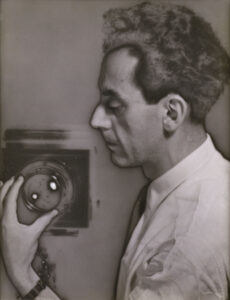
From 1923 to 1925, Berenice Abbott worked as an assistant in Man Ray’s Paris studio, learning the technical skills of studio photography while absorbing his experimental approach to the medium. Though their formal collaboration was brief, Abbott’s early portraits of interwar cultural figures were shaped by the precision and modernist sensibility she observed under his guidance. The exposure broadened her artistic vocabulary and encouraged her independent practice, leading to her own decisive documentary and scientific investigations later in her career.
Verified 2026-09-05Wikipedia
Berenice Abbott | National Museum of Women in the Arts (opens a new site)
Artist profile from NMWA, offering an overview of Abbott's contributions as a female photographer and featuring examples from her oeuvre, with emphasis on her urban landscape photographs.
Berenice Abbott | International Center of Photography (opens a new site)
Archive page from ICP's collection, documenting Abbott's role as a photographer and her association with the Photo League. It highlights selected prints from her major series.
Berenice Abbott – Wikipedia (opens a new site)
A comprehensive encyclopedia entry on the American photographer Berenice Abbott, outlining her time as a sculptor in Paris, apprenticeship with Man Ray, portraiture of literary figures, and the Changing New York series that documented the city's architecture and street life, plus later scientific photographs.
COMMUNITY DISCUSSION
Discuss this entry
Share interpretations, reading notes, and source-aware questions. For catalog corrections, use the feedback form below.
No discussion yet. Start the first focused conversation.
Sign in to join the discussion.
Optionally receive a digest when related photobooks are added to the catalog.
See something incorrect? Sign in to suggest a correction or report an issue.