Photographer
Leo Rubinfien
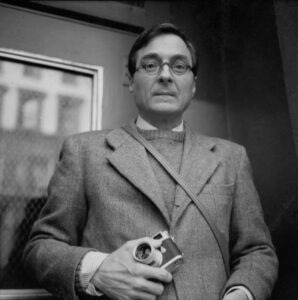
Leo Rubinfien (born 1953) is an American photographer and essayist based in New York City. Raised partly in Japan, he arrived at Reed College from Tokyo in 1970, an early immersion in Asian life that would shape his mature practice. Working largely in color, Rubinfien has spent decades photographing the urban and social landscapes of Asia and the United States, focusing on how globalizing forces transform everyday experience. His dual role as a writer and photographer is unusual; he writes essays that contextualize his images, treating photography as a form of sustained cultural inquiry rather than detached observation.
Rubinfien’s visual language is marked by a careful, methodical attention to the fleeting collisions of modernity and tradition. Rather than chasing the exotic or the spectacular, he seeks out ambiguous moments in streets, markets, and public spaces, often in Beijing, Tokyo, Bangkok, or New York. His work shares affinities with the New Color movement of the 1970s and 1980s, yet his photographs are less about bold chromatic gestures than about psychological nuance and the quiet weight of history pressing on the present. He has described his pictures as belonging to a larger global narrative, each frame a fragment of a vast interconnected story.
His first landmark book, A Map of the East (1992), distilled a decade of photographs made across China and Southeast Asia. The book established him as a singular voice at a moment when the region was undergoing dramatic economic and social change. A later project, Waking Up in New York City (2005), addressed the aftermath of September 11, 2001, documenting the city’s emotional and physical wounds with an intimate, street-level gaze. More recently, his book Wounds of the Real (2018) explored themes of loss and collective memory. These publications, created with notable editorial rigor, demonstrate his commitment to the photobook as a contemplative medium.
Exhibitions at Fraenkel Gallery, Steven Kasher Gallery, Taka Ishii Gallery, and the Cooley Gallery at Reed College, as well as inclusion in SFMOMA’s collections and discussions, have kept his work in institutional view. He has also participated in public conversations and podcasts, including a Stanford-hosted video talk and the Real Photo Show, where he elaborated on his working methods and artistic philosophy. While critical reception has been generally respectful, some reviews, such as an Artforum piece, have noted that the breadth of his gallery shows can at times dilute the impact of his strongest images, suggesting a body of work that rewards selective encounter.
For photobook collectors, Rubinfien offers a distinctive entry point into late-twentieth-century color documentary practice. His volumes are thoughtfully sequenced and designed, often published by smaller presses or museums, and pair his photographs with his own incisive essays. A Map of the East remains a touchstone for understanding how a Western photographer navigated a transforming Asia without falling into cliché; Waking Up in New York City provides a somber counterpoint in his oeuvre. Collectors interested in the intersection of photography, writing, and global urbanism will find his books intellectually substantial and visually rewarding.
〔PBL-BIO/2〕
Leo Rubinfien (born 1953) is an American photographer known for his color images of public spaces, especially urban scenes in Asia and the United States. He studied with Garry Winogrand and emerged in the 1970s as part of the generation that expanded color photography beyond commercial contexts. His work often examines the interplay of people and environments, earning him a Guggenheim Fellowship in 1983. He later taught at Yale University and other institutions.


Selected Works & Key Projects
A source-backed introduction to individual photographs and significant bodies of work.
Key projects

Project · 1992
A Map of the East
Published in 1992, A Map of the East is one of Rubinfien’s principal bodies of work. The Whitney characterizes it as an exploration of the character and idiosyncrasies of Japan, China, and Southeast Asia. Its importance within his oeuvre is also demonstrated by the Metropolitan Museum of Art’s 1992 master portfolio and by individual photographs in the Museum of Fine Arts, Houston collection. The project merits selection because it gives a sustained, geographically wide framework for Rubinfien’s photographs made across Asia rather than presenting a single isolated image.
View source ↗
Project · 2014
New Turns in Old Roads
New Turns in Old Roads was published by Taka Ishii Gallery Photography / Film in Tokyo in 2014 as a 130-page hardcover containing 60 illustrations and an essay by Rubinfien in English and Japanese. Taka Ishii Gallery identifies a 1980 photograph made at the Yaumatei typhoon shelter in Kowloon, Hong Kong, as belonging to the series. The gallery also describes Rubinfien’s photographs of world cities as intimate, humane, and closely attentive to detail. This project merits selection as a later book-length articulation of that city-focused strand of his work, presented through a substantial bilingual publication.
View source ↗Selected photographs
1984 · Miyajima
A Cherry Blossom Picnic in a Grove, Miyajima
Made in 1984 and printed in 2019, this inkjet print with applied coating is catalogued by the Museum of Fine Arts, Houston as part of A Map of the East. MFAH records it as a museum purchase funded by Photo Forum 2019 and Joan Morgenstern, and documents exhibitions of other prints at the Metropolitan Museum of Art, Seibu Art Forum in Tokyo, the Cleveland Museum of Art, and the Seattle Art Museum. It is selected as a named, institutionally collected example of the project’s Asian photographs and because its exhibition record evidences sustained public presentation of this image in the larger series.
Work source ↗1982 · Kenceran Beach, Surabaya
On the Breakwater at Kenceran Beach, Surabaya, Idul Fitri
This 1982 photograph, printed in 2019, is an inkjet print with applied coating in the Museum of Fine Arts, Houston. MFAH identifies it as from A Map of the East, records it as a gift of an anonymous donor, and preserves the artist’s dated inscription and edition number, 8/15. The work merits inclusion as an early, specifically located entry in Rubinfien’s principal Asian project. Its museum catalogue supplies a direct connection between the individual image, the larger series, and a public collection, making it a dependable representative work rather than an unverified title from a checklist.
Work source ↗1984 · Chungking
A View from a Bridge, Chungking
A View from a Bridge, Chungking was made in 1984 and printed in 2019. The Museum of Fine Arts, Houston catalogues the inkjet print with applied coating as part of A Map of the East and cites its publication in Rubinfien’s 1992 book A Map of the East, page 53. The museum received the print as an anonymous gift in 2019. This is a particularly useful selection from the project because the catalogue documents both its series membership and its inclusion in the project’s book, connecting the individual photograph to the work’s published form as well as to an institutional collection.
Work source ↗2006 · Colombo, Sri Lanka
Colombo, 2006, in Main Street, the Pettah
This 2006 inkjet print is catalogued by the Museum of Fine Arts, Houston as Colombo, Sri Lanka, and as part of Wounded Cities. The museum records dimensions of 33 1/2 by 41 inches for the image, a 2009 gift from Jane Mayer and William Hamilton, and an inscription identifying the work as from the series. It is selected because it gives a precisely dated and located individual case within Rubinfien’s project on cities affected by terror attacks. Its large format and museum acquisition make the photograph a well-documented public-collection representative of the wider body of work.
Work source ↗2007 · Tel Aviv
Tel Aviv, 2007, at Allenby and Sheinkin Streets
Tel Aviv, 2007, at Allenby and Sheinkin Streets is a 2007 photograph printed in 2014 and held by the National Gallery of Art as an inkjet print. NGA associates it with Wounded Cities, a group of 100 works under that title, and records its 2018 acquisition as an anonymous gift. The artist’s inscription on the verso identifies the title, place, year, and edition number, 4/7. This photograph merits selection because it is a specifically catalogued Tel Aviv component of the broader project, held by a national museum and directly linked there to the series’ substantial associated group.
Work source ↗-
1975
Education
Bachelor of Arts, University of Chicago
Rubinfien completed his undergraduate degree at the University of Chicago, where he was first drawn to photography and developed the intellectual curiosity that would later inform his street-based, psychologically rich images. This liberal arts foundation marked the beginning of his formal engagement with the medium, leading to his subsequent graduate studies in art.
Source: Wikipedia Verified Sep 5, 2026
-
1977
Education
Master of Fine Arts, Yale University
Rubinfien received his MFA from the Yale University School of Art, one of the most prestigious graduate programs in the country. His training at Yale refined his technical skills and encouraged a rigorous conceptual approach. This period solidified his dedication to making photographs that probe urban life and human emotions, a hallmark of his mature style.
Source: Wikipedia Verified Sep 5, 2026
-
1982
Award
Guggenheim Fellowship
Rubinfien was awarded a fellowship from the John Simon Guggenheim Memorial Foundation, which recognized his early promise as an independent photographer. This prestigious grant provided crucial support for his ongoing documentary and street projects, allowing him to travel extensively, especially in Asia, where he would later produce his landmark publication. The fellowship cemented his standing among emerging American artists.
Source: Wikipedia Verified Sep 5, 2026
-
1992
Series
Publication of "A Map of the East"
Rubinfien's first major monograph, "A Map of the East," was published by Aperture. Spanning a decade of photography in East and Southeast Asia, the book compiles portraits, cityscapes, and intimate scenes that reveal the physical and psychological traces of rapid modernization. It became a touchstone in contemporary street photography, celebrated for its quiet empathy and formal precision. The work solidified Rubinfien's reputation internationally and remains his most influential project.
Source: Aperture Verified Sep 5, 2026
-
1993
Exhibition
Exhibition at the San Francisco Museum of Modern Art
In 1993, the San Francisco Museum of Modern Art presented an exhibition of photographs from "A Map of the East," giving Rubinfien's work a major museum platform. This institutional showcase brought his Asian street photography to a broad American audience, affirming his position as a significant contemporary practitioner. It also stimulated scholarly discussion about cross-cultural representation and the documentary potential of street photography.
Source: SFMOMA Verified Sep 5, 2026
-
2001–2002
Series
Creation of "The Wounded City"
Following the September 11 attacks on New York, Rubinfien began photographing the city to document the collective grief and disorientation. The resulting series, "The Wounded City," moves beyond literal ruins, instead focusing on empty streets, dust-covered surfaces, and somber human portraits. This project is praised for its restraint and psychological depth, offering a subtle yet profound meditation on urban trauma. It stands as a major contribution to post-9/11 visual discourse.
Source: Wikipedia Verified Sep 5, 2026
-
2003
Photobook
Publication of "The Wounded City"
The photo book "The Wounded City" was published in 2003, compiling Rubinfien's post-9/11 photographs. Unlike typical war or disaster photojournalism, the book presents quiet, often desolate scenes that convey a sense of suspended time and communal hurt. It received international attention and is now considered an essential response to the attacks from an artist's perspective. The work demonstrates Rubinfien's ability to transform personal observation into lasting visual testimony.
Source: Wikipedia Verified Sep 5, 2026
Collection
Museum of Modern Art (MoMA)
MoMA holds original prints by Leo Rubinfien in its permanent collection, confirming his recognition within the institutional history of contemporary American photography.
Verified 2026-09-05Wikipedia
Collection
Metropolitan Museum of Art
The Metropolitan Museum of Art includes Rubinfien's work in its collection, marking his standing in established art and photographic history collections.
Verified 2026-09-05Wikipedia
Thomas Roma and Leo Rubinfien with Sara Christoph (opens a new site)
This Brooklyn Rail conversation places Rubinfien alongside Thomas Roma in a discussion of city-street photography, portraiture, photographic ethics, editing, and trauma. Rubinfien addresses the influence and difference of Garry Winogrand’s practice, his experience of September 11, 2001, and the limits he felt photography encountered after the attacks. The exchange is especially valuable for his articulated view of photographs as interpretive rather than transparent records.
My Asian Road (opens a new site)
Rubinfien’s New York Review of Books essay was adapted from the introduction to his book New Turns in Old Roads. He recounts returning to Tokyo to photograph and traveling through China and Southeast Asia, reflecting on walking, looking, solitude, and the possibility that ordinary scenes can exceed their immediate appearance. It is a direct account of the experiential basis of his Asian photographs.
Leo Rubinfien: How Do You Photograph a Psychological Wound? (opens a new site)
In this SFMOMA artist interview, Rubinfien recounts living in lower Manhattan during the September 11 attacks and discusses Wounded Cities, his 2008 book project. The museum describes the project as an attempt to photograph the psychological wounds caused by violence in cities around the world. It is a concise first-person introduction to the premises behind the series.
Garry Winogrand at Jeu de Paume (opens a new site)
Released in connection with the Jeu de Paume retrospective of Garry Winogrand, this short Fraenkel Gallery video features curators Erin O’Toole and Leo Rubinfien. They address Winogrand’s early career, photographic philosophy, later Los Angeles work, and the negatives left behind at his death. It documents Rubinfien’s curatorial and scholarly engagement with Winogrand, rather than concentrating on Rubinfien’s own photographs.
Artcast March 2009 (opens a new site)
This SFMOMA Artcast episode includes Rubinfien discussing the personal narrative behind Wounded Cities. The museum describes the series as portraying residents of places that had recently experienced terrorist attacks. Presented within a program on politics, history, and individual lives, the recording provides institutional context for the series and an accessible account of the project from the photographer.
COMMUNITY DISCUSSION
Discuss this entry
Share interpretations, reading notes, and source-aware questions. For catalog corrections, use the feedback form below.
No discussion yet. Start the first focused conversation.
Sign in to join the discussion.
Optionally receive a digest when related photobooks are added to the catalog.
See something incorrect? Sign in to suggest a correction or report an issue.