Photographer
Bruce Gilden
Bruce Gilden (born 1946) is an American street photographer whose work is closely associated with New York City, where he was born in Brooklyn. He has been a member of Magnum Photos since 1998, and his career sits within the documentary and street-photography traditions while pushing their methods toward a deliberately confrontational extreme. His approach is instantly recognizable and has made him one of the more debated figures in contemporary photography.
Gilden’s signature method is the use of a flashgun at very close range, often catching people mid-stride on the sidewalk. The resulting pictures are harshly lit, tightly cropped, and frequently framed so that a face or torso fills the image. The flash flattens depth and isolates the subject from the surrounding street, producing an intensity that differs from the more observational, distance-respecting mode of many of his peers. Rather than waiting for a decisive moment to resolve itself, he works aggressively within the crowd, treating the street as a stage of abrupt encounters.
His published books have been central to how this work is received. Gilden has had various books of his work published, and his monographs function as sequences rather than loose portfolios, allowing viewers to see how the flash aesthetic accumulates across a series. He has received the European Publishers Award for Photography and is a Guggenheim Fellow, recognition that has helped bring his work to a wider international audience. These honours are part of the record, but they are secondary to the visual argument his photographs make about proximity, class, and urban life.
Historically, Gilden belongs to a lineage of New York photographers who used the street as raw material, yet his flash-driven close-ups mark a departure from the quieter humanism often associated with that lineage. His pictures raise uncomfortable questions about consent, intrusion, and the ethics of photographing strangers without their participation. Critics have questioned whether the work exposes or exploits its subjects; supporters argue that the intensity is precisely what makes the photographs honest about the friction of city life. This tension, rather than resolving it, is what keeps the work relevant.
For photobook collectors, Gilden’s monographs are the most coherent way to encounter the images, since their editing and sequencing shape the aggressive rhythm of the flash work in ways that single pictures cannot. Readers approaching him for the first time should look for a collection that represents his New York street photography, then compare it with later projects to see how the same visual grammar is applied in different settings. Because editions, publishers, and reprints vary, checking a reliable bibliography is advisable before buying.
Bruce Gilden was born in Brooklyn, New York, in 1946. He briefly attended Penn State University, then bought a camera in 1967 after considering acting; he also took evening classes at New York’s School of Visual Arts. His official biography describes him as substantially self-taught. It identifies a practice marked by direct, flash-lit photographs of passers-by, first in black and white and later in color. Gilden joined Magnum Photos in 1998 and has received fellowships and grants including National Endowment for the Arts fellowships and a 2013 Guggenheim Fellowship.
Magnum Photos presents Bruce Gilden as a street photographer whose graphic, often confrontational flash close-ups are central to his visual identity. The agency emphasizes the intimacy and directness produced by this close working distance, quoting Gilden’s own description of moving ever nearer to his subjects. It situates his beginnings in the sidewalks of New York City, where he grew up, while documenting substantial bodies of work made in Haiti, Japan, Moscow, France, Ireland, and India. This account frames his career around a sustained approach to close-range street portraiture across multiple places.


Selected Works & Key Projects
A source-backed introduction to individual photographs and significant bodies of work.
Key projects
Project · 1984
Haiti
Gilden began working in Haiti in 1984, initially drawn to Vodou places, rites and beliefs. The resulting long-term body of work ranges across everyday life, markets, nightlife, funerals, history and terrain, according to the publisher’s description of the later expanded volume. It merits selection as a major project because the first monograph drawn from the series was published in 1996 and received the European Publishers Award for Photography. The 2023 edition adds many previously unpublished photographs, demonstrating both the project’s continued editorial life and the breadth of Gilden’s sustained engagement with Haiti.
View source ↗Project
Coney Island
Coney Island was Gilden’s first major project, worked on through 1986. Magnum’s book description places its origin in the late 1960s, when he traveled by subway through Brooklyn to photograph sunbathers, weekend visitors, sideshow booths and the Cyclone roller coaster. The project merits selection because it establishes an early and sustained encounter with a celebrated photographic subject while concentrating on the park’s people and eccentricities. Its 2002 Trebruk book gives this early body of work a durable monographic form rather than treating the pictures as isolated street scenes.
View source ↗Project
Go
Go is Gilden’s book-length project on Japan, photographed in Tokyo and Osaka. Its stated premise was to look beneath what Gilden characterized as a public “mask of uniformity” and find people who stood apart physically and psychologically. The work brings together homeless people, day workers, Yakuza, right-wing nationalists and bosozoku. It merits selection because its subject is not Japan in general but a deliberately chosen set of communities that counters conventional visual expectations of Japanese society. The project also extends Gilden’s close, flash-accented and confrontational approach beyond New York into a distinct social setting.
View source ↗Selected photographs
1982 · Coney Island, New York City, USA
Coney Island, New York City, USA, 1982
This 1982 Coney Island photograph is individually identified by Magnum as a signed gelatin-silver fine print, in two limited edition sizes. It merits selection because its exact date and place locate one single image within Gilden’s first major project, a body of work made through 1986 around the people of the renowned Brooklyn beach and amusement district. Rather than assigning unverified subject matter to the frame, this record foregrounds what the sources establish: its place in his formative Coney Island period, its continuing availability as a designated fine print, and its connection to a project later consolidated in a 2002 monograph.
Work source ↗1984 · Little Italy, Manhattan, New York City, USA
Feast of San Gennaro, New York City, 1984
This photograph was made at the Feast of San Gennaro in 1984, in Manhattan’s Little Italy. Gilden did not give his photographs formal titles, but he called this image “Best Street,” saying that he did not think he could make a better New York street picture. That direct statement makes it an especially well-supported selection among his individual works. Magnum describes a crowded, frenetic scene, and offers the image as an archival pigment print bearing a Magnum stamp. It is therefore a concise entry point to Gilden’s New York street work and to the standard he himself assigned to one photograph.
Work source ↗1984 · Fifth Avenue, New York City, USA
Fifth Avenue, New York City, USA, 1984
Magnum identifies this work as a signed gelatin-silver photograph made on Fifth Avenue in 1984, issued in limited editions at two print sizes. It merits inclusion as a precisely located example from Gilden’s New York street practice during the period when he had already been working on the city’s streets since 1981. The source characterizes his broader method through graphic, close and often confrontational flash pictures marked by directness and intimacy. This individual print is useful because it anchors those documented characteristics to a specific Manhattan address, year and collectible photographic object without adding unsupported claims about its pictured subject.
Work source ↗1986 · New York City, USA
New York City, USA, 1986
This signed gelatin-silver fine print is catalogued by Magnum as made in New York City in 1986 and issued in limited editions. It merits selection as a dated single work from the closing year of Gilden’s first major Coney Island project, while also belonging to his broader New York practice, which began in 1981. Magnum identifies graphic, flash-lit close-ups, intimacy and directness as defining qualities of that practice. Although the source does not identify the pictured subject or a series title, the work remains a useful catalog record: it preserves reliable object information and a specific date within the formative period of Gilden’s sustained work in the city.
Work source ↗1992 · Fifth Avenue, New York City, USA
Fifth Avenue, New York City, USA, 1992
Magnum catalogues this work as a signed gelatin-silver fine print made on Fifth Avenue in 1992, with two limited edition formats. Its date coincides with the publication year of Facing New York, the project that Magnum’s archive describes as the culmination of Gilden’s New York street work begun in 1981. That chronology makes this print a meaningful selection: it identifies a specific image from the same year that his city practice achieved book form. The source does not connect the photograph explicitly to that book, so the record does not claim such inclusion; its significance rests on its precise date, location and position in that documented career moment.
Work source ↗-
1946
Career milestone
Born in Brooklyn, New York
Bruce Gilden was born in Brooklyn, New York, the borough whose sidewalks, crowds and street life became the recurring subject of his photography. Growing up in New York shaped a practice built on walking at close range among strangers with a camera, a method he sustained across decades of work.
Source: Wikipedia Verified Oct 4, 2026
-
1968
Education
Turn to photography after seeing Blowup; studies at the School of Visual Arts
Gilden studied sociology at Pennsylvania State University before turning to photography. After seeing Michelangelo Antonioni's film Blowup he decided to become a photographer and enrolled at the School of Visual Arts in New York, where his formal training in the medium began and from which his later street practice developed.
Source: Wikipedia Verified Oct 4, 2026
-
1988
Representation
Joins Magnum Photos as a nominee
Gilden began his association with Magnum Photos as a nominee in 1988, entering the member-run photographic co-operative at its first stage of membership. This marked the start of a long institutional relationship that placed his street work within the agency framework built by photographers such as Henri Cartier-Bresson and Robert Capa.
Source: Wikipedia Verified Oct 4, 2026
-
1992
Photobook
Facing New York published
Facing New York, Gilden's first major book, collected the close-range, hard-flash street pictures he made in his home city. Its confrontational framing — subjects caught at very close distance with camera and flash — defined the visual signature he is known for and established him as one of the most debated street photographers of his generation, at a moment when documentary photography was reconsidering its relationship to its subjects.
Source: Wikipedia Verified Oct 4, 2026
-
1992
Representation
Becomes associate member of Magnum Photos
Gilden advanced to associate member of Magnum Photos in 1992, the intermediate stage between nominee and full membership. The step reflected the agency's recognition of his long-term projects in New York and abroad and gave his work the distribution and editorial reach of the co-operative's international network.
Source: Wikipedia Verified Oct 4, 2026
-
1998
Representation
Full member of Magnum Photos
Gilden became a full member of Magnum Photos in 1998, completing a decade-long progression through the agency's nominee and associate stages. Full membership confirmed his standing within the documentary tradition and allowed his street work, including continued projects in New York, to circulate through one of photography's most established international institutions.
Source: Wikipedia Verified Oct 4, 2026
Representation
Magnum Photos
Magnum Photos is the photographer-owned cooperative that lists Bruce Gilden as one of its members and acts as the main institutional channel for his work: it hosts his biography and picture selection, licenses his images for editorial use, and sells prints. Because Gilden works largely on self-directed street projects rather than for a single newspaper or magazine, his Magnum affiliation is the clearest documented record of who represents, distributes and archives his photographs, and it is the source for the agency's own chronology of his career.
Verified 2026-10-04Magnum Photos
Foundation
John Simon Guggenheim Memorial Foundation
The John Simon Guggenheim Memorial Foundation awarded Bruce Gilden a Guggenheim Fellowship, a grant given to support a photographer's own proposed project rather than a commissioned assignment. The fellowship listing is the foundation's official record of that award and evidences institutional recognition of his long-term personal practice, distinguishing peer-reviewed grant support from gallery or agency representation and giving a verifiable link between Gilden and a major American arts funding body.
Verified 2026-10-04John Simon Guggenheim Memorial Foundation
Bruce Gilden Takes Street Photos Like You’ve Never Seen Before (opens a new site)
In this VICE Loves Magnum interview, Gilden discusses his understanding of street photography, close working distance and flash, personal risk, Haiti, Japan, and his Foreclosures project. The conversation is especially useful for his own account of how comfort, intuition, framing, and emotional content inform his practice.
‘No Place Like Home: Foreclosures in America’ by Bruce Gilden (opens a new site)
TIME examines Gilden’s Foreclosures series, begun in 2008 and expanded from Florida to other states. It records his stated shift toward a more direct, photojournalistic project about foreclosed homes and people affected by the housing crisis, and notes its presentation at Photoville 2012 through the Magnum Foundation.
A Short Interview with Bruce Gilden (opens a new site)
This short Vimeo interview presents Gilden discussing two central parts of his working process: making photographs and printing them. The page identifies him as a Magnum photographer, and the video offers a direct primary-source complement to written profiles of his approach.
In Conversation | with Magnum Photos’ Bruce Gilden on Street Photography (opens a new site)
Wex Photo Video’s interview follows Gilden in Manhattan and has him reflect on work made in New York during the 1980s. Its stated focus is his approach to candid, unfiltered street photographs, making it a concise contemporary introduction to the practice for which he is widely recognized.
Bruce Gilden’s Take on the Meaning of Photography (opens a new site)
TIME’s First Take video features Gilden reflecting on the art and craft of photography and the process behind his candid, sometimes controversial portraits. He relates his pictures to his own perspective, so the resource is useful for hearing him articulate authorship and personal investment in the work.
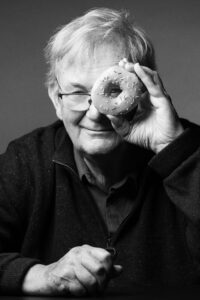
Martin Parr
Shared publisher: Dewi Lewis Publishing, GOST Books
21 photobook(s) in the library
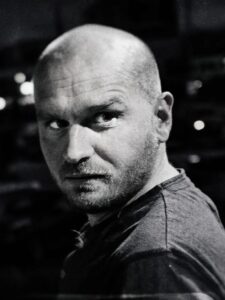
Jacob Aue Sobol
Shared publisher: Dewi Lewis Publishing, SUPER LABO
4 photobook(s) in the library
Nik Roche
Shared publisher: Dewi Lewis Publishing, Setanta Books
2 photobook(s) in the library
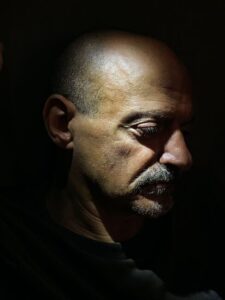
Antoine D'Agata
Shared publisher: SUPER LABO
22 photobook(s) in the library
COMMUNITY DISCUSSION
Discuss this entry
Share interpretations, reading notes, and source-aware questions. For catalog corrections, use the feedback form below.
No discussion yet. Start the first focused conversation.
Sign in to join the discussion.
Optionally receive a digest when related photobooks are added to the catalog.
See something incorrect? Sign in to suggest a correction or report an issue.