Photographer
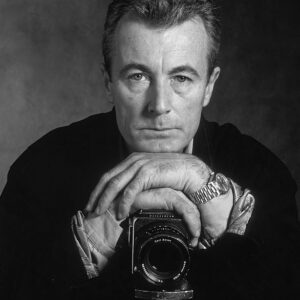
Raymond Cauchetier
Raymond Cauchetier was a French photographer whose most consequential work was made on the sets of French New Wave films. Born in 1920 and active as a set photographer from 1959 to 1968, he worked at a moment when a younger generation of French directors was reshaping cinematic form and production culture. He died in 2021. His pictures have since become an important visual record of the New Wave at its formative stage, preserving not only the appearance of particular productions but also the atmosphere of a cinema in transition.
Rather than functioning simply as promotional stills, Cauchetier’s photographs preserve the practical and social conditions around filmmaking. They show directors at work, performers between takes, crews, locations, and the informal working methods associated with a cinema made outside more conventional studio routines. His vantage point gives the images a double status. They document films and their makers, while also standing as photographs with their own account of gesture, concentration, collaboration, and the charged interval between rehearsal and the finished screen image.
His principal body of work is the set photography he made across many French New Wave productions between 1959 and 1968. The significance of this sustained assignment lies in its breadth: it records not only individual shoots but also directors at the beginnings of their careers and a changing production environment. Cauchetier’s archive is therefore useful to both film history and photographic history. It complicates any strict division between behind-the-scenes documentation and autonomous visual work, since the images are attentive to composition, movement, space, and human presence as well as to the films they helped publicize.
A 2009 Aperture profile went further, describing Cauchetier’s photographs as central works of the New Wave itself. That assessment emphasizes their role in shaping memory of the movement, not merely illustrating it after the fact. Cauchetier’s importance rests in his unusual proximity to a period often discussed through its finished films. His images offer another way to understand the era: through bodies at work, spatial arrangements on set, and contingent processes that conventional film publicity can conceal.
For photobook collectors and readers, Cauchetier’s work merits attention less as celebrity imagery than as a coherent photographic account of filmmaking in transition. Its value lies in the sustained encounter between documentary purpose and independent visual sensitivity. When on-set scenes, portraits, and working details are encountered in book form, their sequencing can make the archive read as a parallel history of the French New Wave rather than a supplementary illustration to it. The books consequently extend the movement’s story from screen aesthetics to the people, spaces, and practical decisions through which those aesthetics were produced.
〔PBL-BIO/2〕

COMMUNITY DISCUSSION
Discuss this entry
Share interpretations, reading notes, and source-aware questions. For catalog corrections, use the feedback form below.
No discussion yet. Start the first focused conversation.
Sign in to join the discussion.
Optionally receive a digest when related photobooks are added to the catalog.
See something incorrect? Sign in to suggest a correction or report an issue.