Photographer
David Seymour
David Seymour, universally known by the pseudonym Chim, was a Polish-born photojournalist and one of the founding members of Magnum Photos. Born in Warsaw as Dawid Szymin in 1911, he grew up in a cultured Jewish family; his father was a respected Yiddish publisher. As anti-Semitism and political turbulence intensified across Europe, Seymour moved to Paris in the 1930s, where he studied and began working as a freelance photographer. From 1934 onward, assignments for publications including Paris-Soir and Regards directed his camera toward social groups often overlooked by mainstream journalism. They established the combination of photoreportage and human concern that remained central to his career.
Chim’s visual language was distinctive among his Magnum peers. Where Robert Capa pursued the urgency of the front line and Henri Cartier-Bresson the geometry of the decisive moment, Seymour’s photographs carried a quieter but persistent moral gravity. He photographed victims of conflict with tenderness without resorting to sentimentality, using light, framing, and carefully observed detail to preserve dignity amid devastation. His early images of the Spanish Civil War gave particular attention to civilians and refugees rather than only combatants, distinguishing his work from conventional war coverage. He could find symbolic details that retained documentary clarity while gathering emotional force.
His best-known body of work is Children of Europe, a series that grew from a 1947 UNESCO commission to document war-orphaned children across the continent. The photographs remain important humanitarian records of the postwar era, presenting suffering alongside the resilience of the young people he encountered. His earlier Spanish Civil War coverage, including a poignant image of a young Spanish orphan, and later projects in places such as Mexico show his sustained interest in the long-term social consequences of political upheaval. Portraits and cultural stories broadened this practice, balancing direct reportage with an interest in art and society.
Seymour’s role at Magnum was both creative and organizational. A co-founder of the cooperative, he became its president in 1954 after Capa’s death, and his editorial judgment and organizational drive helped guide the agency through its difficult formative years. His own career ended in 1956, when he was killed by an Egyptian sniper while covering the Suez Crisis, aged forty-five. His archive, including negatives once believed lost and later rediscovered in what became known as the Mexican Suitcase, continues to be studied and exhibited by major museums and cultural institutions worldwide.
For photobook collectors, Seymour’s legacy lies not only in vintage prints but also in posthumous publications that give coherent form to his archive. Essays in Photography, a 2005 monograph edited by Magnum, offers a substantial, well-produced overview, combining his images with critical texts. Catalogues connected with the Mexican Suitcase exhibition and the UNESCO children’s series provide further insight into his working methods and editorial sequencing. Because his career was short but dense, collectors generally value books with accurate reproductions and scholarly annotation over hastily produced market items. Seymour’s quiet, humane account of vulnerability remains essential to the history of socially engaged mid-century photojournalism.
〔PBL-BIO/2〕


Collaboration
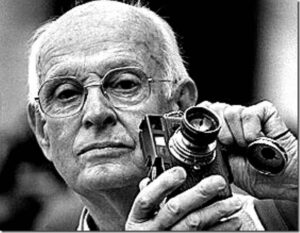
Henri Cartier-Bresson
David Seymour, known as 'Chim', was a Polish-born photographer and a founding member of Magnum Photos with Cartier-Bresson and Capa. Seymour's work on the Spanish Civil War and postwar Europe brought a social-conscious perspective that complemented Cartier-Bresson's street-oriented reportage. Their professional relationship included sharing editorial roles at Magnum and traveling on joint commissions, cementing a deep mutual influence on documentary practice.
Verified 2026-09-04Wikipedia – David Seymour

Collaboration
Robert Capa
Capa collaborated with David Seymour (known as Chim) during the Spanish Civil War and later together they co-founded Magnum Photos in 1947. Their working relationship exemplified mutual support among war photographers and was essential to the establishment of an independent photographer-run agency.
Verified 2026-09-05Magnum Photos – History
COMMUNITY DISCUSSION
Discuss this entry
Share interpretations, reading notes, and source-aware questions. For catalog corrections, use the feedback form below.
No discussion yet. Start the first focused conversation.
Sign in to join the discussion.
Optionally receive a digest when related photobooks are added to the catalog.
See something incorrect? Sign in to suggest a correction or report an issue.