Photographer
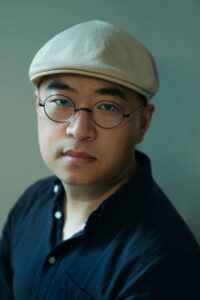
Chen Jiagang
Chen Jiagang (b. 1962, Chongqing, China) is a Chinese architect-turned-photographer. He trained in architecture and worked as a successful architect and real estate developer before stepping away from that career in 2001 to commit himself fully to photography. His trajectory from builder to image-maker gives him a distinctive point of view on the physical remnants of China’s recent past. He is perhaps best known for his large-format photographs of the decaying industrial cities created during the country’s ‘Third Front’ (三线) campaign, a Cold War–era initiative that moved strategic industries inland to the mountains, leaving behind vast, half‑abandoned settlements when the economy shifted.
Chen’s visual language is marked by a use of the large-format camera and a deliberate, painterly sense of composition. His images often present empty streets, deserted apartment blocks, theatres, and public halls, rendering socialist architecture with an eerie clarity and a melancholic atmosphere. Unlike documentary photographers who capture people in crisis, Chen almost never includes human figures; the buildings and landscapes themselves become protagonists, standing as silent witnesses to a forgotten ambition. This approach sets him apart from peers who focused on the speed of China’s urban transformation, because he chooses stillness and absence over motion and crowd.
Among his major bodies of work are series that explore the legacy of China’s Cold War industrial development, such as the ‘Third Front’ (三线) and ‘The Restless Land’ works, which are repeatedly cited in exhibition and collection contexts. Those series not only document the physical decay of military factories and residential compounds sunk into the mountains of southwestern China, but also probe the relationship between ideology, place, and memory. His photographs of abandoned cinemas, dormitories, and tunnels are both archaeological and allegorical, offering viewers a space to reflect on how national projects leave behind human ruins. These images have appeared in museum and gallery shows and in publications that range from art magazines to exhibition catalogs, helping to introduce the topic of the Third Front to an international audience.
Chen’s career developed in tandem with the rise of contemporary Chinese photography on the global stage in the 2000s. He participated in exhibitions and media profiles that positioned him as a figure linking architecture, memory, and photography. Yet as an artist he also works internationally, photographing cities such as Paris, London, and Valparaíso, and producing lyrical street and landscape imagery that shows a different, more subtle side of his practice. This duality—between the monumental ruins of China and the transitory scenes of foreign streets—gives him a broad emotional and thematic range, though critics have noted that his most committed and influential statements remain those that engage with China’s hidden histories.
For anyone collecting photobooks on contemporary Chinese photography, Chen Jiagang provides an entry point into the still-underrepresented subject of the Third Front. His published monographs and exhibition catalogs are often designed with careful sequencing, allowing the viewer to move through the empty spaces of a town in a narrative rather than merely look at isolated prints. A collector interested in the intersections between architecture, ideology, and memory would find his work indispensable; those just beginning might start with a monograph that collects his Third Front–related images, which still defines his position in the history of Chinese lens-based art.
〔PBL-BIO/2〕


COMMUNITY DISCUSSION
Discuss this entry
Share interpretations, reading notes, and source-aware questions. For catalog corrections, use the feedback form below.
No discussion yet. Start the first focused conversation.
Sign in to join the discussion.
Optionally receive a digest when related photobooks are added to the catalog.
See something incorrect? Sign in to suggest a correction or report an issue.