Photographer
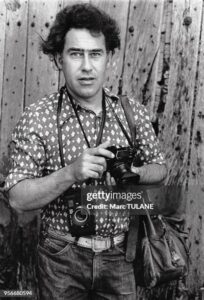
Jean-Pierre Laffont
Jean-Pierre Laffont is a French-American photojournalist born in Algeria on January 29, 1935. Growing up in Morocco, he completed his secondary and college education there, graduating in 1955. He then studied at the School of Graphic Art in Vevey, Switzerland, where he earned a master’s degree in photography. This transcontinental upbringing—shaped by North Africa, Europe, and later the United States—gave him a uniquely mobile perspective on the world, which would become central to his career as a witness to turbulent times.
Laffont’s photographic language is best described as direct, engaged, and deeply humanistic. He favored accessible, documentary-style images that often captured social tensions, political unrest, and everyday struggles. Unlike many of his contemporaries who leaned toward the iconic or the dramatic, Laffont consistently sought out the quieter, more intimate moments within large historical events. His work on child labor across twelve countries and his coverage of American civil rights and anti-war protests demonstrate his commitment to social issues, often shooting in close physical and emotional proximity to his subjects. He liked to say he photographed “in total freedom,” valuing personal autonomy over assignments or editorial constraints.
Among his major bodies of work, the photobook *Turbulent America* stands out as a landmark. Published in the late 2010s, it compiles his extensive coverage of the United States during the 1960s and 1970s—a period of profound change marked by civil rights marches, the Vietnam War protests, and countercultural movements. Another significant project is his documentation of child labor, which he pursued across multiple countries, bringing visibility to a global issue that remains urgent today. In addition, his long-running career has been surveyed in exhibitions such as “Photographing in Total Freedom,” which offered a retrospective of half a century of his work and highlighted his desire to remain independent from commercial and political pressures.
Laffont’s historical significance lies not only in the images themselves but also in his institutional contributions. He was a founding member of both Gamma and Sipa, two of the most influential photo agencies of the post-war era, which helped shape the business of photojournalism and provided a platform for many photographers. His practice bridged European and American editorial cultures, and his archive, represented by galleries such as Sous Les Etoiles Gallery in New York, continues to be exhibited and collected. He received a Lifetime Achievement in Photojournalism recognition, and his work has been honored by institutions like the French-American Foundation (FASNY).
For photobook collectors, Laffont offers a rewarding mix of historical gravitas and editorial polish. *Turbulent America*, in particular, is a well-crafted publication with a clear narrative arc, strong sequencing, and high-quality reproductions that do justice to the richness of his black-and-white prints. Its design balances documentary urgency with art-book elegance, making it an accessible entry point into his practice. For those interested in postwar social documentary and the evolution of the photo agency, Laffont’s books and portfolios provide both visual pleasure and historical insight. His work stands as a testament to the power of photography to record collective memory, and collectors who value authentic, human-centered journalism will find his legacy particularly appealing.
〔PBL-BIO/2〕



Veronique de Viguerie
Shared publisher: Editions de La Martinière
4 photobook(s) in the library

Sandro Miller
Shared publisher: G Editions
3 photobook(s) in the library
Hans Silvester
Shared publisher: Editions de La Martinière
3 photobook(s) in the library
Thomas Jorion
Shared publisher: Editions de La Martinière
3 photobook(s) in the library
COMMUNITY DISCUSSION
Discuss this entry
Share interpretations, reading notes, and source-aware questions. For catalog corrections, use the feedback form below.
No discussion yet. Start the first focused conversation.
Sign in to join the discussion.
Optionally receive a digest when related photobooks are added to the catalog.
See something incorrect? Sign in to suggest a correction or report an issue.