Photographer
Henri Cartier-Bresson
Henri Cartier-Bresson (1908–2004, France) was one of the most influential photographers of the 20th century and a founding member of Magnum Photos. He is best known for pioneering street photography and for his concept of the “decisive moment,” capturing fleeting instances with precision and clarity.
Cartier-Bresson’s work is characterized by a strong sense of composition, geometry, and timing. Working primarily in black and white with a Leica camera, he sought to capture life as it unfolded, avoiding cropping or manipulation. His photographs often reveal the poetic structure underlying everyday scenes.
His photobooks, particularly The Decisive Moment, are considered foundational in the history of photography and photobook publishing. For collectors, Cartier-Bresson’s work holds exceptional historical and artistic significance, representing a cornerstone of modern photographic practice.
Henri Cartier-Bresson was a French photographer and pioneer of street photography. Born in 1908, he studied painting before turning to photography in the early 1930s. He developed the concept of the ‘decisive moment,’ emphasizing capturing an ephemeral instant with meaning and composition. In 1947, he co-founded Magnum Photos, a cooperative photographic agency. Over his career he traveled globally, documenting major events and everyday life. He later reduced his photographic activity and returned to drawing. He died in 2004. His work has profoundly influenced photojournalism and documentary photography.

Henri Cartier-Bresson in China: 1948-1949/1958

The Extended Moment

Henri Cartier-Bresson: The Decisive Moment

Henri Cartier-Bresson: Here and Now

Henri Cartier-Bresson

Henri Cartier-Bresson: The Modern Century

Immaginare New York

Henri Cartier-Bresson: The Man, The Image, & The World: A Retrospective

An Inner Silence: The Portraits of Henri Cartier-Bresson

Mexican Notebooks 1934–1964

Henri Cartier-Bresson in India
Selected Works & Key Projects
A source-backed introduction to individual photographs and significant bodies of work.
Key projects
Project · 1952
The Decisive Moment (Images à la Sauvette)
Published in 1952 as Images à la Sauvette in France and as The Decisive Moment in the United States, this book gathered photographs from the first twenty years of Cartier-Bresson’s career. Its American title introduced the phrase that became inseparable from his work. The Fondation Henri Cartier-Bresson characterizes the book as a major photographic publication: it joins intimate interpretation to documentary observation, received strong critical acclaim, and has remained a reference for photographers. It merits selection because the book made a dispersed early practice legible as a coherent, influential photographic proposition.
View source ↗Project · 1948–1958
China, 1948–1949 | 1958
This two-part body of work began with a Life commission in November 1948 to photograph Beijing before Maoist troops arrived. Cartier-Bresson remained for ten months, working principally around Shanghai as political control changed, and returned in 1958. The Fondation describes the first stay as a seminal episode in photojournalism: the series coupled historical transition with attention to people and compositional balance rather than event alone. It was widely published in Life and other international magazines, and helped establish Cartier-Bresson as a reference point for postwar photojournalism.
View source ↗Project · 1950–1955
The Europeans
Published by Verve in 1955, The Europeans brings together 114 photographs made between 1950 and 1955 in ten European countries, many produced on assignments for Harper’s Bazaar, Life, Holiday, and Paris Match. Rather than offering an inventory or travel guide, Cartier-Bresson constructed a portrait of inhabitants of a continent rebuilding after war. This project merits selection because it turns magazine commissions into a sustained book-length account of postwar Europe, balancing national particularity with shared human experience and giving social reconstruction a human scale.
View source ↗Selected photographs

1932 · Paris, France
Behind the Gare Saint-Lazare
Made in 1932, this photograph is a defining early statement of Cartier-Bresson’s street practice. The Detroit Institute of Arts places it within his search for the street’s “theater of life,” in which he waited for an unexpected arrangement of figures and details. The museum further connects this method to the Surrealist ideas that shaped his early visual thinking. The Fondation identifies the image of a man leaping above a puddle near the Gare Saint-Lazare as an illustration of the decisive moment: a formal and emotional peak rather than merely the climax of an action.
Work source ↗1932 · Hyères, France
Hyères, France
Hyères, France belongs to the year in which Cartier-Bresson had mastered the compact 35mm Leica and was developing a style that would become central to twentieth-century photography. The Metropolitan Museum of Art identifies the photograph with his early use of bold planes, collage-like composition, and spatial ambiguity—qualities linked to Cubism and Surrealism. The Met also relates this period to his later formulation of photography as the simultaneous recognition of an event’s significance and the organization of forms. It merits selection as a concise early demonstration of that developing visual intelligence.
Work source ↗1933 · Córdoba, Spain
Córdoba (Woman in Doorway)
This 1933 photograph is especially valuable for showing how Cartier-Bresson’s early street work transformed an ordinary encounter into a Surrealist-inflected visual proposition. The Art Institute of Chicago describes a chance encounter between a woman and a corset advertisement, whose posed figure is echoed by the woman’s unconscious gesture and by a related treatment of the eyes. The museum situates the work within Cartier-Bresson’s reinvention of street life as surprising, mysterious theater. It merits selection because its significance lies in visual correspondence and ambiguity, not in a news event or celebrated sitter.
Work source ↗1948 · Shanghai, China
Gold Rush in Shanghai
Taken on 23 December 1948 during the last days of Kuomintang rule in Shanghai, this photograph records people scrambling outside a bank to buy gold. It emerged from Cartier-Bresson’s extended China assignment during the transition to Communist control. The Fondation Henri Cartier-Bresson specifically names Gold Rush in Shanghai among the photographs that remain most famous in photography. Its selection is warranted not simply by its crowded, forceful image of financial panic, but by its place in a reportage series that shifted photojournalism toward a more poetic, compositionally attentive account of political change and civilian experience.
Work source ↗1954 · Paris, France
Rue Mouffetard, Paris
Rue Mouffetard, Paris is a 1954 gelatin silver print held by the Museum of Modern Art, where it entered the collection as a gift of the artist. Its selection represents Cartier-Bresson’s sustained attention to ordinary public life after the war and the importance of the photographic print within his museum reception. MoMA’s cataloguing of the work in its Photography department, together with its artist-gift provenance, documents institutional recognition rather than supplying an anecdotal reading of the scene. It merits inclusion as a widely circulated Paris image preserved in a major public collection and tied directly to the artist’s own gift.
Work source ↗-
1927–1929
Education
Studied painting in Paris
Born into a wealthy industrial family, Cartier-Bresson studied painting under André Lhote, a Cubist painter and theorist. Lhote's emphasis on geometric structure and composition would influence his photographic approach, though he later rejected formal painting for photography.
Source: Wikipedia – Henri Cartier-Bresson Verified Sep 4, 2026
-
1933
Exhibition
First exhibition at the Julien Levy Gallery
Cartier-Bresson's first solo exhibition was held at the Julien Levy Gallery in New York, which showed his early photographs from Europe and North Africa. This introduced his work to the American art world and aligned him with Surrealist circles.
Source: Wikipedia – Henri Cartier-Bresson Verified Sep 4, 2026
-
1937–1939
Career milestone
Worked as a photographer for the French Communist daily Ce Soir
Cartier-Bresson was employed as a staff photographer for the Communist daily Ce Soir, covering cultural and political events. This marked his shift from personal, Surrealist-influenced photography to photojournalism, preparing him for later war documentation.
Source: Wikipedia – Henri Cartier-Bresson Verified Sep 4, 2026
-
1940–1943
Career milestone
Imprisoned as a prisoner of war
After being drafted and captured by German forces, Cartier-Bresson spent three years in a Nazi prisoner-of-war camp. He escaped and joined the underground French Resistance, organizing photographic documentation of the occupation and liberation.
Source: Wikipedia – Henri Cartier-Bresson Verified Sep 4, 2026
-
1945
Career milestone
Filmed the documentary Le Retour (The Return)
Commissioned by the U.S. Office of War Information, Cartier-Bresson directed and photographed Le Retour, a film documenting the return of French prisoners and displaced persons after the war. The film was later shown widely and reflected his commitment to humanitarian storytelling.
Source: Wikipedia – Henri Cartier-Bresson Verified Sep 4, 2026
-
1947
Career milestone
Co-founded Magnum Photos
Together with Robert Capa, David Seymour, George Rodger, and others, Cartier-Bresson co-founded the cooperative agency Magnum Photos. It was conceived to give photographers full rights over their images and editorial independence, transforming the profession.
Source: Magnum Photos official history Verified Sep 4, 2026
-
1952
Series
Published The Decisive Moment
Cartier-Bresson's seminal book The Decisive Moment (originally Images à la sauvette) presented his concept of capturing the precise instant when a scene's geometric structure and meaning align. The book's cover was designed by Henri Matisse and its preface outlined his philosophy, influencing generations of photographers.
Source: Wikipedia – The Decisive Moment Verified Sep 4, 2026
-
1954–1955
Series
First solo exhibition at the Louvre Museum
In 1955, Cartier-Bresson was the first photographer to be exhibited at the Louvre in Paris. The exhibition curated a selection of his works, marking institutional recognition of photography as art and his own status within that canon.
Source: Wikipedia – Henri Cartier-Bresson Verified Sep 4, 2026
-
1968
Career milestone
Documented the May 1968 protests in Paris
Cartier-Bresson photographed the student and worker uprisings in Paris during May 1968, creating works that captured the energy and uncertainty of the moment. These images became part of his later documentary legacy, showing his sustained engagement with contemporary events.
Source: Magnum Photos – May 68 collection Verified Sep 4, 2026
-
1970–1972
Career milestone
Directed several documentaries
In this period Cartier-Bresson produced short films including Vietnam and Iran, drawing on his experiences as a photojournalist. These works extended his artistic range and showed his commitment to moving image documentation.
Source: Wikipedia – Henri Cartier-Bresson Verified Sep 4, 2026
-
1970
Award
Received the Hasselblad Award
Cartier-Bresson was awarded the first Hasselblad Foundation International Award in Photography in 1970, recognizing his lifetime achievement and influence. The award is one of the most prestigious in photography.
Source: Hasselblad Foundation Verified Sep 4, 2026
-
2003
Archive
Founded the Henri Cartier-Bresson Foundation
In the year before his death, Cartier-Bresson established the Fondation Henri Cartier-Bresson in Paris to preserve and exhibit his work and to support contemporary photography. The foundation holds his archives and runs a museum and research center.
Source: Fondation Henri Cartier-Bresson official Verified Sep 4, 2026
Foundation
Fondation Henri Cartier-Bresson
The Fondation Henri Cartier-Bresson was established in 2003 by the artist and his wife to house and preserve his photographic archive, and it now administers his estate. Located in Paris, the foundation holds a large collection of his prints, negatives, and correspondence, and organizes rotating exhibitions that provide scholars and the public with direct access to his legacy. It stands as the primary institutional steward of Cartier-Bresson's work and reflects his personal commitment to making his creative output publicly accessible.
Verified 2026-09-04Fondation Henri Cartier-Bresson official website
Representation
Magnum Photos
Magnum Photos is a cooperative photographic agency founded in 1947 by Cartier-Bresson together with Robert Capa, David Seymour, George Rodger, and others. Cartier-Bresson remained an active member for decades, and the agency served as the primary outlet for his assignments and the global distribution of his images. The cooperative structure gave photographers control over their copyrights, a model that deeply influenced post-war reportage photography and secured Cartier-Bresson's working independence.
Verified 2026-09-04Magnum Photos official photographer page

Collaboration
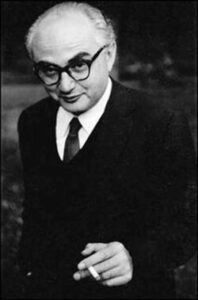
Robert Capa
Robert Capa, a Hungarian war photographer, was a close colleague and co-founder of Magnum Photos alongside Cartier-Bresson in 1947. Their working relationship spanned the agency's formative years, and they shared assignments across conflict and humanitarian zones. Though Capa favored active battlefronts while Cartier-Bresson sought the decisive moment, their complementary approaches defined a humanistic vision that guided Magnum's documentary ethos.
Verified 2026-09-04Wikipedia – Robert Capa
Collaboration
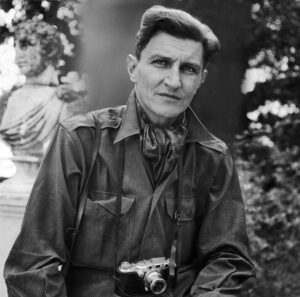
David Seymour
David Seymour, known as 'Chim', was a Polish-born photographer and a founding member of Magnum Photos with Cartier-Bresson and Capa. Seymour's work on the Spanish Civil War and postwar Europe brought a social-conscious perspective that complemented Cartier-Bresson's street-oriented reportage. Their professional relationship included sharing editorial roles at Magnum and traveling on joint commissions, cementing a deep mutual influence on documentary practice.
Verified 2026-09-04Wikipedia – David Seymour
Collaboration
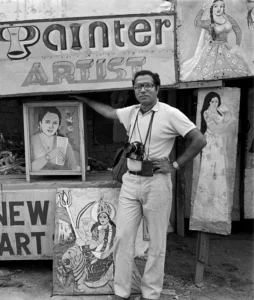
George Rodger
British photographer George Rodger was another founding member of Magnum Photos with Cartier-Bresson. Rodger documented war in Africa and the liberations of concentration camps, and his emphasis on narrative sequencing influenced Cartier-Bresson's approach to photo-essays. Together they built Magnum's early global coverage network, pioneering a model of itinerant photographic storytelling that shaped editorial and documentary traditions.
Verified 2026-09-04Wikipedia – George Rodger
Influence & affinity
Raghubir Singh
Raghubir Singh was profoundly influenced by Henri Cartier-Bresson's concept of the 'decisive moment', but Singh adapted it to color photography. He acknowledged Cartier-Bresson's guidance in his approach to composition and timing, while insisting on color as essential to representing India's vibrant visual culture.
Verified 2026-09-04Wikipedia
Le siècle d’Henri Cartier-Bresson (opens a new site)
This 52-minute documentary by writer Pierre Assouline retraces Cartier-Bresson’s life and work. The Fondation Henri Cartier-Bresson lists it as an Arte Editions publication and notes that it is available in French and English. It is a concise long-form entry point for viewers seeking a biographical film rather than a single-work discussion.
Unreleased Footage of Henri Cartier-Bresson Photographing the Streets of New York (opens a new site)
The Fondation presents digitized and reassembled excerpts from Morris Engel’s late-1950s film material, in which Cartier-Bresson is seen photographing a New York street. The page notes his recurring reluctance to be filmed or photographed while working, making this short archival record particularly valuable as direct visual evidence of him using a camera in the field.
On “The Decisive Moment” (opens a new site)
In this 21-minute lecture, Agnès Sire, then director of the Fondation Henri Cartier-Bresson, examines the “decisive moment,” the concept associated with Cartier-Bresson’s work. Framed as an introduction to a Sound and Vision Conversations event with Taryn Simon and Stephen Shore, it offers focused institutional context for a term frequently used to interpret his photography.
COMMUNITY DISCUSSION
Discuss this entry
Share interpretations, reading notes, and source-aware questions. For catalog corrections, use the feedback form below.
No discussion yet. Start the first focused conversation.
Sign in to join the discussion.
Optionally receive a digest when related photobooks are added to the catalog.
See something incorrect? Sign in to suggest a correction or report an issue.