Photographer
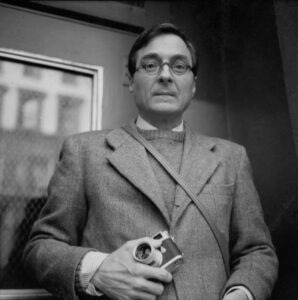
Miguel Rio Branco
Miguel Rio Branco (born 1946 in Las Palmas, Spain) is a Brazilian photographer, painter, and filmmaker whose work has long centered on the social textures and visceral intensities of Brazilian life. Raised between cultures—his childhood spanned Portugal, Switzerland, and Brazil—Rio Branco eventually settled in Brazil, where he developed an artistic practice that resists tidy categorization. He came of age during the 1960s and 1970s, a period of political upheaval and cultural ferment, and his imagery often carries the residue of that era’s tensions: poverty, desire, violence, and the raw poetics of the street.
Rio Branco’s visual language is distinctive: he works in saturated, almost painterly color, employing sharp diagonals, fragmented compositions, and a tactile attention to surfaces—peeling paint, stained walls, bodies in motion. Unlike the cool observational stance of classic documentary photography, his approach is immersive and expressive, blending photojournalistic urgency with a fine-art sensibility. He has described photography as interpretation rather than documentation, a philosophy that separates him from peers who sought neutrality. His subjects range from prostitutes and street children to boxers and fishermen, yet he treats them not as victims but as figures embedded in complex, often brutal environments.
Among his landmark bodies of work, the series ‘Nakta’ (published as a book in 1997) explores the harsh conditions of sex workers in Salvador, Bahia, using color and shadow to evoke both tenderness and exploitation. Another significant project, ‘Silent Book’ (1997), compiles images from his travels into a sequenced meditation on absence and memory. His photobook ‘Miguel Rio Branco: Between the Eyes’ (2018) offers a career-spanning overview and demonstrates his mastery of sequencing and design, often collaborating with publishers to craft objects that feel like sensory experiences. These works matter because they expand the possibilities of color photography in an era when black-and-white still dominated serious photojournalism.
Rio Branco’s historical significance lies in his role as a bridge between Brazilian visual culture and the international art-photography circuit. He joined Magnum Photos in the 1970s, lending his work global reach, yet his images remain deeply rooted in Latin American realities. He has exhibited widely, including at SITE Santa Fe and in major museums, and his influence can be seen in younger photographers who embrace color as a structural element rather than mere decoration. His career also reflects the broader acceptance of photography as contemporary art in Brazil during the late twentieth century.
For photobook collectors, Rio Branco’s publications are notable for their physical inventiveness—unusual formats, fine printing, and a deliberate interplay between image and text. ‘Nakta’ and ‘Between the Eyes’ exemplify his care for the book as a complete object, where sequencing and pacing create an emotional arc. Collectors seeking an entry point might begin with ‘Nakta’ for its historical importance and emotional force, or with the retrospective volume ‘Between the Eyes’ to appreciate the range of his vision. His work challenges the distinction between witness and artist, and his books reward slow, attentive viewing.
〔PBL-BIO/2〕



COMMUNITY DISCUSSION
Discuss this entry
Share interpretations, reading notes, and source-aware questions. For catalog corrections, use the feedback form below.
No discussion yet. Start the first focused conversation.
Sign in to join the discussion.
Optionally receive a digest when related photobooks are added to the catalog.
See something incorrect? Sign in to suggest a correction or report an issue.