Photographer
Roger Ballen
Roger Ballen, born in 1950, is an American artist and photographer who has lived in Johannesburg and worked in South Africa and its surrounding region since the late 1970s. Over a career extending more than four decades, he has moved from photographing people and environments at society’s margins toward a deliberately constructed practice that combines photography with drawing and installation. South Africa is therefore more than a backdrop in his work: it is the setting in which his artistic language developed, even as that language became increasingly psychological rather than conventionally documentary.
Ballen is best known for stark black-and-white photographs made in enclosed, often distressed interiors. Figures, animals, wires, stains, crude drawings and ambiguous objects occupy shallow spaces that can resemble rooms, stages or mental chambers. The directness of the camera coexists with careful fabrication, leaving it uncertain where observation ends and performance begins. This tension distinguishes him from photographers committed either to transparent social documentation or to polished studio tableaux. His pictures acknowledge real bodies and difficult circumstances, yet their compressed spaces and recurring marks redirect attention toward fear, absurdity, confinement and the unconscious.
Several titles chart that development. “Shadow Chamber” encapsulates the room as both physical enclosure and metaphorical interior, helping establish the claustrophobic vocabulary associated with his mature work. “Inferno” extends his constructed approach, and the documented involvement of editor Didi Bozzini points to the importance of selection and collaboration in translating the project into book form. “Hungry Ghosts,” from which Ballen has presented poetry, indicates a practice that reaches beyond isolated photographs into text and other expressive forms. The later book “Spirit and Spaces” continues his stated fusion of photography, drawing and installation, foregrounding environments as active psychological structures rather than neutral settings.
His career belongs to the broader late-20th- and early-21st-century expansion of photography beyond straightforward record-making. Ballen’s work has been widely exhibited, while his development from documentary observation to constructed imagery parallels a larger breakdown of boundaries among photography, performance, drawing, sculpture and film. A balanced reading must nevertheless retain the friction between social context and psychological theater: the people and spaces in his earlier work cannot be reduced entirely to symbols, even when later images openly resist factual interpretation.
For photobook readers, Ballen is especially significant because repetition and sequencing intensify motifs that a single famous image can only suggest. Faces, animals, lines and damaged walls accumulate into an internally consistent world, while shifts between portraits, objects and empty spaces create an uneasy rhythm. “Shadow Chamber” is a useful entry point into the mature visual vocabulary; “Inferno” offers a route into the role of editing and collaboration; and “Spirit and Spaces” provides a later view of his cross-media direction. Collectors should attend less to any single shocking picture than to how each book organizes recurring forms into a sustained psychological experience.
〔PBL-BIO/2〕



Martin Parr
Shared publisher: Damiani, Phaidon Press Limited
21 photobook(s) in the library

Nick Waplington
Shared publisher: Damiani, Phaidon Press Limited
18 photobook(s) in the library

Stephen Shore
Shared publisher: Nazraeli Press, Phaidon Press Limited
14 photobook(s) in the library
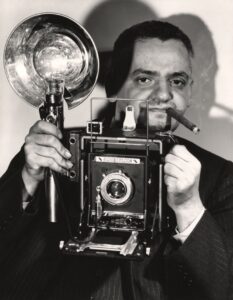
Weegee
Shared publisher: Damiani, Thames & Hudson
14 photobook(s) in the library
COMMUNITY DISCUSSION
Discuss this entry
Share interpretations, reading notes, and source-aware questions. For catalog corrections, use the feedback form below.
No discussion yet. Start the first focused conversation.
Sign in to join the discussion.
Optionally receive a digest when related photobooks are added to the catalog.
See something incorrect? Sign in to suggest a correction or report an issue.