Photographer
Ed van der Elsken
Dutch photographer known for influential street photography and photobooks.


Selected Works & Key Projects
A source-backed introduction to individual photographs and significant bodies of work.
Key projects
Project · 1950–1954
A Love Story in Saint-Germain-des-Prés
A Love Story in Saint-Germain-des-Prés is Van der Elsken’s 1956 photo-novel, built from photographs made while he lived in Paris between 1950 and 1954. He photographed bohemian and independent young people around Vali Myers, then reordered documentary pictures into a fictional love story, supplying the text himself and working with designer Jurriaan Schrofer. The project matters because it makes sequencing, captions, and cinematic narrative devices integral to photographic meaning rather than treating photographs as separate illustrations. Published in Dutch, German, and English, it brought Van der Elsken international recognition and remains a defining contribution to the postwar photobook. ([edvanderelsken.nl](https://www.edvanderelsken.nl/boeken?utm_source=openai))
View source ↗
Project · 1959–1960
Sweet Life
Sweet Life is Van der Elsken’s 1966 photobook account of a journey made with Gerda van der Veen from August 1959 to September 1960, through Africa, Southeast Asia, Hong Kong, Japan, the United States, and Mexico. Instead of organizing the trip around recognized sights, it foregrounds fleeting encounters with people. Its meaning also resides in its construction: Van der Elsken tested several handmade dummies, then used forceful crops, double-page images, dark gravure printing, and grainy, high-contrast pictures to create a rapid visual rhythm. Regarded as a key work of Dutch photobook history, it merits selection as his fullest fusion of travel, street observation, darkroom printing, and book design. ([rijksmuseum.nl](https://www.rijksmuseum.nl/en/collection/publication/Ed-Van-der-Elsken-Sweet-life–39517ccd36b73cb2e55d42d7ac6838dc?utm_source=openai))
View source ↗Selected photographs

1950 · Paris, France
“Jean Michel” (Pierre Feuillette) and “Claudine” (Paulette Vielhomme) Kissing in Café “Mau Mau” (Café Chez Moineau)
This gelatin silver photograph catches Pierre Feuillette and Paulette Vielhomme kissing at Café Chez Moineau, the Saint-Germain-des-Prés meeting place renamed “Mau Mau” in A Love Story in Saint-Germain-des-Prés. Its compressed view of an intimate gesture within a public café exemplifies Van der Elsken’s proximity to the young Parisian circle he photographed. The picture matters especially through its role in the 1956 book: a documentary image was incorporated into a fictional photo-narrative. It merits selection as a clear, identifiable instance of the exchange between lived observation and authored sequence that made the project internationally consequential. ([rijksmuseum.nl](https://www.rijksmuseum.nl/nl/collectie/object/Jean-Michel-Pierre-Feuillette-en-Claudine-Paulette-Vielhomme-kussend-in-cafe-Mau-Mau-cafe-Chez-Moineau–a5d4339f07e13cadbb6326fd3bb6c033))
Work source ↗
1959 · Hong Kong
View of Hong Kong
Made in Hong Kong in November 1959, this view brings ships and dense urban housing into the world itinerary of Sweet Life. Rather than functioning simply as travel description, it was designed into the book’s visual movement across places and later appeared as a double-page spread in both Once upon a Time and Hong Kong: The Way It Was. Its significance is therefore tied to circulation and sequencing as well as to the image itself. It merits selection as evidence that Van der Elsken’s global work could make a cityscape carry the same personal, street-level attention to everyday life as his portraits and encounters. ([rijksmuseum.nl](https://www.rijksmuseum.nl/nl/collectie/object/Gezicht-op-Hong-Kong–592e5513a02ddac76c91f64c147234d3))
Work source ↗
1960 · Manhattan, New York, United States
Passers-by and Onlookers beside a Drunken Man on 42nd Street, Manhattan, New York
This 1960 New York street photograph records the social ring that forms around a drunken man on 42nd Street: passers-by, onlookers, and a person in distress become a single unstable public scene. It demonstrates Van der Elsken’s attraction to unscripted urban contact and to moments in which looking itself becomes the subject. Made during the Sweet Life journey but omitted from the finished book, it should not be treated as a celebrated published plate. Its reason for selection is more revealing: it preserves the broader field of observation behind the photobook and makes the photographer’s later editorial choices visible. ([rijksmuseum.nl](https://www.rijksmuseum.nl/nl/collectie/object/Passanten-en-omstanders-bij-een-dronken-man-op-42nd-Street-in-Manhattan-New-York–30fa14b035c2d387da0d349ba1994d8c))
Work source ↗
1961 · Zeedijk, Amsterdam, Netherlands
Dancing on the Zeedijk during the Nieuwmarkt Fair, Amsterdam
Made during the May 1961 Nieuwmarkt fair, this photograph turns dancing on Amsterdam’s Zeedijk into an image of collective motion and street sociability. It belongs to the long Amsterdam body of work in which Van der Elsken repeatedly returned to the Nieuwmarkt, Zeedijk, and nearby old-city districts, concentrating on people, festivities, conflict, and urban change rather than monumental views. Although it was not reproduced in Amsterdam! Old Photographs 1947–1970, the surviving contact sheet confirms its place within that sustained practice. It merits selection as a lively, less-familiar counterpart to the photographer’s better-known Amsterdam images and photobook edit. ([rijksmuseum.nl](https://www.rijksmuseum.nl/nl/collectie/object/Dansen-op-de-Zeedijk-tijdens-kermis-op-de-Nieuwmarkt-Amsterdam–24e4ef8c749f14ba3c1e159084cfb87b))
Work source ↗
1970 · Japan
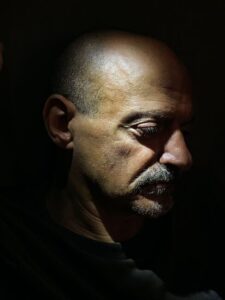
Portrait of an Unknown Man, Japan
This narrow vertical gelatin silver portrait depicts an unidentified man in Japan, where Van der Elsken worked repeatedly from 1959 through 1988. With no sitter’s name and no documented link to a specific published project in the Rijksmuseum record, the photograph’s value lies in its direct, concentrated encounter rather than biography or celebrity. The format isolates the figure and recalls the photographer’s persistent search for people who caught his attention, often in the street and through intuition. It merits selection as a restrained example of the sustained Japanese work that occupied a major place in his later career. ([rijksmuseum.nl](https://www.rijksmuseum.nl/nl/collectie/object/Portret-van-een-onbekende-man-Japan–d6243e2b4736407dae30b6dd51523849))
Work source ↗-
1925
Career milestone
Born in Amsterdam
Ed van der Elsken was born in Amsterdam.
Source: Ed van der Elsken Verified Sep 3, 2026
-
1950–1954
Career milestone
Lives and works in Paris
He lived and worked in Paris, where he photographed the material later developed into Een liefdesgeschiedenis in Saint Germain des Prés.
Source: Ed van der Elsken Verified Sep 3, 2026
-
1956
Photobook
Publication of Een liefdesgeschiedenis in Saint Germain des Prés
His first photobook was published; the official biography identifies it as the work that brought immediate international fame.
Source: Ed van der Elsken Verified Sep 3, 2026
-
1958
Photobook
Publication of Bagara
Bagara was published following his 1957 stay in French Equatorial Africa.
Source: Ed van der Elsken Verified Sep 3, 2026
-
1966
Photobook
Publication of Sweet Life
Sweet Life was published as a 180-page photobook.
Source: Ed van der Elsken Verified Sep 3, 2026
-
1971
Career milestone
Moves to the countryside near Edam
He began living in the countryside near Edam, which became a base for journeys to Japan while he continued working in Amsterdam.
Source: Ed van der Elsken Verified Sep 3, 2026
-
1988
Photobook
Publication of De ontdekking van Japan
De ontdekking van Japan was published after fifteen trips to Japan made between 1959 and 1988.
Source: Ed van der Elsken Verified Sep 3, 2026
-
1990
Career milestone
Death
Van der Elsken died in 1990.
Source: Ed van der Elsken Verified Sep 3, 2026
-
2019
Collection acquisition
Joint acquisition of the personal archive
The Rijksmuseum and the Nederlands Fotomuseum jointly acquired his personal archive and subsequently managed it together.
Source: Rijksmuseum Verified Sep 3, 2026
Archive
Nederlands Fotomuseum
The Nederlands Fotomuseum manages Ed van der Elsken’s archive and the copyright to his photographs.
Verified 2026-09-03Ed van der Elsken
Collection
Rijksmuseum
The Rijksmuseum jointly acquired Van der Elsken’s personal archive with the Nederlands Fotomuseum in 2019 and looks after that archive together with it.
Verified 2026-09-03Rijksmuseum
Representation
Annet Gelink Gallery
The Ed van der Elsken website lists Annet Gelink Gallery in Amsterdam among galleries with his work.
Verified 2026-09-03Ed van der Elsken
Representation
Kicken Berlin
The Ed van der Elsken website lists Kicken in Berlin among galleries with his work.
Verified 2026-09-03Ed van der Elsken
Representation
Howard Greenberg Gallery
The Ed van der Elsken website lists Howard Greenberg Gallery in New York among galleries with his work.
Verified 2026-09-03Ed van der Elsken
10 Things about Ed van der Elsken (opens a new site)
Rijksmuseum’s thematic introduction to ten episodes from the photographer’s life and work, including Paris, Japan, photobooks and the archive acquisition.
Biography (opens a new site)
Official biographical overview covering Van der Elsken’s Amsterdam birth, Paris period, photobooks, filmmaking, travels and death.
Ed van der Elsken. Up Close (opens a new site)
Rijksmuseum press material on the 2026 exhibition, its archive-based research, and the photographs, contact prints, notes, book dummies and film material used to examine his practice.
Ed van der Elsken (opens a new site)
A seven-minute Rijksmuseum tour in which photography curator Mattie Boom discusses Van der Elsken and techniques used in making his oeuvre.
Ed van der Elsken: Crazy World (opens a new site)
A Rijksmuseum curator presentation by Hans Rooseboom about the museum’s acquisition of nearly 8,000 Van der Elsken photographs and what the acquisition reveals about his working method.
Ed van der Elsken (opens a new site)
An interview made during the opening week of the 2020 exhibition Ed van der Elsken: Crazy World, in which Angela Tellier speaks with photography curator Mattie Boom, one of the exhibition’s makers.
COMMUNITY DISCUSSION
Discuss this entry
Share interpretations, reading notes, and source-aware questions. For catalog corrections, use the feedback form below.
No discussion yet. Start the first focused conversation.
Sign in to join the discussion.
Optionally receive a digest when related photobooks are added to the catalog.
See something incorrect? Sign in to suggest a correction or report an issue.