Photographer
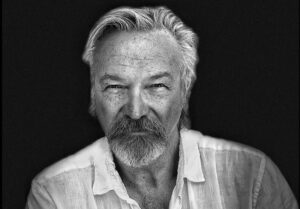
Frans Lanting
Frans Lanting is a Dutch-born nature and wildlife photographer, author, and public speaker who has spent his career documenting the living planet for a global audience. Born in the Netherlands on 13 July 1951, he developed an early fascination with natural history and photography before relocating to the United States. He eventually established his studio in Santa Cruz, California, where he works with his wife and creative partner, the writer and editor Christine Eckstrom. Widely recognized through his long association with National Geographic, Lanting is regarded as one of the most influential nature photographers of his generation, combining scientific curiosity with a highly artistic visual sensibility.
Lanting’s visual language is immersive and often strongly graphic. Rather than simply recording animal behavior, he seeks to convey what he calls the “essence” of a species or ecosystem. Light, composition, and intimate proximity allow him to make images that feel at once monumental and tender. He is distinguished by his patience in extreme conditions and by his continuing experimentation with perspective, moving from underwater and aerial views to close-up studies. His work bridges fine-art photography and conservation-oriented reportage, using beauty and emotional immediacy to encourage wonder and concern for the natural world.
Among his major bodies of work, Eye to Eye (1997) is a landmark exploration of primates and their evolutionary relationship with humans. Working across rainforests and savannas, Lanting photographed apes and monkeys in an intimate portrait of primate life that has become an important reference for photographers and primatologists. Life: A Journey Through Time (2006) was inspired by scientific narratives of evolution and Earth history. In a sequence extending from the Big Bang to the present, it creates a visual account that joins extraordinary natural forms to a meditative, almost cosmic perspective. His contribution to the Day in the Life series, including a visit to Guilin in China, also shows his ability to connect landscape and culture within a broad tradition of visual storytelling.
Lanting’s historical importance lies in his elevation of nature photography from straightforward documentation to visual poetry and a means of scientific communication. His images have appeared in numerous National Geographic features, while expeditions from the Amazon to Antarctica have brought remote ecosystems into public view. Exhibitions and lectures have extended his influence beyond magazine publishing, positioning him between conservation science, the art museum, and the world of books. His Santa Cruz studio functions as a center for image-making and storytelling, and his longstanding partnership with Eckstrom has added depth and nuance to his books and exhibitions.
For photobook collectors, Lanting’s volumes demonstrate the close collaboration of photographer, designer, and publisher. Eye to Eye, Life: A Journey Through Time, and earlier works such as Okavango: Africa’s Last Eden reveal not only compelling photographs but also careful sequencing, large-format reproduction, and extensive captions. Eye to Eye offers an accessible entry point with powerful subject matter and representation, while Life proposes a more expansive and intellectually ambitious arc. These books reward close attention to print quality and editorial design, making clear that Lanting treats the photobook itself as an artistic medium alongside the individual photograph.
〔PBL-BIO/2〕


COMMUNITY DISCUSSION
Discuss this entry
Share interpretations, reading notes, and source-aware questions. For catalog corrections, use the feedback form below.
No discussion yet. Start the first focused conversation.
Sign in to join the discussion.
Optionally receive a digest when related photobooks are added to the catalog.
See something incorrect? Sign in to suggest a correction or report an issue.