Photographer
Pieter Hugo
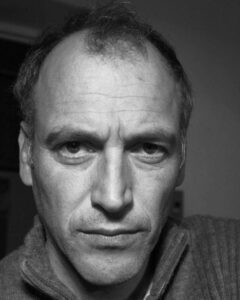
Pieter Hugo (born 1976 in Johannesburg) is a South African photographer known for his confrontational and empathetic portraiture, exploring the social, political, and environmental tensions shaping contemporary Africa. Based in Cape Town, Hugo is largely self-taught. After early work in the film industry, he completed a two-year residency at Fabrica in Italy, a turning point that launched his international career.
His practice moves fluidly between documentary and staged photography, examining marginalized communities, constructed identities, and the residual imprint of history on everyday life. Hugo’s breakthrough series “The Hyena & Other Men,” created in Nigeria between 2005 and 2007, brought him global attention and earned him major awards. Subsequent series such as “Nollywood,” “Permanent Error,” “Kin,” and “La Cucaracha” extend his investigations into the complexities of representation, belonging, and cultural mythmaking across Africa and beyond.
Hugo has exhibited widely at institutions including Museu Coleção Berardo, Kunstmuseum Wolfsburg, Musée de l’Elysée, Fotografiska, MAXXI, the Institute of Modern Art Brisbane, and Tate Modern. His work is held in major museum collections such as MoMA, the Metropolitan Museum of Art, SFMOMA, the Victoria & Albert Museum, Centre Pompidou, and the J. Paul Getty Museum. His monographs—including “The Hyena and Other Men,” “Nollywood,” “Permanent Error,” “This Must Be the Place,” and “Kin”—are considered essential contributions to contemporary photography.
Among numerous accolades, Hugo received the Discovery Award at the Rencontres d’Arles (2008), the KLM Paul Huf Award (2008), and the Seydou Keïta Award at the Bamako Biennale (2011), and has been shortlisted for the Deutsche Börse Photography Prize and the Prix Pictet. His work remains central to current dialogues around representation, postcolonial identity, and the photographic gaze in the Global South.
Pieter Hugo, born 1976 in Johannesburg, is a South African photographer who lives in Cape Town. He produces documentary-style portraits and series such as ‘The Hyena & Other Men’ and ‘Permanent Error,’ which critique social and political conditions in Africa. His work has been exhibited internationally at institutions including the Museum of Modern Art in New York and the Victoria and Albert Museum in London.


Selected Works & Key Projects
A source-backed introduction to individual photographs and significant bodies of work.
Key projects

Project · 2005–2007
The Hyena and Other Men
Made in Nigeria between 2005 and 2007, this series follows travelling performers who earn money through choreographed appearances with tamed hyenas and other animals. Hugo made two trips to work closely with the group. Rather than treating the animals as spectacle alone, the photographs make the relationship between handler and animal central, registering calm and tenderness alongside drama. The project merits selection because it concentrates Hugo’s patient, large-format portrait practice on a mutually dependent human–animal relationship and on lives shaped by performance, mobility, and urban change.
View source ↗
Project · 2008–2009
Nollywood
Nollywood was made in 2008–09 in response to Nigeria’s prolific popular film culture. Hugo did not make a behind-the-scenes documentary; instead, he worked with actors and assistants to stage and photograph fictional figures and familiar genre types. The resulting portraits examine how costumes, make-up, direction, and viewers’ expectations make a photograph appear believable. It merits selection because it marks a decisive expansion of Hugo’s portraiture: the work uses the visual language of a locally rooted mass medium to test the boundary between documentary evidence, theatrical invention, and cultural self-representation.
View source ↗
Project · 2009–2010
Permanent Error
Permanent Error pictures Agbogbloshie, on the outskirts of Accra, and people who burn discarded electronic components to recover metals for resale. Its named portraits, full-length figures, smoke, and dismantled equipment connect an individual encounter with a chain of global consumption and disposal. The series merits selection because it gives a human scale to e-waste processing while retaining the formal force of portraiture: the sitters confront the camera amid conditions produced by obsolete technologies and unequal recycling systems. It was exhibited by Yossi Milo Gallery in 2011 and published by Prestel that year.
View source ↗Selected photographs

2005 · Nigeria
Mallam Mantari Lamal with Mainasara, Nigeria
This 2005 chromogenic print is a large, square-format work from Hugo’s Nigerian hyena-handler photographs. The Metropolitan Museum of Art records it at 60 by 60 inches as an object in its Department of Photographs, acquired in 2009 through the Alfred Stieglitz Society Gifts. It merits selection as a collection-defining individual work because its title names both a handler and Mainasara, preserving the paired identity at the center of the series rather than reducing either subject to anonymous spectacle. Its museum acquisition documents its sustained institutional place within contemporary photography collections.
Work source ↗2007 · Lagos, Nigeria
Abdullahi Mohammed with Mainasara, Lagos, Nigeria
In this 2007 photograph, Hugo depicts Abdullahi Mohammed with Mainasara in Lagos. The Museum of Fine Arts, Houston identifies it as part of The Hyena and Other Men and describes Hugo’s work with the Gadawan Kura, who perform and sell medicines and talismans. The museum frames the image within both uncontrolled urbanization and a difficult interspecies dependency: the handlers rely on the animals for work, while the animals depend on the handlers for food. This is a key selection because it gives that wider project a precise, named, museum-collected encounter.
Work source ↗2009 · Agbogbloshie Market, Accra, Ghana
Al Hasan Abukari, Agbogbloshie Market, Accra, Ghana
Created in 2009, this chromogenic print is catalogued by SFMOMA as part of Permanent Error. Its title precisely identifies Al Hasan Abukari and the Agbogbloshie Market in Accra, anchoring the photograph in the place central to Hugo’s e-waste series. SFMOMA acquired the work in 2012 through its Foto Forum. It merits selection as a recognizable project photograph because a major museum preserves it as an individual object while its full title retains both the sitter’s name and the market location—two facts essential to the project’s portrait-based structure.
Work source ↗
2009 · Agbogbloshie Market, Accra, Ghana
Naasra Yeti, Agbogbloshie Market, Accra, Ghana
This 2009 digital chromogenic print portrays Naasra Yeti at Agbogbloshie. The Spencer Museum of Art describes her standing full length with a bowl on her head amid smoking electronic waste, and places the photograph within Permanent Error’s account of obsolete devices from Europe and the United States becoming toxic waste in Ghana. The work merits selection because the named child’s frontal, solitary presence turns an infrastructure of disposal into a direct portrait encounter. Its museum label further identifies the image as a prompt to consider recycling, technological obsolescence, and the loss of information once stored in the machines.
Work source ↗2008 · Enugu, Nigeria
Escort Kama, Enugu, Nigeria
Escort Kama, Enugu, Nigeria was made in 2008 and was included in Dunedin Public Art Gallery’s presentation of Nollywood. The gallery explains that Hugo collaborated with actors and assistants to recreate Nollywood myths, symbols, and stereotypical figures, then photographed them in Enugu rather than documenting a conventional film set. This photograph merits selection because it is a clearly identified example of that constructed method: its significance lies at project level in the deliberate transformation of popular-film visual culture into staged portraiture, where fiction and ordinary urban space are made to coexist.
Work source ↗-
2005–2007
Series
The Hyena & Other Men
Pieter Hugo’s acclaimed series documenting Nigerian itinerant performers who keep captive hyenas and other animals. The photographs reveal complex layers of human-animal relations, postcolonial spectacle, and the ethics of portraiture. Exhibited internationally, it established Hugo as a leading voice in contemporary African photography and prompted critical discourse on the West’s exoticized gaze.
Source: Wikipedia Verified Sep 4, 2026
-
2005–2020 (active international career)
Career milestone
International Exhibitions and Major Venues
Hugo’s work has been exhibited at prominent venues including the Victoria and Albert Museum, London; the Museum of Contemporary Art, Chicago; and the Fondation Cartier, Paris. His series have been shown in numerous biennials and museum surveys, making him a central figure in global contemporary photography. These exhibitions have generated critical reviews and expanded his audience beyond South Africa.
Source: Wikipedia Verified Sep 4, 2026
-
2008–2009
Series
Nollywood
A portrait series of actors from Nigeria’s film industry, known as Nollywood. Hugo photographed the performers in their homes and sets, presenting them with dramatic poses and props. The work examines the boundaries between fiction and reality, identity, and the cultural influence of this dynamic industry, cementing Hugo’s standing as a documentarist of African everyday life.
Source: Wikipedia Verified Sep 4, 2026
-
2010–2011
Series
Permanent Error
This body of work focuses on the Agbogbloshie e-waste dump near Accra, Ghana, where electronic waste from wealthier nations is processed under hazardous conditions. Hugo’s large-format portraits and landscapes highlight the ecological and human costs of global consumerism, creating an unsettling visual record that has been widely exhibited and discussed within environmental photography discourse.
Source: Wikipedia Verified Sep 4, 2026
-
2014–2016
Series
Kin
An intimate family series in which Hugo photographs his own relatives, including his mother, partner, and son, often in states of undress or vulnerability. The project subverts the public/private divide, presenting the family as both a site of affection and estrangement. Exhibited in major institutions, it solidified Hugo’s reputation for raw psychological depth and formal precision.
Source: Wikipedia Verified Sep 4, 2026
Representation
Yossi Milo Gallery
Pieter Hugo's work is represented by this New York contemporary art gallery. The gallery has presented his works in group and estate contexts, focusing on contemporary photography, and has been a primary commercial supporter of his projects such as Permanent Error and Nollywood.
Verified 2026-09-04Yossi Milo Gallery artist page
Representation
Stevenson Gallery
The Stevenson Gallery in Cape Town represents Pieter Hugo in South Africa. It regularly exhibits his series and holds his works for collectors, playing a key role in introducing his photography within its local context and across international fair circuits.
Verified 2026-09-04Stevenson Gallery artist page
Collection
Museum of Modern Art (MoMA)
The Museum of Modern Art in New York holds photographs by Pieter Hugo in its collection, including works from his acclaimed series. Inclusion in MoMA's permanent collection marks an institutional recognition of his significance in contemporary documentary photography.
Verified 2026-09-04Wikipedia: Pieter Hugo
Collection
Victoria and Albert Museum
The Victoria and Albert Museum in London holds Pieter Hugo's work in its photography collection. This acquisition reflects the museum's interest in his artistic and documentary contributions, placing him within an international context of photographic practice.
Verified 2026-09-04Wikipedia: Pieter Hugo
Pieter Hugo: This Must Be The Place — Selected Works 2003–2011 (opens a new site)
Fotomuseum Den Haag’s exhibition resource documents This Must Be The Place, presented from 3 March to 20 May 2012. It identifies the exhibition as the museum’s first extensive survey of Hugo’s work from 2003–2011 and describes selections from The Hyena & Other Men, Nollywood, and Permanent Error. The page is useful for understanding the museum framing of Hugo’s staged portraiture and its attention to contemporary African subjects.
Pieter Hugo’s New Portraits Capture the Confidence and Fragility of Youth (opens a new site)
AnOther interviews Hugo about Solus Vol. 1. The article traces the project to casting photographs he encountered while working on a New York fashion story and records his interest in the typology of faces. It also considers how the work engages beauty, attraction, sex, and identity, alongside Hugo’s reflections on fashion commissions and slower personal practice.
Pieter Hugo: In Conversation (opens a new site)
Phillips publishes a conversation between Pieter Hugo and Yuka Yamaji focused on the series Kin, including Hugo’s account of its development and a discussion of Green Point Common, Cape Town (2013). The interview also addresses his understanding of photography and his movement from photojournalism toward self-directed projects.
Pieter Hugo: Being Present (opens a new site)
Les Rencontres d’Arles presents this exhibition film for Pieter Hugo: Being Present. Its description characterizes the presentation as a major retrospective centered on Hugo’s portrait practice, emphasizing the intimacy and humanity associated with that work. It is a concise audiovisual entry point to a portrait-focused survey rather than a project-specific interview.
Interview with Pieter Hugo on His Photography of Africa (opens a new site)
FotoTV’s interview introduces Hugo through The Hyena Men, Permanent Error, and Kin, describing these bodies of work as portraits addressing the complexity and contradictions of South African society. The page states that the film covers his photographic path from receiving a camera at age twelve, through practical training in photojournalism, to independent work as an artist. The interview is in English with subtitles.
The PIETER HUGO_KIN Exhibition Told by the Artist Himself (opens a new site)
Fundación Foto Colectania presents a video in which Pieter Hugo discusses the project Kin and several works included in its exhibition at the foundation. The accompanying page identifies the exhibition dates as 18 September–10 December 2014 and credits GrisArt-Escola Superior de Fotografia for producing and editing the recording. This is a direct artist-led resource on the project’s exhibition presentation.
COMMUNITY DISCUSSION
Discuss this entry
Share interpretations, reading notes, and source-aware questions. For catalog corrections, use the feedback form below.
No discussion yet. Start the first focused conversation.
Sign in to join the discussion.
Optionally receive a digest when related photobooks are added to the catalog.
See something incorrect? Sign in to suggest a correction or report an issue.