Photographer
Gilles Caron
Gilles Caron (8 July 1939 – 5 April 1970) was a French photographer and photojournalist, born in Neuilly-sur-Seine, Hauts-de-Seine, France. He began his career in fashion and advertising photography but rose to prominence as a war correspondent during the turbulent late 1960s. Often described as the “James Dean of photojournalism” for his youthful charisma and early, mysterious death, Caron left an outsize mark on the field in barely three years of active photojournalism.
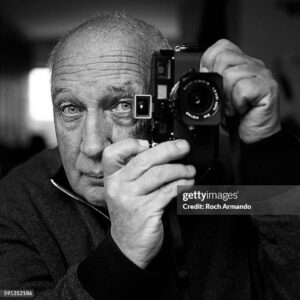
Caron’s visual language was marked by a direct, intimate approach to conflict. Working with a Leica, he favored close-range, human-centered frames that conveyed the emotional texture of political upheaval rather than distant spectacle. His subjects – from the streets of Paris during the May 1968 protests to battlefields in Vietnam, Nigeria, Northern Ireland, and Israel – were approached with a moral urgency that distinguished him from more detached colleagues. He quickly evolved from an early romanticism about the war correspondent as hero to a more questioning and critical stance about the ethics and value of his own profession.
Among his most verified bodies of work are his photographs of the May 1968 student uprisings in Paris, which became emblematic of that period, and his coverage of the Six-Day War and the Nigerian Civil War (Biafra). He also documented the early stages of the Vietnam War and the civil rights marches in Northern Ireland. His images appeared widely in French and international press, though no dedicated photobook was produced during his lifetime.
Caron disappeared in Cambodia in April 1970 while covering the conflict there, at the height of his career. He was just thirty years old. His fate remains unresolved, and his work was largely forgotten for decades until a series of retrospective exhibitions and documentaries revived interest. Notable recent projects include the 2019 exhibition “Gilles Caron: The Conflict Within” at the Jeu de Paume in Paris, and the 2018 documentary image (likely referencing the FRANCE 24 piece) that traced his legacy. The Blind Magazine article from 2020, “Gilles Caron: Through the Eyes of a Photojournalist,” also contributed to his rediscovery.
For photobook collectors, Caron’s work is a compelling entry into the golden age of French photojournalism. Posthumous monographs and exhibition catalogs – often designed to showcase his contact sheets alongside final prints – provide insight into his editing instincts and the collaborative nature of wire-agency reporting. His untimely death cut short a promising trajectory, but the surviving negatives and prints now exist as essential documents of a decade when photography and politics were inseparably intertwined.
〔PBL-BIO/2〕

COMMUNITY DISCUSSION
Discuss this entry
Share interpretations, reading notes, and source-aware questions. For catalog corrections, use the feedback form below.
No discussion yet. Start the first focused conversation.
Sign in to join the discussion.
Optionally receive a digest when related photobooks are added to the catalog.
See something incorrect? Sign in to suggest a correction or report an issue.