Photographer
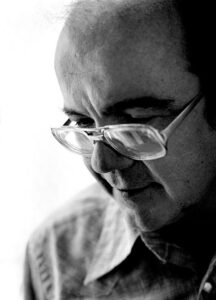
Kevin Bubriski
Kevin Bubriski (born 1954) is an American documentary photographer whose four-decade engagement with the Himalayas, especially Nepal and the remote regions of Tibet in China, has produced lasting visual records of cultures in flux. He first arrived in Nepal in 1975 as a Peace Corps volunteer, an experience that established his deep connection to the country and shaped his approach to long-term, participatory documentary work.
Bubriski’s visual language is characterized by direct, unposed portraiture and a sensitivity to everyday life, often working in black-and-white to emphasize texture, gesture, and dignity. Unlike many itinerant photojournalists, he returns over years and decades, building trust and allowing subtle social and environmental changes to emerge across his frames. His images avoid exoticism, favoring respectful observation of mountain communities amid modernization and geopolitical pressures.
Two major bodies of work anchor his oeuvre: his decades-long documentation of Nepal, beginning in the 1970s and continuing into the twenty-first century, and his later studies of the Tibetan highlands (within China), capturing rituals, landscapes, and lives at high altitude. These projects matter not only for their archive value but for their narrative consistency; they show a single photographer’s evolving view of a region often seen through fleeting imagery. Museums and galleries have collected his prints, including the Museum of Modern Art and the Metropolitan Museum of Art in New York, and his photographs have been exhibited worldwide.
Bubriski’s career has encompassed both practice and pedagogy. He has taught photography at institutions such as Green Mountain College in Poultney, Vermont, where he served as associate professor, and later as an assistant professor there according to a LinkedIn profile, although the dates and ranks vary across sources. He remains based in Vermont, United States. His work has been the subject of artist talks and museum store features, including an event at the Albuquerque Museum Foundation in late 2024.
For collectors of photobooks, Bubriski’s sustained projects offer an entry into a tradition of socially engaged documentary photography that evolved from the Farm Security Administration legacy into post-1970s humanist practice. While specifics about his monographs are not widely documented in general references, his prints and exhibitions provide a means to engage with his vision. A useful starting point may be his official website, which presents portfolios and institutional affiliations. Collectors should note the difference between his earlier journalistic approach and later, more reflective series, and consider how his repeated returns to the same villages create a longitudinal portrait uncommon in the medium.
〔PBL-BIO/2〕
Kevin Bubriski is an American documentary photographer born in 1954. He is recognized for his extended black-and-white photographic studies of Nepalese society, culture, and landscape, spanning several decades. His work has been exhibited internationally and collected in publications such as Nepal: Portraits of a People. Bubriski’s photographs are held in major institutional collections, and he has received fellowships including a Guggenheim Fellowship.

Selected Works & Key Projects
A source-backed introduction to individual photographs and significant bodies of work.
Key projects

Project · 1975–2011
Nepal: 1975–2011
This long-term body of black-and-white photographs grew from Bubriski’s 1975 arrival in Nepal as a Peace Corps volunteer and continued through 2011. The accompanying publication describes work made in the remote Karnali Zone as well as a sustained association with the country over nearly four decades. Its importance lies in duration and scope: the project records people and places across Nepal while tracing the country’s movement from a Himalayan kingdom toward a rapidly changing globalized society. A 2014 Harvard exhibition selected thirty prints from this larger archive, confirming the project as a central retrospective statement in Bubriski’s practice.
View source ↗
Project
Pilgrimage: Looking at Ground Zero
Pilgrimage: Looking at Ground Zero records four visits Bubriski made to the World Trade Center site in the weeks following September 11. Rather than centering the ruins alone, the project photographs people paused at the barricades: businesspeople, families, young people, couples, and visitors from abroad confronting loss. This emphasis on viewers makes the work a document of public mourning and private reflection at the same site. The published volume contains seventy-eight duotone photographs and an afterword by Richard B. Woodward. It merits selection as Bubriski’s focused response to a defining U.S. event and as a marked departure in setting from his sustained South Asian work.
View source ↗Selected photographs

1987 · Teku, Kathmandu, Nepal
Naga Baba with Chimta, Teku, Kathmandu, Nepal
This 1987 image is a platinum-palladium print, printed in 1996, and one of fifteen photographs in Bubriski’s Sadhu: Hindu Holy Men portfolio at the Metropolitan Museum of Art. Its precise title identifies a Naga Baba and his chimta at Teku, Kathmandu, situating an individual religious figure in a specific place. The photograph merits selection not as a generic illustration of the portfolio, but as a named, independently catalogued print in the Met’s Department of Photographs. Its inclusion demonstrates the portfolio’s attention to distinct sitters and the durable, exhibition-oriented platinum-palladium printing through which the series entered a major museum collection.
Work source ↗
1987 · Pashupatinath, Kathmandu, Nepal
Shyam Puri Naga Baba, Pashupatinath, Kathmandu, Nepal
Shyam Puri Naga Baba, Pashupatinath, Kathmandu, Nepal was made in 1987 and printed in platinum-palladium in 1996. The Metropolitan Museum of Art catalogs it as a photograph by Bubriski and as part of the related Sadhu: Hindu Holy Men portfolio. The work is notable for the specificity supplied by its title: it records an identified sitter, Shyam Puri Naga Baba, at Pashupatinath rather than offering an anonymous religious type. It merits selection as a museum-collected example of Bubriski’s portrait-based approach to the series, joining individual naming, Kathmandu location, and a carefully specified photographic print process.
Work source ↗
1989 · Allahabad, India
Udasin Boy Baba and Guru, Allahabad, India
Made in Allahabad in 1989 and printed in 1996, this platinum-palladium print is catalogued by the Metropolitan Museum of Art as one photograph within Bubriski’s Sadhu: Hindu Holy Men portfolio. Its title distinguishes two figures—a Udasin boy baba and a guru—and fixes the encounter in Allahabad. That documentary specificity is central to its value: the work gives the portfolio a relational subject rather than a single isolated figure. It merits selection because the Met preserves it as an individual collection object while also linking it to the fifteen-print portfolio, demonstrating how Bubriski’s sustained study of holy men included varied people, places, and image structures.
Work source ↗
1989 · Sangam, Kumbh Mela, Allahabad, India
Three Pilgrims at the Sangam, Kumbh Mela, Allahabad, India
Three Pilgrims at the Sangam, Kumbh Mela, Allahabad, India was made in 1989 and printed in platinum-palladium in 1996. It is a separately catalogued photograph in the Metropolitan Museum of Art and is also the sole Bubriski work listed online by the Museum of Modern Art. The image merits selection because two leading U.S. museums document this exact titled work, giving it exceptional institutional visibility within the artist’s recorded oeuvre. Its title anchors the photograph in a pilgrimage setting at the Kumbh Mela and shifts the Sadhu portfolio from individual named ascetics to a small group of pilgrims in a specifically identified religious gathering.
Work source ↗
1989 · Benares, India
Shiva Ratri Procession, Benares, India
Shiva Ratri Procession, Benares, India is a 1989 photograph printed in platinum-palladium in 1996 and held by the Metropolitan Museum of Art. Unlike the portfolio’s individually named portraits, this work records a procession, broadening Sadhu: Hindu Holy Men from portraiture to a communal religious event. The Met’s cataloging of the work as an individual photograph, together with its association with the fifteen-print portfolio, supports its selection as an important structural counterpart within the series. It shows that Bubriski’s subject was not limited to isolated sitters: the portfolio also incorporated collective ritual activity and a different, horizontal pictorial format.
Work source ↗-
1977–1979
Career milestone
Peace Corps Service in Nepal
Kevin Bubriski volunteered with the United States Peace Corps in Nepal from 1977 to 1979. During this period he began photographing the people and landscapes of Nepal, establishing a subject matter that would define his entire career. This experience gave him intimate access to communities in Kathmandu and remote mountain villages, and his early photographs already demonstrated the empathetic, understated style that would later earn him international recognition.
Source: International Center of Photography Verified Sep 5, 2026
-
1987
Award
Guggenheim Memorial Foundation Fellowship
Kevin Bubriski received a John Simon Guggenheim Memorial Foundation Fellowship in 1987. The fellowship supported his long-term photographic study of Nepal, enabling him to travel to previously inaccessible high-altitude regions and expand his documentation of cultural change and social conditions. This grant not only recognized his past achievements but also allowed him to produce the substantial body of work that later appeared in major exhibitions and monographs.
Source: John Simon Guggenheim Memorial Foundation Verified Sep 5, 2026
-
April 2015
Career milestone
Documentation of the Nepal Earthquake Aftermath
After the devastating earthquake that struck Nepal in April 2015, Bubriski returned to the country he had photographed for nearly four decades. He documented the destruction of historic monuments in Kathmandu as well as the resilience of its citizens. These photographs mark both a poignant return to the subject of his life's work and an urgent contribution to the global coverage of a disaster, reaffirming the lasting relationship he has maintained with the people and places of Nepal.
Source: Kevin Bubriski official website Verified Sep 5, 2026
Publishing relationship
Aperture Foundation
Aperture Foundation published Bubriski's first major monograph 'Portrait of Nepal' in 2001, bringing his black-and-white documentary images of Nepal to a broad audience and establishing his reputation as a committed observer of South Asian life.
Verified 2026-09-05Wikipedia – Kevin Bubriski
Publishing relationship
powerHouse Books
powerHouse Books released 'Nepal: 1975-2010' in 2012, a retrospective book that spans four decades of Bubriski's work in Nepal, documenting the country's social, political, and cultural transformations through his evolving style.
Verified 2026-09-05Wikipedia – Kevin Bubriski
Influence & affinity
Charles Harbutt
Bubriski studied under documentary photographer Charles Harbutt at Hampshire College; Harbutt's humanistic and empathetic approach to photographing people deeply influenced Bubriski's own committed and socially engaged practice.
Verified 2026-09-05Kevin Bubriski – Official Biography
Kevin Bubriski – Wikipedia (opens a new site)
A Wikipedia entry providing biographical information about Kevin Bubriski, an American photographer.
COMMUNITY DISCUSSION
Discuss this entry
Share interpretations, reading notes, and source-aware questions. For catalog corrections, use the feedback form below.
No discussion yet. Start the first focused conversation.
Sign in to join the discussion.
Optionally receive a digest when related photobooks are added to the catalog.
See something incorrect? Sign in to suggest a correction or report an issue.