Photographer
Man Ray
American modernist artist and photographer associated with Surrealism and Dada.


Selected Works & Key Projects
A source-backed introduction to individual photographs and significant bodies of work.
Key projects

Project · 1922
Champs délicieux (Delicious Fields)
Champs délicieux is a 1922 portfolio of twelve rayographs, introduced by Tristan Tzara. Rather than presenting a single photograph, the project brought Man Ray’s cameraless experiments into print as a coherent sequence: ordinary objects appear as luminous, fragmentary, and difficult-to-name forms made by direct exposure on sensitized paper. It was the first occasion on which he presented his photograms publicly, and contemporary critics praised their claim to the status of original pictorial works. The portfolio merits selection as the public formulation of the rayograph, the method through which he most decisively recast photography as an arena for objects, chance, and imaginative transformation. ([metmuseum.org](https://www.metmuseum.org/de/press-releases/man-ray?utm_source=openai))
View source ↗
Project · 1926
Revolving Doors
Published in 1926, Revolving Doors translates ten colorful collages Man Ray made in New York in 1916–17 into pochoir, a stencil-print process that preserves their sharp planes and saturated color. The earlier collages had been hinged on a rotating stand for a 1919 installation, so that turning the ensemble produced changing optical effects; the portfolio fixes that kinetic experiment in an edition. Initially unfamiliar to collectors accustomed to Cubist restraint, the original works met a cool response. This project merits selection because it demonstrates that Man Ray’s concern with movement, perception, and reproducibility extended well beyond the camera and his Paris Surrealist years. ([nationalgalleries.org](https://www.nationalgalleries.org/art-and-artists/23999/revolving-doors-i-mime-published-1926-after-collages-1916-1917?utm_source=openai))
View source ↗
Project · 1931
Électricité (Electricity)
Électricité is a 1931 advertising portfolio commissioned by the Compagnie Parisienne de Distribution d’Électricité to promote household electricity. Its ten photogravures reproduce images made from camera photographs combined with rayographs: bulbs, a fan, iron, toaster, cords, and female nudes make an invisible utility appear as light, motion, and bodily energy. Accompanied by a text by Pierre Bost, the project applies Man Ray’s experimental vocabulary to a commercial brief without reducing it to product illustration. It merits selection because it shows a major avant-garde technique entering mass-oriented advertising while retaining the oblique, metaphorical visual logic of his art. ([resources.metmuseum.org](https://resources.metmuseum.org/resources/metpublications/pdf/Recent_Acquisitions_A_Selection_2012_2014.pdf?utm_source=openai))
View source ↗Selected photographs

1918
La femme (Woman)
Constructed from darkroom equipment—metal reflectors, clothespins, and glass—La femme turns an improvised assemblage into a teasing bodily image. Made as a counterpart to Man Ray’s L’homme, it parodies inherited nude conventions by making “woman” a photographic reading rather than a living sitter or stable object. Prepared for Tristan Tzara’s Dadaglobe project and exhibited at the 1921 Salon Dada in Paris, the pair circulated his New York Dada photography in Europe. It merits selection for making photography itself the surviving artwork after the temporary assemblage was dismantled. ([metmuseum.org](https://www.metmuseum.org/art/collection/search/283274?utm_source=openai))
Work source ↗
1922
Rayograph
This rayograph is a cameraless photogram: objects placed on or near sensitized paper were exposed to light, producing overlapping silhouettes rather than a lens-made view. Kiki de Montparnasse’s hand and profile, an egg, and a wineglass become unstable traces in a deliberately dreamlike arrangement. Although photograms predated Man Ray, Tristan Tzara’s name “rayograph” identified his particular reimagining of the process in 1921–22. This print merits selection because it shows how he made an experimental darkroom procedure carry portraiture, still life, and Surrealist fantasy at once. ([metmuseum.org](https://www.metmuseum.org/art/collection/search/283276?utm_source=openai))
Work source ↗
1924
Le violon d’Ingres
Le violon d’Ingres presents Kiki de Montparnasse from behind, posed with a turban in allusion to Ingres’s odalisques; Man Ray added violin f-holes to the print, turning her torso into an instrument. The intervention compresses photography, painting, erotic wordplay, and darkroom manipulation into a single image. It has become a landmark of his 1920s work not simply for its witty visual pun, but because the pun also makes the body available for viewing and use, intensifying its objectification. It merits selection as a concise, uneasy demonstration of his dialogue with art history and photographic invention. ([metmuseum.org](https://www.metmuseum.org/art/collection/search/902421?utm_source=openai))
Work source ↗
1926
Noire et blanche
Noire et blanche stages Kiki de Montparnasse’s pale, closed-eyed face beside a dark Baule portrait mask from Côte d’Ivoire, arranging the two oval forms as uncanny reflections. First published in the French edition of Vogue in May 1926, it moved from fashion-periodical circulation into Surrealist readings centered on dream, analogy, and estrangement. The picture also records Paris’s 1920s fascination with African art, while treating a culturally specific object chiefly as a formal counterpart to a European model. It merits selection for its exacting tonal design and for the historical tensions embedded in that visual equivalence. ([metmuseum.org](https://www.metmuseum.org/exhibitions/listings/2011/reconfiguring-an-african-icon/photo-gallery?utm_source=openai))
Work source ↗
1933
Meret Oppenheim at the Printing Wheel
Man Ray photographed the Swiss-born artist Meret Oppenheim nude and inked beside the flywheel of a printing press, binding bodily pose, industrial mechanism, and graphic black marks into a deliberately provocative studio image. Its publication in the Surrealist journal Minotaure gave it wide circulation within the movement and helped establish Oppenheim’s contemporary reputation as a Surrealist “muse”—a gendered role that is itself part of the photograph’s reception history. The print merits selection as both an early image of an artist later known for Breakfast in Fur and a revealing example of how Surrealist photography fashioned public personae. ([metmuseum.org](https://www.metmuseum.org/art/collection/search/264625?utm_source=openai))
Work source ↗-
October 2, 1910–May 25, 1912
Education
Studies at the Art Students' League
Man Ray studied at the Art Students' League in New York.
Source: The Museum of Modern Art Verified Sep 3, 2026
-
Spring 1912
Career milestone
Begins signing work as Man Ray
The Radnitzky family changed its surname to Ray, and he began signing his paintings Man Ray.
Source: The Museum of Modern Art Verified Sep 3, 2026
-
September–October 1915
Career milestone
Purchases a camera
He bought a camera in order to photograph his paintings.
Source: The Museum of Modern Art Verified Sep 3, 2026
-
January 1920
Career milestone
Founding member of Société Anonyme
At Katherine Dreier’s invitation, Man Ray and Marcel Duchamp became founding members of Société Anonyme, Inc.
Source: The Museum of Modern Art Verified Sep 3, 2026
-
November 1921
Career milestone
Makes first rayograph
MoMA’s chronology records that Man Ray made his first rayograph in Paris.
Source: The Museum of Modern Art Verified Sep 3, 2026
-
December 1922
Series
Publishes Champs délicieux
He published a selection of rayographs in the portfolio Champs délicieux, introduced by Tristan Tzara.
Source: The Museum of Modern Art Verified Sep 3, 2026
-
1923
Series
Le Retour à la raison
With Le Retour à la raison, Man Ray extended rayograph techniques to moving images.
Source: The Museum of Modern Art Verified Sep 3, 2026
-
1931
Series
Électricité commission
The Compagnie Parisienne de Distribution d'Electricité commissioned Man Ray to produce images promoting private electricity consumption; the resulting Électricité portfolio used rayographs reproduced as photogravures.
Source: The Museum of Modern Art Verified Sep 3, 2026
-
September 19–October 29, 1944
Exhibition
Man Ray: Retrospective Exhibition
The Pasadena Art Institute presented a retrospective of Man Ray’s paintings, drawings, watercolors, and photographs from 1913 to 1944.
Source: The Museum of Modern Art Verified Sep 3, 2026
-
1951–1976
Career milestone
Lives in Paris
MoMA’s chronology records Paris as Man Ray’s residence from 1951 until 1976.
Source: The Museum of Modern Art Verified Sep 3, 2026
-
November 18, 1976
Career milestone
Death in Paris
MoMA’s chronology records Man Ray’s death in Paris.
Source: The Museum of Modern Art Verified Sep 3, 2026
Collection
The Museum of Modern Art
MoMA holds Man Ray works in multiple media. Its artist essay notes that the museum expanded its holdings in 1941 through James Thrall Soby’s gift, including 24 first-generation unique rayographs from the 1920s.
Verified 2026-09-03The Museum of Modern Art
Archive
Getty Research Institute
The Getty Research Institute identifies existing Man Ray collections at the Research Institute and the Getty Museum’s Department of Photographs; acquired agendas, letters, photographs, and publications enhance those holdings.
Verified 2026-09-03Getty Research Institute
Collection
The Metropolitan Museum of Art
The Met’s collection includes Man Ray’s 1922 Rayograph, a gelatin silver print in the Gilman Collection.
Verified 2026-09-03The Metropolitan Museum of Art
Other institution
Société Anonyme, Inc.
At Katherine Dreier’s invitation, Man Ray and Marcel Duchamp became founding members of Société Anonyme, Inc. in January 1920.
Verified 2026-09-03The Museum of Modern Art
Influence & affinity
Berenice Abbott
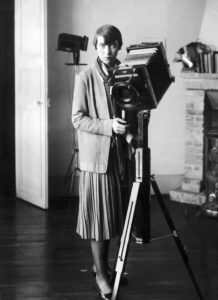
From 1923 to 1925, Berenice Abbott worked as an assistant in Man Ray’s Paris studio, learning the technical skills of studio photography while absorbing his experimental approach to the medium. Though their formal collaboration was brief, Abbott’s early portraits of interwar cultural figures were shaped by the precision and modernist sensibility she observed under his guidance. The exposure broadened her artistic vocabulary and encouraged her independent practice, leading to her own decisive documentary and scientific investigations later in her career.
Verified 2026-09-05Wikipedia
Champs délicieux 2ème rayographie (opens a new site)
Centre Pompidou’s collection entry situates a 1922 rayograph within Champs délicieux and notes the portfolio’s preface by Tristan Tzara.
More Than a Muse (opens a new site)
The Met examines images made by Man Ray with Kiki de Montparnasse, including Noire et blanche, Rayograph, Kiki de Montparnasse, and Le violon d’Ingres.
Man Ray (Emmanuel Radnitzky) (opens a new site)
MoMA’s artist essay surveys Man Ray’s Dada beginnings, rayographs, Surrealist photography and objects, and the early history of his work at the museum.
The Mysteries of the Château de Dé (Les Mystères du Château de Dé) (opens a new site)
MoMA provides a video entry for Man Ray’s The Mysteries of the Château de Dé (Les Mystères du Château de Dé).
Le Retour à la raison (opens a new site)
MoMA’s film record describes this 1923 work as a sequence of visual and kinetic experiments that combines abstract and concrete imagery and extends rayograph techniques into moving images.
COMMUNITY DISCUSSION
Discuss this entry
Share interpretations, reading notes, and source-aware questions. For catalog corrections, use the feedback form below.
No discussion yet. Start the first focused conversation.
Sign in to join the discussion.
Optionally receive a digest when related photobooks are added to the catalog.
See something incorrect? Sign in to suggest a correction or report an issue.