Photographer
Eugène Atget
Eugène Atget (1857–1927) is a foundational figure in the history of documentary photography, a French image-maker who devoted roughly three decades to recording the streets, courtyards, shopfronts, and forgotten corners of a Paris that was rapidly being transformed. He began adult life as a sailor and then trained as an actor, but by his late forties he had turned to photography as a practical trade, selling prints to painters, illustrators, and architects as “documents” of the old city rather than as works of art.
Atget’s visual language is quiet, precise, and decidedly anti-spectacular. He used a large-format camera and long exposures, usually photographing in the early morning to avoid the bustle of modern life. His images favour straight-on views of buildings, doorways, staircases, and shuttered windows, often with empty streets or solitary figures. He referred to himself not as a photographer but as an “author-producer,” stressing that he was actively creating archival material rather than merely taking pictures. This self-conception set him apart from most pictorialist colleagues, who treated photographs as subjective, painterly evocations.
His undertaking is often described as a pictorial inventory of “old Paris,” yet it was not conceived as a single published book. Instead, Atget built extensive series that could be sold piecemeal to studios and collectors: views of historic houses, craftsmen’s interiors, street trades, and remnants of the ancien régime. Later, in the 1920s, American photographer Berenice Abbott rescued a large portion of his negatives and prints from obscurity, helping to introduce his work to a wider art audience in the United States and Europe.
Atget’s reputation grew considerably after his death, particularly as Surrealists and modernists rediscovered his ability to find strangeness in everyday façades. Postwar discussions of street photography and “deadpan” objectivity likewise looked back to him as a key predecessor. Major exhibitions and permanent collections—at the Museum of Modern Art in New York, the J. Paul Getty Museum, and the Metropolitan Museum of Art, among others—have turned his one-time commercial files into central documents of urban modernity.
For collectors and readers of photobooks, Atget offers a rich but demanding area of study. Since his work was produced as working documents, any printed edition or original print must be understood through provenance and institutional research rather than through a single iconic masterpiece. A useful entry point is the MoMA collection and the well-produced museum surveys that reproduce his images in sequence, allowing one to appreciate the deliberate, nearly archaeological ordering of his archive. The attention given to his plates and prints by museums also underscores a crucial lesson: even a self-effacing archive can be transformed by curatorial contexts into a defining chapter of twentieth-century photography.
〔PBL-BIO/2〕


Other relationship
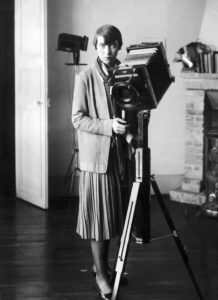
Berenice Abbott
In 1927, Berenice Abbott purchased the negatives and prints of Eugène Atget from his assistant, preserving his archive and actively promoting his work through exhibitions and publications. Her efforts were pivotal in establishing Atget’s posthumous reputation as a master of documentary photography, connecting his detailed street scenes of old Paris to the modern avant-garde. Abbott later sold the collection to the Museum of Modern Art, ensuring its institutional preservation and scholarly accessibility, a decisive act in canonizing Atget within photographic history.
Verified 2026-09-05Wikipedia
Influence & affinity
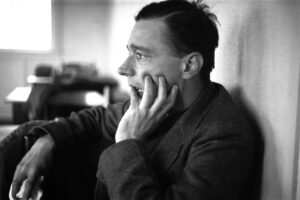
Walker Evans
Evans was deeply influenced by Atget's objective and documentary approach to Parisian architecture and street life; he collected Atget's prints and praised his vision.
Verified 2026-09-05Wikipedia
COMMUNITY DISCUSSION
Discuss this entry
Share interpretations, reading notes, and source-aware questions. For catalog corrections, use the feedback form below.
No discussion yet. Start the first focused conversation.
Sign in to join the discussion.
Optionally receive a digest when related photobooks are added to the catalog.
See something incorrect? Sign in to suggest a correction or report an issue.