Photographer
George Rodger
George Rodger (1908–1995) was a British photojournalist and a founding member of Magnum Photos, remembered as one of the most significant war and travel photographers of the twentieth century. Born in Hale, Cheshire, he spent his childhood between Cheshire and Scotland, and later developed a restless, globe-trotting career that took him from the battlefields of World War II to the remote regions of Africa. His work helped define the modern photo-essay and shaped the visual language of postwar photojournalism.
Rodger’s visual approach was marked by a documentary directness combined with a sensitivity to human suffering and cultural dignity. He began working with 35mm cameras, which allowed him to move quickly and unobtrusively in dangerous environments. Unlike many of his peers who emphasized dramatic action, Rodger often sought quieter moments within chaos, conveying the psychological weight of conflict rather than mere spectacle. This ability to balance graphic reality with empathy distinguished his coverage from conventional war photography of the era.
Among his most important bodies of work are his wartime photographs, particularly his documentation of the liberation of concentration camps, which brought the atrocities of the Holocaust to a global audience. His extensive travels across Africa, including his iconic studies of the Nuba people in Sudan, produced some of his most celebrated imagery and helped expand Western perceptions of African cultures. As a founding member of Magnum Photos in 1947 alongside Robert Capa, Henri Cartier-Bresson, and David Seymour, Rodger helped create a cooperative that gave photographers unprecedented editorial control and artistic freedom.
Rodger’s historical significance lies both in his pioneering contributions to photojournalism and in his role in establishing Magnum as a model for independent documentary photography. He also worked for magazines such as Life, and his images were published widely, influencing subsequent generations of photographers. His archives are now preserved by the George Rodger estate and accessible through institutional channels, and his work has been exhibited in major museums and galleries, including shows hosted by Magnum Photos.
For photobook collectors, George Rodger’s legacy offers a rich and often underexplored area of study. His major works, such as his African portfolios and the wartime reportage, have been published in various monographs and retrospective volumes, often with meticulous sequencing that mirrors his narrative instincts. Collectors should seek publications that reproduce his original contact sheets and incorporate archival materials, as these provide insight into his editing process and the collaborative publishing environments of mid-century magazine culture. Rodger’s books remain an accessible entry point into the broader history of documentary photography and the evolution of the photo-essay.
〔PBL-BIO/2〕


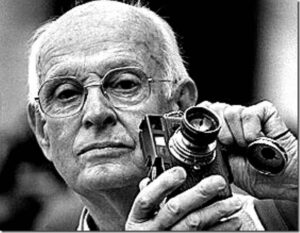
Collaboration
Henri Cartier-Bresson
British photographer George Rodger was another founding member of Magnum Photos with Cartier-Bresson. Rodger documented war in Africa and the liberations of concentration camps, and his emphasis on narrative sequencing influenced Cartier-Bresson's approach to photo-essays. Together they built Magnum's early global coverage network, pioneering a model of itinerant photographic storytelling that shaped editorial and documentary traditions.
Verified 2026-09-04Wikipedia – George Rodger
COMMUNITY DISCUSSION
Discuss this entry
Share interpretations, reading notes, and source-aware questions. For catalog corrections, use the feedback form below.
No discussion yet. Start the first focused conversation.
Sign in to join the discussion.
Optionally receive a digest when related photobooks are added to the catalog.
See something incorrect? Sign in to suggest a correction or report an issue.